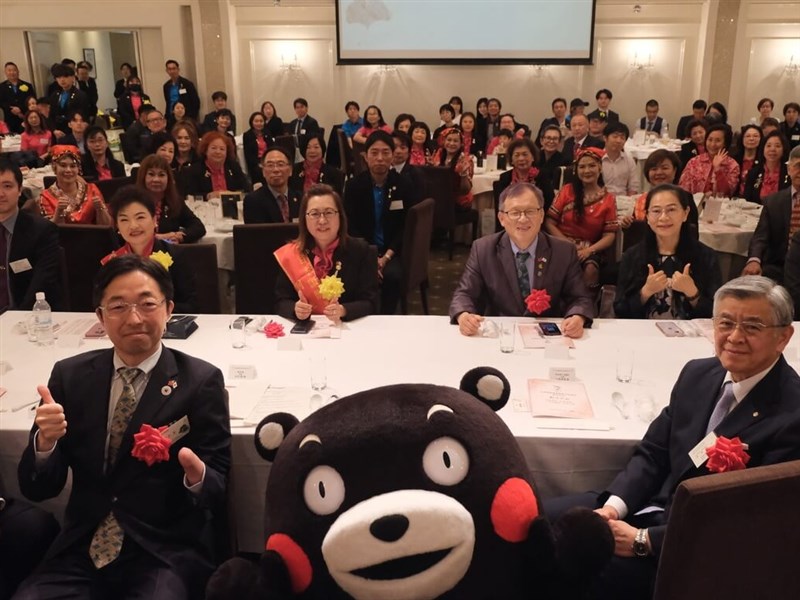
As TSMC settles in Kumamoto, Japan, Taiwan-Japan exchange is on the rise. The Taiwan International Food Innovation Exchange Association established its Kumamoto branch today. The event, attended by around 160 Taiwanese and Japanese figures, including Kumamon, aims to deepen cultural exchange through food and promote Japanese agricultural products in Taiwan. The association emphasizes 'healthy and sustainable eating.'
SUMMARY: As TSMC establishes its presence in Kumamoto, Japan, fostering increased Taiwan-Japan exchange, the Taiwan International Food Innovation Exchange Association inaugurated its Kumamoto branch. The ceremony, held at the Kumamoto Taiwan-Japan Hall, saw approximately 160 attendees from Taiwanese and Japanese political, business, and local sectors, with the popular mascot Kumamon also present. Association president Qian Miaoling highlighted the group's expansion into its second Japanese branch within a year, emphasizing its core principles of 'healthy and sustainable eating' to promote international food culture exchange. She noted the cultural and humanistic similarities between Kumamoto and Taiwan, aiming to use food as a bridge for deeper interaction and to facilitate the entry of high-quality Japanese agricultural products into the Taiwanese market. He Shuzi stressed the importance of Taiwanese cuisine as a 'true support' alongside the 'Protector of the Nation Mountain' (TSMC) and advocated for 'anti-food waste, transform into sacred food.' Wang Ching-yao stated that TSMC's factory establishment extends Taiwan-Japan relations beyond semiconductors to local and cultural levels, making the Kumamoto branch's establishment significant. He believes Taiwanese cuisine, combined with Japanese ingredients and technology, can create new industrial value and boost bilateral agricultural trade and tourism. Kumamoto Governor Kimura Kei recalled the 10th anniversary of the Kumamoto earthquake, expressing gratitude for Taiwan's past aid, and mentioned the increasing flight frequency between Taiwan and Kumamoto. He praised Taiwan's 'banquet' culture and stated Kumamoto's ambition to become a 'city of gastronomy,' anticipating deepened mutual understanding through food. During the event, the association donated 2 million Japanese Yen worth of snacks to Kumamoto's children's cafeterias, for which Kimura Kei expressed thanks.
FACT BOX
- Source: CNA (Central News Agency)
- Category: partnership
FAQ
When was the Kumamoto branch of the Taiwan International Food Innovation Exchange Association inaugurated and what event marked its opening? Include details about venue and attendees.
The Kumamoto branch was inaugurated during a ceremony on the Kumamoto Taiwan-Japan Hall, attended by approximately 160 Taiwanese and Japanese political, business, and local sector representatives along with the mascot Kumamon.
Who is the president of the Taiwan International Food Innovation Exchange Association and what did she emphasize about the organization’s expansion in Japan? Provide details about branch count and principles.
The association’s president, Qian Miaoling, emphasized that the group opened its second Japanese branch within a year, highlighting its core principles of “healthy and sustainable eating” to promote international food culture exchange.
What role did He Shuzi attribute to Taiwanese cuisine in relation to TSMC and anti‑food‑waste efforts? Provide his quoted description.
He Shuzi described Taiwanese cuisine as a “true support” alongside the “Protector of the Nation Mountain” (TSMC) and advocated for anti‑food‑waste initiatives, urging that waste be transformed into sacred food.
How did Governor Kimura Kei connect the 10th anniversary of the Kumamoto earthquake to Taiwan‑Japan relations, and what future aspiration did he state for Kumamoto? Include details on flights and gastronomy.
Governor Kimura Kei recalled the 10th anniversary of the Kumamoto earthquake, thanked Taiwan for past aid, noted the increasing flight frequency between Taiwan and Kumamoto, and said the city aims to become a “city of gastronomy” to deepen mutual understanding through food.
According to Wang Ching‑yao, how does TSMC’s factory establishment influence Taiwan‑Japan collaboration beyond semiconductors, and what benefits does he foresee for agricultural trade and tourism? Provide specifics.
Wang Ching‑yao said TSMC’s factory expands Taiwan‑Japan relations beyond semiconductors to local and cultural levels, believing that combining Taiwanese cuisine with Japanese ingredients and technology will create new industrial value, boost bilateral agricultural trade, and increase tourism.