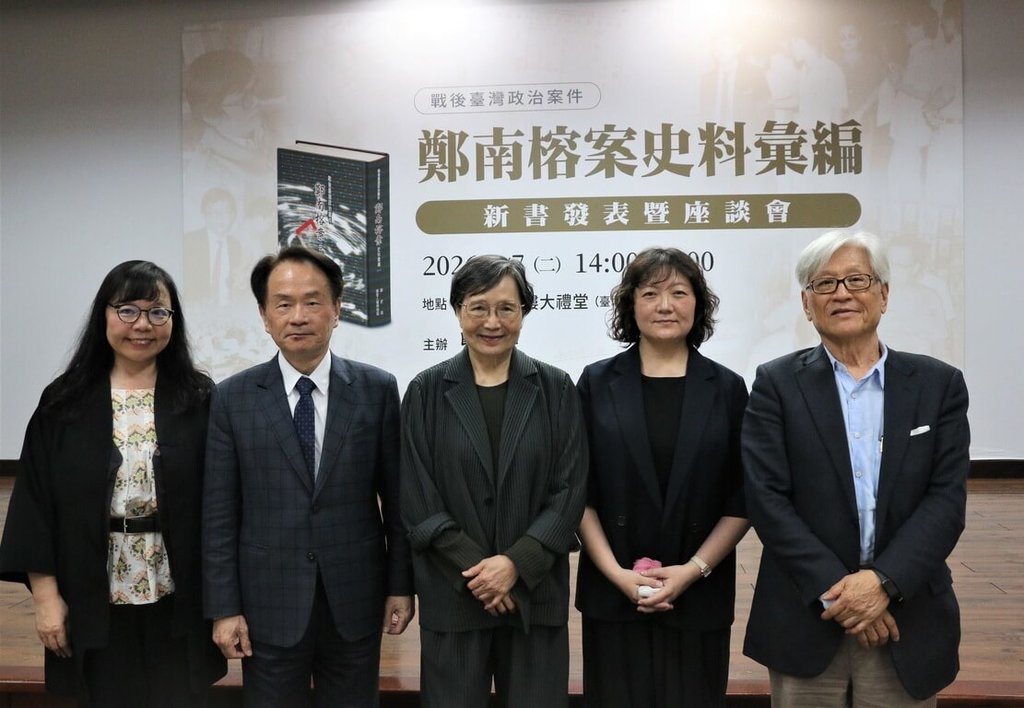
The National History Museum held a launch event and seminar this afternoon for the five-volume 'Post-War Taiwan Political Cases: Zheng Nan-rong Case Historical Materials Compilation.' Director Chen Yi-shen stated in his address that the 1980s are often described as a period when Taiwan's authoritarian rule loosened and the party-state system began to collapse, a fact evident from how the operations of the 'Freedom Era' magazine kept intelligence agencies scrambling. After the Formosa Incident, the democracy movement was reborn, and opposition magazines proliferated, creating a vibrant intellectual scene. Among them, Zheng Nan-rong's 'Freedom Era' series was the most frequently banned yet also the longest-running magazine.
He stated that through the historical materials compilation published today, one can see the frequent mobilization of intelligence agencies, the establishment of multiple channels, and files filled with agency codes and informant aliases. Perhaps no other opposition magazine, except for 'Formosa,' received such treatment, which demonstrates the influence of 'Freedom Era' and Zheng Nan-rong's resilience and will.
He mentioned that 37 years ago today was an unforgettable day in Taiwan's political history: in 1989, Zheng Nan-rong, at the prime age of 42, self-immolated to realize his ideals. He was born in 1947, the year of the February 28 Incident; if he were alive today, he would be only 79. Last year, some began to calculate that 'we have now lived more days after martial law was lifted than under martial law, which behind it lies such an awkward and poignant shared memory.'
He said that recalling those difficult years of demanding the lifting of martial law, Zheng Nan-rong was a key figure. He was indeed an 'activist thinker,' who, with his unique, prophetic, and tragic stance, chronicled that era of resisting the party-state authoritarianism and striving for freedom, also shaping an irreplaceable model for the opposition movement.
Chen Yi-shen stated that Taiwan's future is still full of crises and turbulence, and the Taiwanese people must take up this baton of action from different aspects.
Zheng Nan-rong's widow, Yeh Chu-lan, stated in her address that many materials and contents might be distorted, divisive, contrary to facts, and shirking responsibility. Reading these files is very painful for the family.
She expressed that many contents in the compilation were written from the perspective of informants, and there are some unclear areas. She hopes that the National History Museum can find ways to provide a clearer understanding for everyone, rather than interpreting Zheng Nan-rong or the contemporary party-state solely from the informants' perspective.
Zheng Nan-rong's daughter, Zheng Chu-mei, said that the publication of this set of books today relieved a heavy burden from her heart, as knowing the truth lightened her emotional load.
However, she noted that political archives are contents from a national perspective, which might be divisive or biased. Therefore, it is crucial to refer to contemporary reports, supplementary materials, oral interviews, and other comprehensive information for a holistic judgment. Zheng Chu-mei stated that if these efforts to seek the truth are not made now while there is still time, it might be even harder to get closer to the truth in another 10 or 20 years. (Editor: Zhai Si-chia) 1150407
FACT BOX
- Source: CNA (Central News Agency)
- Category: event