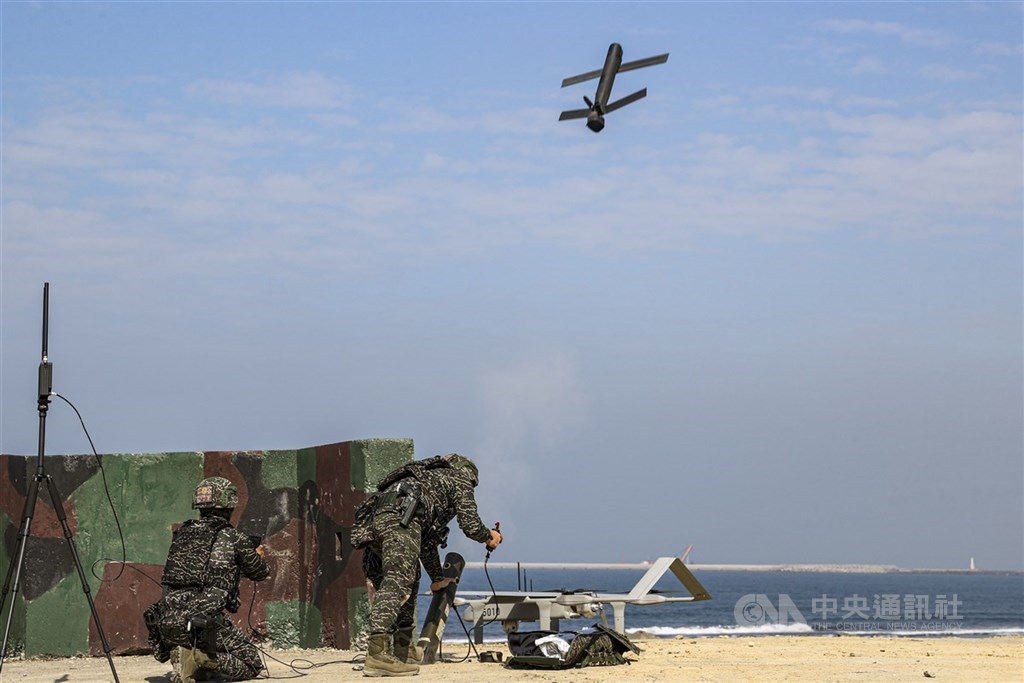
Sydney – Australian defense expert Peter Layton told CNA that while partners in the Indo-Pacific region are increasingly emphasizing the importance of drones in deterring China's expansion, Taiwan's parliament has significantly cut its domestic drone budget, which could potentially damage Taiwan's "coastal warfare" defense capabilities.
Layton, a retired Australian Air Force Group Captain and a visiting fellow at the Griffith Asia Institute, stated in a phone interview with CNA today that during the "Balikatan" joint military exercises between the U.S. and the Philippines, which concluded last week, regional partners demonstrated the importance of drones in coordinating multi-service and multinational joint operations.
Layton mentioned that the "Balikatan" exercises, held in the Philippine archipelago, included seven countries this year: the host nations the U.S. and the Philippines, along with Australia, Canada, France, Japan, and New Zealand. One of the highlights was the role drones played in "littoral warfare."
Layton cited examples from the exercises, stating that Japan introduced its Type 88 anti-ship missiles, the U.S. launched Tomahawk cruise missiles using the "Typhoon" system, and HIMARS multiple rocket systems were used to target vessels. "The launches of these anti-ship missiles were all based on intelligence provided by drones, including U.S.-operated 'Predator' drones and Japan's smaller 'ScanEagle,'" he said.
Layton noted that this was the first time Japan had fired missiles during military exercises held in the Philippines, and also the first time the U.S. had launched Tomahawk cruise missiles using the "Typhoon" system in the Philippines. He believes this reflects a clear stance by Indo-Pacific partners to jointly deter China's expansion.
Layton stated that the importance of drones in deterring China is already very clear. He pointed out that the Australian government announced in April this year an investment of AUD 1.2 to 1.5 billion (approximately NT$27.4 to 34.2 billion) over the next decade for the development of the "Ghost Bat" drone, the "Ghost Shark" unmanned submarine, and counter-drone weapon technologies, but he considers this amount to be far from sufficient.
Layton suggested that insufficient investment from Australia, coupled with Taiwan's budget cuts for domestic drones, would be good news for China. "Cutting the drone budget is akin to cutting coastal warfare capabilities."
Layton believes China is well aware of the power of drones integrated with "coastal warfare" systems, considering them an effective defense system that is difficult for China to counter.
He stated that with Taiwan cutting its domestic drone budget, the obstacles for China in dismantling Taiwan's military strength are reduced. Taiwan will have no choice but to rely more on purchasing U.S. weapons, leaving Beijing with the task of securing a politically advantageous deal with U.S. President Trump, he noted.
Layton warned that China continues to threaten Taiwan's security and the stability of the Indo-Pacific region. For example, Chinese Ministry of National Defense spokesperson Wu Qian's public denial of the existence of the "median line" on May 9th reflects China's ongoing "grey zone" tactics, attempting to normalize its outward expansion activities. He added that the timing of this denial, shortly before a potential meeting between Trump and Xi, suggests China aims to gain more bargaining chips to pressure the U.S. (Edited by Chen Hui-ping) May 13, 2023.
FACT BOX
- Source: CNA (Central News Agency)
- Category: Survey