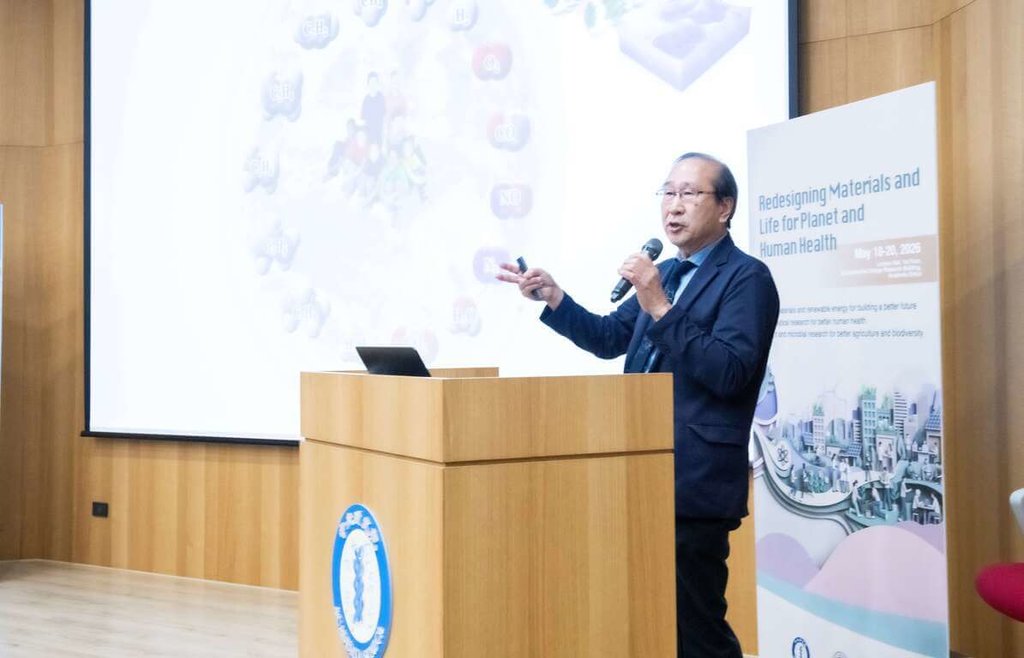
(CNA, Taipei, 18th, by reporter Chang Hsiung-feng) Nobel laureate in Chemistry Susumu Kitagawa stated today that this is an era for science to contribute to peace. He also encouraged the next generation with the concept of 'the usefulness of the useless,' urging them not to give up easily, because the most valuable breakthroughs are often hidden in these profound, overlooked areas.
Academia Sinica issued a press release today stating that from today until the 20th, it will jointly host a trilateral symposium in Taipei with Kyoto University of Japan and the University of California, Los Angeles (UCLA), focusing on topics such as new materials and renewable energy, biomedicine and human health, and plant and microbial research and agricultural development.
The first day of the symposium featured a keynote speech by one of last year's Nobel laureates in Chemistry, Distinguished Professor Susumu Kitagawa of Kyoto University, titled 'Designing Molecular Space: From Metal-Organic Frameworks to a Better Future.' He shared his journey in advancing research on metal-organic frameworks (MOFs).
MOFs are a new type of molecularly structured material composed of metal ions and organic molecules, with a structure full of nano-sized pores like a sponge. Scientists can design their pore size, shape, and function as if assembling building blocks.
Through the continuous efforts of Kitagawa's team and other research groups worldwide, these materials have been applied in areas such as water harvesting from desert air, removal of pollutants from water, and carbon dioxide capture, bringing innovative solutions to environmental science, energy, and medicine.
Kitagawa pointed out that if such porous materials can be utilized, even resource-poor countries may have the opportunity to develop new resources from the environment.
During the conference, Kitagawa expressed his hope for young researchers, stating that this is an era for science to contribute to peace, and such a vision is not achieved overnight; it requires the younger generation to invest and accumulate efforts over decades. He also encouraged them with 'the usefulness of the useless,' advising them not to give up easily just because their current research or work 'seems useless,' because the most valuable breakthroughs are often hidden in these profound, overlooked places.
According to Academia Sinica, the three-day symposium will feature nearly 30 academic presentations and discussions, not only showcasing the latest scientific research results but also specially inviting young scholars and doctoral students to participate, promoting cross-national cooperation and creative exchange among researchers of different generations. (Editor: Kuan Chung-wei)
FACT BOX
- Source: CNA (Central News Agency)
- Category: 學術交流