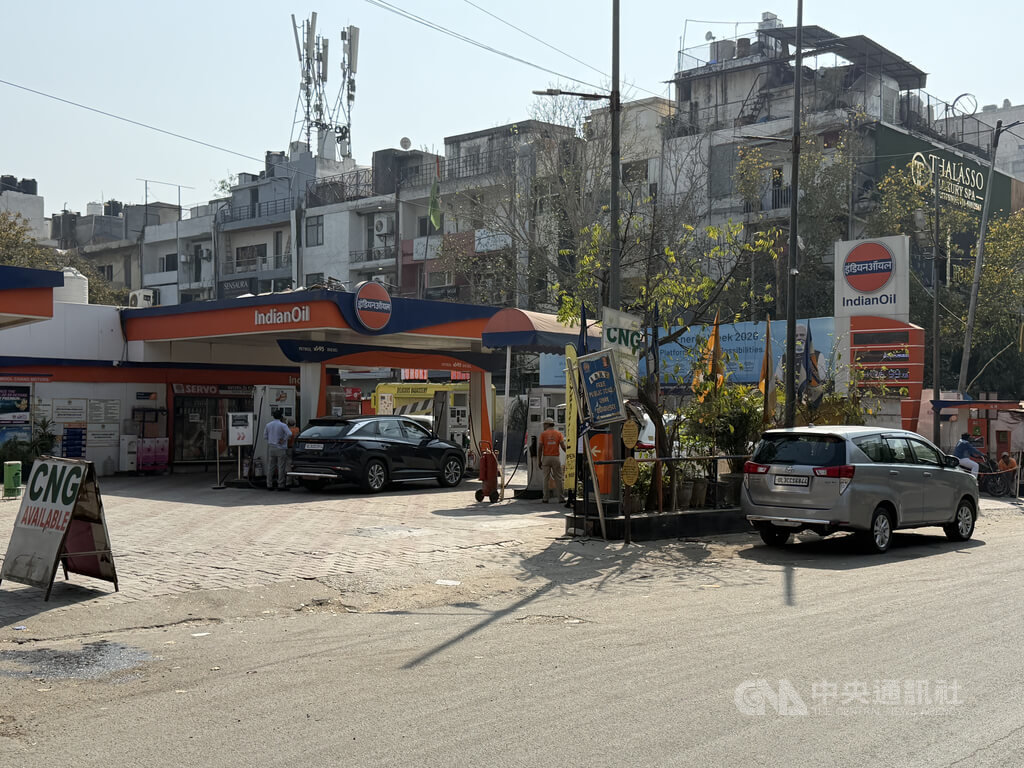
Conflict in the Middle East has led to a global energy supply shortage. After a price hike on the 15th, India's gasoline and diesel prices rose again today, marking the second increase in a single week. Uber drivers worry that if prices continue to rise in several increments, fuel costs could become very high, making it impossible to earn a profit.
According to the Press Trust of India (PTI), fuel prices in India have been raised twice in one week. The largest increase was in Kolkata, where gasoline rose to ₹109.70 per liter (approx. NT$35.42) and diesel to ₹96.07 per liter (approx. NT$31.53).
In the capital, Delhi, gasoline rose to ₹98.64 per liter and diesel to ₹91.58 per liter. In Mumbai, gasoline reached ₹107.59 per liter and diesel ₹94.08 per liter. In Chennai, gasoline is now ₹104.49 per liter and diesel ₹96.11 per liter.
Kishore Kumar, an Uber driver in New Delhi, told a CNA reporter that he had heard about two weeks ago that fuel prices were likely to rise. At that time, an increase of about ₹25 per liter was expected. However, the first wave only saw a ₹3 increase. A few days later, prices rose again today, but this time by less than ₹1, so the impact has not been significant so far.
Kumar expressed concern that if fuel prices continue to rise in the future but the fares charged by ride-hailing platforms to consumers are not adjusted in sync, it would mean drivers have to absorb the costs themselves. The impact could then become more significant.
Another Uber driver, Ravindra, told a CNA reporter that while the current price increases are not substantial, the fact that they occurred twice within a week worries him. He fears it will be as rumored: instead of one large hike, there will be several smaller, successive increases, which could eventually make fuel prices very high.
An official from a related department told the Hindustan Times that although gasoline and diesel prices were just raised on the 15th, the daily losses for related companies still amount to nearly ₹7.5 billion (approx. NT$2.462 billion), making continued price adjustments seem unavoidable.
The military conflict involving the United States, Israel, and Iran has led to the blockade of the Hormuz Strait, a channel for 20% of the world's oil and natural gas transport. The conflict has severely impacted the public's livelihood and economies worldwide.
The Economic Times pointed out that global oil prices have been continuously rising due to the conflict in the Middle East, at one point soaring to US$120 per barrel (approx. NT$3739). As a result, countries have had to raise their domestic fuel prices successively.
Three Indian state-owned enterprises—Indian Oil Corporation Ltd., Bharat Petroleum Corporation Ltd., and Hindustan Petroleum Corporation Ltd.—control over 90% of all gas stations in India. Before these two price hikes, their combined monthly losses were nearly ₹300 billion (approx. NT$98.5 billion).
FACT BOX
- Source: CNA (Central News Agency)
- Category: 事件
- Organizations: Uber
- Products / services: Uber