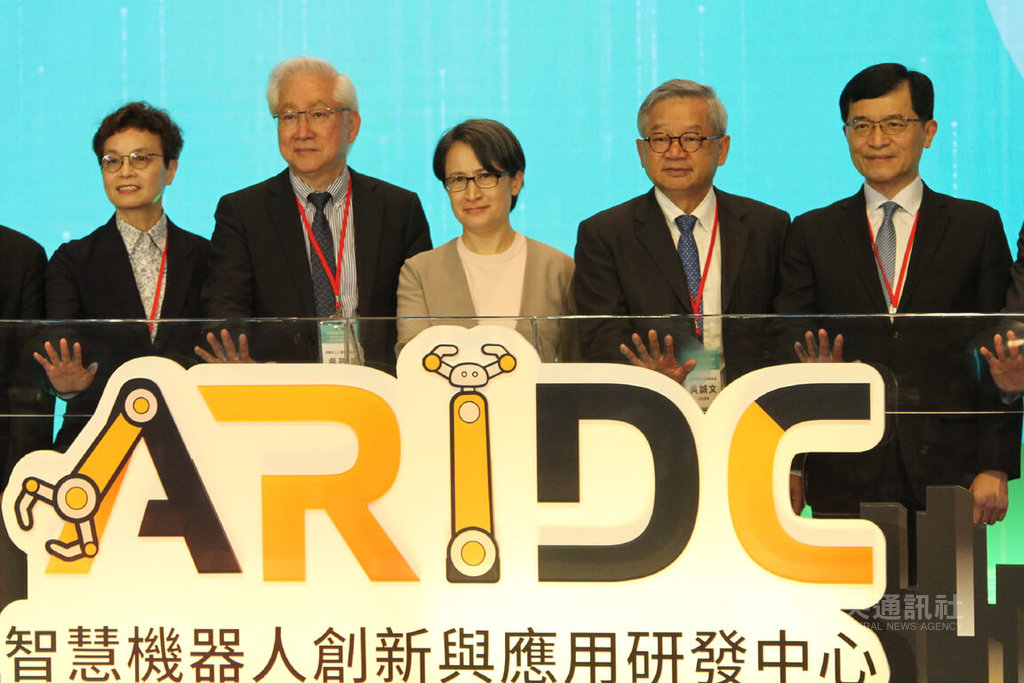
(CNA, Tainan, by reporter Yang Szu-jui, 19th) Vice President Hsiao Bi-khim attended the inauguration ceremony of the "Smart Robot Innovation and Application R&D Center" at ITRI's Liujia campus today, stating that the government is integrating resources to launch a systematic layout, hoping to establish a smart robot industry ecosystem corridor from R&D to mass production. The Ministry of Economic Affairs, in collaboration with the National Development Council and the National Science and Technology Council, has jointly created the "Smart Robot Innovation and Application R&D Center." The inauguration ceremony was held today at ITRI's Liujia campus in Tainan's Liujia District, showcasing related application projects in four major fields: medical care, logistics and warehousing, food and beverage services, and inspection and disaster relief. In her address, Vice President Hsiao stated that while the whole world is talking about AI, for some it seems very distant, perhaps only existing in the cloud or large data centers. However, the core goal of the government's new top ten AI construction projects is to localize it and truly implement it in everyone's life, becoming a powerful assistant for national industrial development. Vice President Hsiao said that mastering this technology is key for Taiwan to maintain its international competitive advantage and a necessary path to strengthening national power. Facing challenges such as an aging population, a low birth rate, and labor shortages, the key spirit of the Smart Robot Innovation and Application R&D Center is to consider how to use Taiwan's advantages and transform them into solutions that meet the overall needs of society. She said the government's goal of integrating cross-ministerial resources to upgrade system integration capabilities is clear. Taiwan is not just a major hardware manufacturing country but must also successfully evolve into a key exporter of smart system integration. Currently, a systematic layout is being developed with the "Greater South" region as its core, constructing an industry ecosystem corridor from advanced R&D, technology verification, to mass production in Tainan's Shalun, Liujia, and Liuying areas. This also implements the spirit of balanced industrial development emphasized by President Lai Ching-te. Vice President Hsiao pointed out that the country values not only large multinational corporations but also considers small, medium, and micro enterprises as the arteries of national development. She hopes that through a corporate platform like ITRI, SMEs can be further linked to the world, establishing a firm footing for development amidst instability. Vice Minister of Economic Affairs Ho Chin-tsang stated that the Ministry of Economic Affairs fully supports ITRI in establishing the Smart Robot Innovation and Application R&D Center. It will provide the industry with comprehensive promotion of key technology R&D, including robot system integration, AI perception and decision-making, key module development, and field verification. The goal is to achieve an output value of NT$50 billion for related industries by 2030, proactively deploying the next trillion-dollar industry for Taiwan. ITRI Chairman Wu Tsung-tsong stated that the important tasks for this center to achieve in the future, besides landing AI in industry and life through robots to help Taiwan's industries make money, will be to focus on the four major application areas, and
FACT BOX
- Source: CNA (Central News Agency)
- Category: 政策