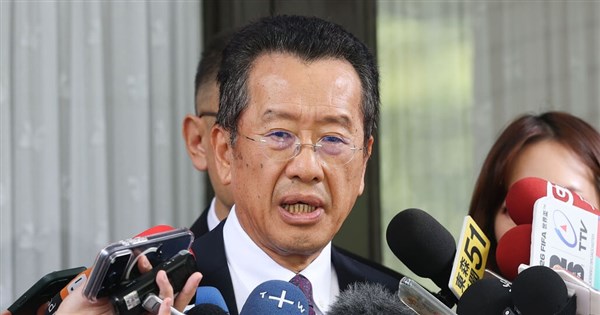
(CNA, Taipei, 19th, by reporter Liu Kuan-ting) Following the conclusion of the Trump-Xi meeting, the New York Times reported that relevant remarks by U.S. President Trump not only weakened the "unwavering" assurances previously given to Taiwan by some U.S. officials but also made it increasingly likely that arms sales to Taiwan could be "indefinitely withheld." In response, Minister of National Defense Wellington Koo said today that the United States has repeatedly stated its policy towards Taiwan remains unchanged, and Taiwan continues to communicate with the U.S., maintaining a cautiously optimistic attitude. Before attending a session at the Legislative Yuan this afternoon, Koo was asked if he was aware of foreign media reports that the U.S. might suspend or shelve arms sales to Taiwan. Koo stated that the U.S. side, including President Trump, has recently and repeatedly affirmed that its policy towards Taiwan is unchanged. This unchanged U.S. policy has two implications, he noted. First, the U.S. has long maintained peace and stability in the Taiwan Strait region through the channel of arms sales, a framework established by the Taiwan Relations Act, and the U.S. and Taiwan have long engaged in such military security and arms sales cooperation. Koo added that this also implies that peace and stability in the Taiwan Strait are at the core of U.S. interests. A crucial counterbalancing force in maintaining this peace and stability is the use of the arms sales channel. Taiwan has also repeatedly explained that it is a maintainer of the status quo of peace and stability in the Taiwan Strait, not a provocateur, and that it is China that is undermining the regional peace and stability. Koo believes that maintaining this arms sales channel is in the interest of the United States. With the U.S. repeatedly stating its policy towards Taiwan is unchanged, Taiwan continues to communicate with the U.S. and currently maintains a cautiously optimistic attitude. Regarding whether to consider a special act for drones, Koo said that Premier Cho Jung-tai likely meant that for unapproved budget portions, a special act, a supplementary budget, or inclusion in the annual budget are all possibilities. The Ministry of National Defense is currently reviewing these, and none of the three options are being ruled out. Discussing KMT legislator Ma Wen-chun's cuts and freezes to defense budgets for submarines and drones, Koo stated that the development of drones is a key element in thinking about how to build an asymmetric strategy. While previously included in the annual budget, the current view is that establishing a large-scale drone industry to strengthen national defense resilience through domestic production is a very important task. Koo also said that whether it is in the annual budget or a special budget, the goal is the same. He noted that Ma Wen-chun had also recently mentioned that drones are an important combat capability, and therefore hopes that all political parties can support the domestic production of drones.
FACT BOX
- Source: CNA (Central News Agency)
- Category: 政策