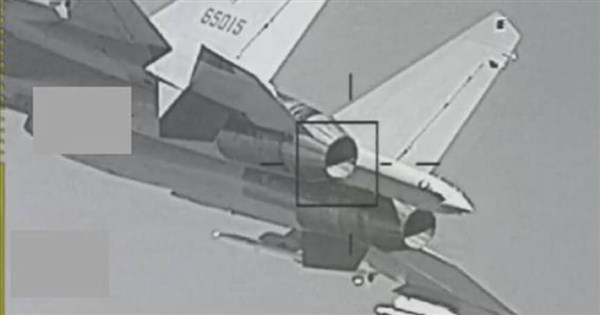
(CNA, Taipei, May 19, by reporter Yu Kai-hsiang) Taiwan's Ministry of National Defense (MND) stated today that starting from 8:36 AM, it successively detected 11 Chinese military aircraft crossing the Taiwan Strait median line and intruding into the northern, central, southwestern, and eastern airspace, in coordination with PLA warships conducting harassment under the guise of a 'joint combat readiness patrol.' The military also released footage of an Air Force F-16V fighter jet equipped with a Sniper pod monitoring a PLA aircraft from behind, as well as a Navy Su'ao-class frigate monitoring a PLA warship in the southwestern waters. In an evening press release, the MND stated that since 8:36 AM, a total of 22 PLA aircraft, including J-10, J-16, and KJ-500 primary and auxiliary fighters and drones, were detected. Among them, 11 crossed the median line and its extension, entering Taiwan's northern, central, southwestern, and eastern airspace, coordinating with PLA warships to harass the surrounding airspace and waters under the name of a 'joint combat readiness patrol.' The MND emphasized that the threatening and provocative actions of the PLA aircraft and ships are the sole factor undermining regional peace and stability. The ROC Armed Forces are committed to maintaining the status quo in the Taiwan Strait, employing joint intelligence, surveillance, and reconnaissance (ISR) to closely monitor PLA movements, and dispatching mission aircraft, naval vessels, and shore-based missile systems to respond appropriately. According to photos released by the MND, an Air Force F-16V (Block 20) fighter jet was shown using an AN/AAQ-33 Sniper Advanced Targeting Pod (Sniper ATP) to monitor a PLA aircraft from behind. Although the military obscured and cropped important parameters such as altitude, speed, and enemy bearing, it demonstrated powerful surveillance capabilities. Additionally, the MND disclosed footage of the PLA's Yinchuan destroyer (175) harassing Taiwan's southwestern waters, with sailors aboard the Navy's Su'ao frigate closely monitoring it. Scholars from the Institute for National Defense and Security Research, Shu Hsiao-huang and Su Tzu-yun, previously told CNA that the AN/AAQ-33 is a passive sensor and does not emit signals, meaning the PLA aircraft might be completely unaware of being tracked and locked on. If an AIM-9X Sidewinder missile were fired at an appropriate distance, it could be shot down, providing a significant tactical advantage. However, as the military has obscured parameters like altitude, speed, and enemy bearing, the tracking range and distance are unknown. Furthermore, the AN/AAQ-33 has both search and targeting functions, with an air-to-ground dual-light (visible and infrared) detection range of about 87 kilometers and an air-to-air range of up to 187 kilometers. This means a PLA aircraft could be locked on from a long distance over the main island using the electro-optical system without triggering its radar warning receiver, potentially achieving a 'silent kill.' (Editor: Lin Gelin)
FACT BOX
- Source: CNA (Central News Agency)
- Category: 事件