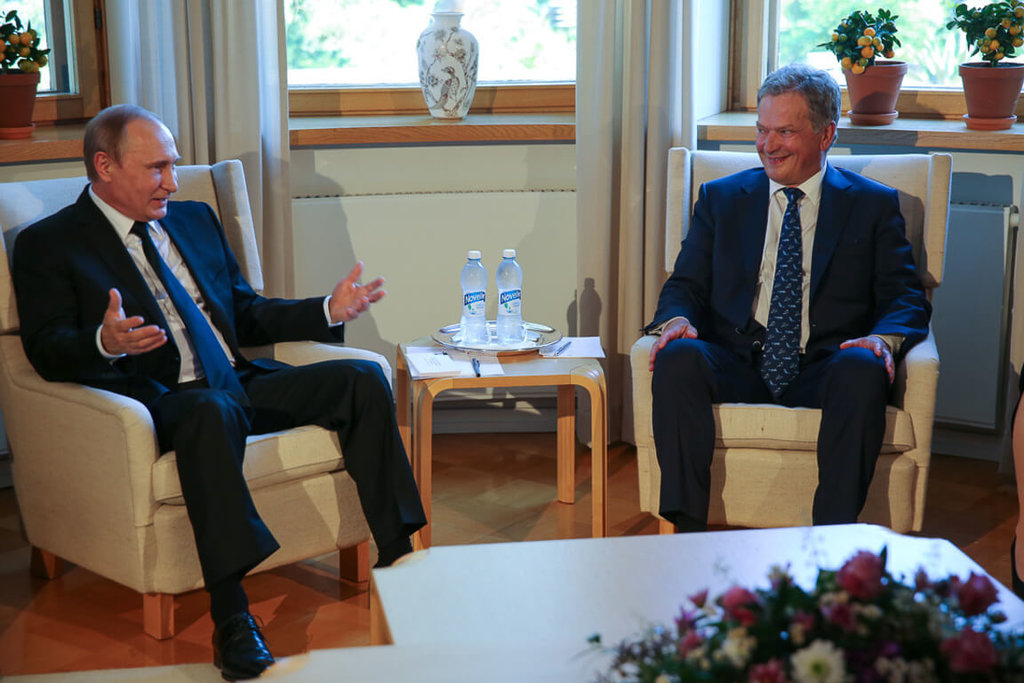
The European Union is contemplating the appointment of a special envoy to initiate dialogue with Russian President Vladimir Putin, and former Finnish President Sauli Niinistö is one of the top candidates. During his 12 years in office, he was one of the few Western leaders who managed to maintain good interactions with both Putin and U.S. President Donald Trump. When Trump traveled to Helsinki in 2018 for a summit with Putin, Niinistö was the host.
In an interview with the Finnish Broadcasting Company (Yle), Niinistö bluntly addressed the dilemma Europe currently faces: regardless of how the war in Ukraine ends, Russia's hostility will not dissipate, especially towards European countries that have strongly supported Ukraine. He advocates that, in the face of hybrid warfare, Europe needs to follow the model of Cold War-era nuclear arms negotiations to gradually establish rules of engagement between major powers. "It is crucial to get this matter into discussion," he said.
Niinistö took office as President of Finland in 2012 and was re-elected, serving until 2024. During his tenure, he met directly with Vladimir Putin multiple times and later revealed that he had explained to Donald Trump how to deal with Putin. Immediately after leaving the presidency, he was commissioned by European Commission President Ursula Von der Leyen to lead the drafting of a report on European defense resilience, earning him considerable prestige in Brussels' decision-making circles.
He also pointed out the current, highly absurd situation: "Europeans threaten to refuse dialogue with the war criminal Putin, but when Trump goes to talk to him, we can only listen to the debriefing afterwards." He believes Europe should take its own seat at the negotiating table, rather than just waiting for reports on America's results.
Niinistö remained non-committal about the envoy rumors but couldn't help but mention something that pleased him more: "Creating a 'more European' NATO has become a focus of everyone's attention. In the past, some people even laughed at me for it."
Those who "laughed at him" back then are now closely watching the report he submitted last Friday. This document, delivered to the EU by a working group, specifically studies how Europe could take over NATO's defense responsibilities if the United States reduces its support. Finland's long border with Russia is listed as one of the potential main fronts.
The report does not advocate for a common European army but rather proposes a "coalition of the willing" as the core mechanism. This would bypass the EU's unanimity requirement and include the UK and Norway.
Niinistö admitted that in the three major areas of nuclear weapons, intelligence, and artificial intelligence, Europe's current capabilities are still insufficient, and it would be difficult to reverse this disadvantage in the short term.
Although Niinistö is a popular choice, he faces an unavoidable obstacle. According to a Financial Times report yesterday, a senior EU official stated bluntly that Moscow still resents Finland's joining NATO in 2023, and Russia is "very dissatisfied" with Finland. While Niinistö is one of the few European leaders with actual experience interacting with Putin, this history could also be a burden. The EU official privately believes the envoy should ideally come from a country that is relatively non-controversial in Russia's eyes, such as the Netherlands or Portugal.
The Financial Times report also named former German Chancellor Angela Merkel, former European Central Bank President Mario Draghi, and current Finnish President Alexander Stubb as other suitable candidates.
EU foreign ministers are expected to meet in Cyprus next week to discuss the envoy selection, and the outcome is expected to be submitted to the EU summit in June.
FACT BOX
- Source: CNA (Central News Agency)
- Category: 國際