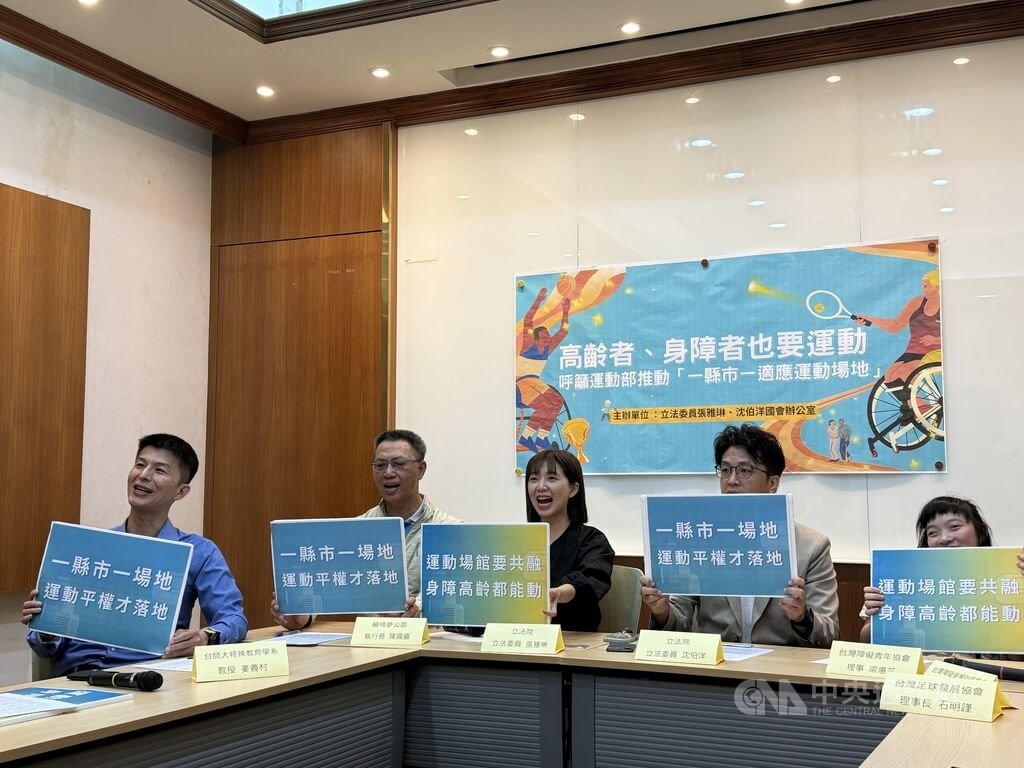
(CNA, Taipei, May 21, by reporter Wang Yang-yu) DPP legislators Chang Ya-lin and Puma Shen, along with civic groups, stated today that with the upcoming National Games for Citizens with Disabilities, they are calling on the government to respond to the daily exercise needs of groups such as people with disabilities and the elderly. They urged the Sports Administration to inventory adaptive sports resources nationwide and promote a 'One Adaptive Sports Venue Per County' plan to implement sports equality. Chang Ya-lin and Puma Shen, together with Liang Hui-hsin, a director of the Taiwan Disability Youth Association; Liu Yu-chi, deputy secretary-general of the Taiwan Disability Rights Promotion Association; Chen Kuo-chia, CEO of Wheelchair Dream Park; Professor Chiang Yi-tsun of the Special Education Department at National Taiwan Normal University; and Ishii Shih-ming, chairman of the Taiwan Football Development Association, held a press conference at the Legislative Yuan today to present these proposals. Chang Ya-lin said that many current gyms lack adaptive equipment, and public and school venues have insufficient barrier-free facilities. This shows that sports policy is still overly focused on 'how healthy people exercise,' ignoring the daily exercise rights of groups that need support. Chang Ya-lin stated that with Taiwan's elderly population ratio exceeding 20% and the number of people with disabilities continuing to increase, the need for adaptive sports support will only grow. After the establishment of the Sports Administration and its Adaptive Sports Division last year, she believes it is necessary to comprehensively inventory national adaptive sports resources and promote the 'One Adaptive Sports Venue Per County' plan to move adaptive sports from sporadic demonstrations to institutionalization and popularization. Chang Ya-lin believes that true sports equality means that every person still has the opportunity to exercise even after being injured, aging, or falling ill. Puma Shen pointed out that the 'One Adaptive Sports Venue Per County' is a very important matter, not just a need for people with disabilities, but a public issue that everyone will face. Promoting adaptive sports venues will inevitably have a transition period. Whether it involves renovating existing venues or constructing new ones, it will take time to accumulate experience. The government can refer to the practices of some countries and introduce mobile sports services during the transition phase, using mobile vehicles to enter different communities with coaches to provide adaptive sports support at different times. Liang Hui-hsin believes that it is not enough for the venue itself to be accessible; it is also necessary to consider whether people with disabilities can actually reach the venue. Although there are rehabilitation buses, they are in long-term short supply and difficult to book on short notice. For many young people with disabilities, the biggest difficulty is not a lack of willingness to exercise, but the high cost in time and psychological stress required for every trip, move, and entry into a venue. Liang Hui-hsin pointed out that she hopes future adaptive sports policy will not just be about having venues, but will truly allow every young person with a disability to exercise with peace of mind,
FACT BOX
- Source: CNA (Central News Agency)
- Category: 政策