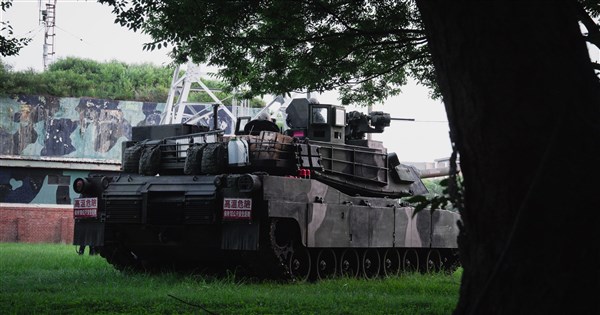
Kuomintang (KMT) Legislator Ma Wen-chun stated today during a budget review at the Legislative Yuan's Foreign and National Defense Committee that the M1A2T tank procurement program's budget, originally around NT$40.5 billion, had ballooned to over NT$45.3 billion without the Legislative Yuan ever being notified. Minister of National Defense Wellington Koo said that the Army did not submit a budget increase proposal in accordance with the Letter of Offer and Acceptance (LOA), and that disciplinary action has been taken.
Ma proposed freezing NT$2 billion of this year's NT$8.7 billion budget for the new tanks. A bipartisan consensus was ultimately reached to do so, with the funds to be released only after the Ministry of National Defense (MND) submits a written report that is approved by the legislature.
The Legislative Yuan's Foreign and National Defense Committee today continued its review of the central government's general budget for fiscal year 115, focusing on the public and classified portions of the MND's budget.
Taiwan's procurement of 108 M1A2T tanks from the US has seen all units arrive in Taiwan. During the budget review, Ma pointed out that the Army Command Headquarters' "New Tank" procurement program, running from 2019 to 2027, requires a total of NT$45,335,002,000. However, the project was originally approved for NT$40,524,159,000, an increase of over NT$4.8 billion. This meant the Army waited until the final batch of tanks was delivered to tell Congress they were short nearly NT$5 billion, concealing the process from the Legislative Yuan. She thus proposed freezing NT$2 billion of this year's NT$8.7 billion new tank budget.
Koo stated that there were some deferred purchases in the M1A2T procurement case and that the Army failed to request a budget increase in line with the LOA, for which he has already administered punishment.
Lieutenant General Huang Wen-chi, Director of the MND's Strategic Planning Department, stated that after the M1A2T tank procurement project was established in 2019, the initial budget was set at NT$40.5 billion. When the U.S. side notified its Congress in 2020, the figure was US$2 billion, nearly NT$600 billion. The large discrepancy between the NT$600 billion figure and the military's estimate was investigated. It was found that 40% of the value was in industrial cooperation, with the U.S. valuing one industrial cooperation point at one US dollar, making the initial NT$600 billion arms sale figure inflated.
Huang explained that the cost in the original LOA exceeded NT$40.5 billion. The MND reviewed the matter and made two decisions. First, because Taiwan has a short and shallow strategic depth, the M1A2T procurement originally included 18 M1070 heavy equipment transporters. Then-Minister Yen Teh-fa ordered the Army to only retain training capacity, so only 6 M1070s were procured.
Huang said the second decision concerned the Army's ongoing "Lei-Chih Project" to supplement its M88A2 armored recovery vehicles. Since the M1A2T deal also included M88A2s, but in a relatively small quantity leading to higher costs, the M88A2s were first deferred for later consideration under the Lei-Chih Project. The Army thus listed the M1070s, M88A2s, and some ammunition as deferred items, retaining the option to purchase them later if budgets allowed.
Huang said when the Army signed the A3 version of the LOA, it included the 6 M1070s and some M88A2s. In theory, the Army should have submitted a special report to the Legislative Yuan before signing the LOA, but the Army Command Headquarters failed to do so and signed it directly.
He admitted, "This was an administrative flaw." Consequently, after the MND discovered this last year, it took administrative disciplinary action against all responsible personnel, from the Army Chief of Staff down, and re-submitted a request for a supplementary budget to the Executive Yuan.
Huang stated that the main cause of the problem was the NTD-to-USD exchange rate. In 2019, it was NT$31.5 to US$1. From 2020 to 2023, it fell to around NT$27 to US$1. The Army was initially optimistic that the surplus from the favorable exchange rate could cover the budget, but in 2024, the US dollar appreciated again, leading to a budget shortfall.
Democratic Progressive Party (DPP) Legislator Wang Ting-yu pointed out that any additions, subtractions, or budget changes in military procurement must be reported to the Legislative Yuan. He said that members of the Defense Committee, regardless of party, are united on this stance and hope the MND and all military branches will learn from this lesson.
FACT BOX
- Source: CNA (Central News Agency)
- Category: 政策