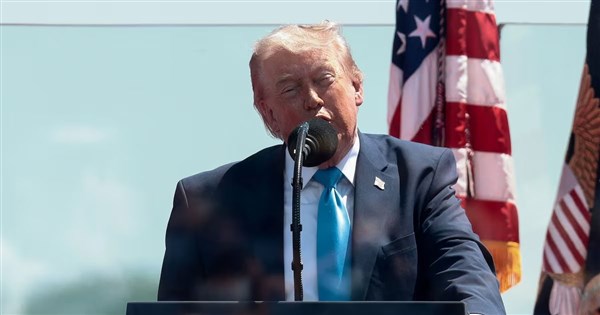
On the 82nd day of a joint US-Israeli offensive against Iran, US President Donald Trump disclosed today that US-Iran negotiations have entered their final phase. He hopes to reach a peace agreement to reduce casualties but does not rule out using military force again.
Here is a summary of the latest developments in the Middle East war, compiled by AFP.
US President Donald Trump said today that talks between the US and Iran have entered the 'final phase,' but he also warned that the US might resort to military action again unless the Iranian authorities agree to a peace deal.
Trump told reporters: 'We are in the final phase on the Iran issue. We'll see how it goes. Either we'll have a deal, or we'll have something that's not going to be very pretty, but hopefully that won't happen.'
He said: 'Ideally, I'd like to see fewer people killed, rather than a lot of people killed. We can do it both ways.'
Israeli military Chief of Staff Eyal Zamir stated that the military is on its highest alert as Tehran and Washington exchange threats of war.
According to a statement released by the military, Zamir said during a meeting with division commanders: 'At this moment, the Israel Defense Forces (IDF) are on the highest state of alert and are prepared for any development.'
Iran's chief negotiator, Parliament Speaker Mohammad Bagher Ghalibaf, stated that the United States is trying to restart the war and wants Tehran to surrender.
In a voice message on his official website, Ghalibaf said: 'The enemy's overt and covert actions show that despite facing economic and political pressure, it has not abandoned its military objectives and is trying to launch a new war.'
Iran's Islamic Revolutionary Guard Corps (IRGC) Navy announced that they have allowed more than 25 ships, including oil tankers, to pass through the Strait of Hormuz in the past 24 hours.
The IRGC Navy posted on the X platform: 'In the past 24 hours, 26 ships, including oil tankers, container ships, and other commercial vessels, have passed through the Strait of Hormuz.'
The post added that the ships passed after 'coordination and security were provided by the IRGC Navy.'
Oil prices fell by 5% and stock markets rose after Iran's announcement that it had allowed about a dozen ships to pass through the Strait of Hormuz, easing concerns about the apparent stalemate in ending the Middle East war.
US Treasury yields plummeted today after US President Trump said American negotiators were close to a potential peace deal with Iran.
The UN's Food and Agriculture Organization (FAO) warned that a blockade of the Strait of Hormuz could 'trigger a severe global food price crisis' in the coming months.
Before the war, one-third of the world's fertilizer supply also passed through the strait, and officials have warned that farmers could face shortages during the summer growing season.
The United Arab Emirates has demanded that Iraq 'immediately' stop further attacks from its territory, after the UAE accused Iraq of launching a drone attack on a nuclear power plant from its soil.
The UAE's Foreign Ministry called on 'Iraq to urgently and unconditionally stop all hostile acts originating from its territory.'
According to Iranian state media, citing diplomatic sources in Islamabad, war mediator Pakistani Interior Minister Mohsin Naqvi traveled to Iran for the second time this week amid a stalemate in proposals between Tehran and Washington to end the conflict.
According to Iranian media, Naqvi had visited Tehran on the 16th to 'facilitate' the process between Tehran and Washington.
The Jordanian military announced it had shot down a drone of unknown origin in its airspace. There have been no reports of casualties so far.
FACT BOX
- Source: CNA (Central News Agency)
- Category: 國際