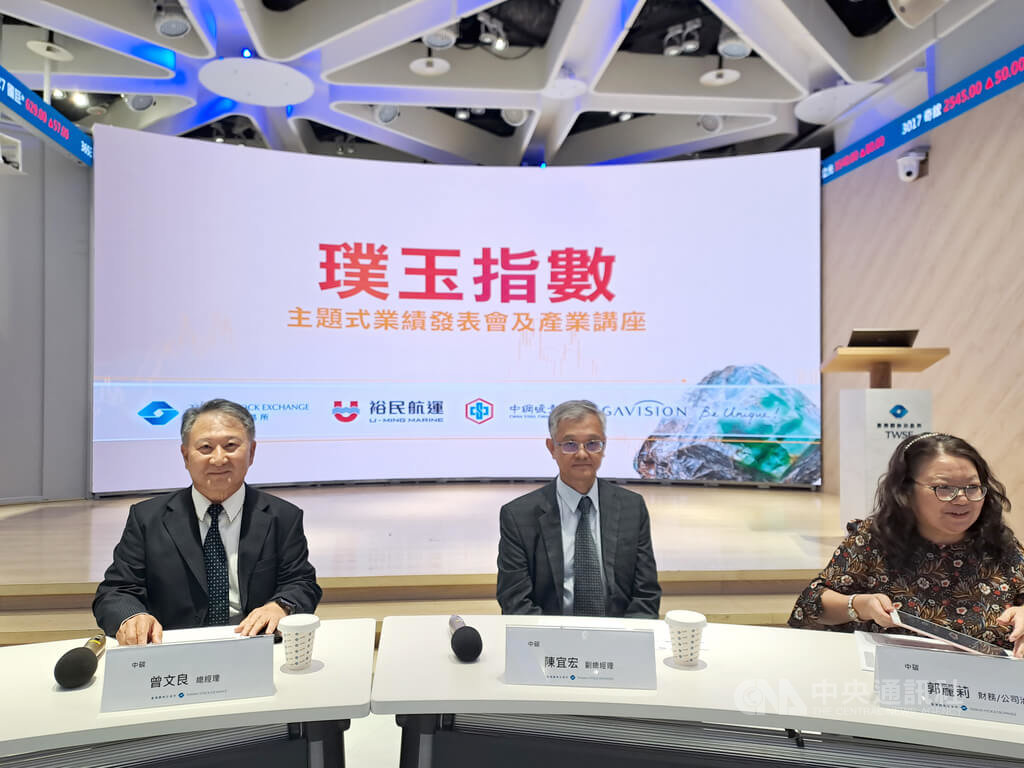
Central News Agency (Taipei, 22nd) CSC Vice President Chen Yi-hung stated today that the company is optimistic about the AI server industry chain and silicon carbide (SiC) semiconductor business opportunities. The company is targeting Battery Backup Unit (BBU) materials and developing Advanced Carbon Materials (ACS). The first phase of the factory expansion project is expected to be completed by early 2027, with the isotropic graphite block factory expansion also scheduled for completion at that time.
CSC participated in an earnings conference hosted by the Taiwan Stock Exchange today. Chen pointed out that CSC's BBU industry chain layout includes high-power anode materials (LIB), which are already being applied by customers in BBUs. Furthermore, they have developed capacitor-like extreme power cells, which hold an advantage in 800V architecture BBUs.
Chen explained that the advanced carbon materials developed by CSC precisely address the safety and stability needs of BBUs in high-voltage and high-temperature environments. They are currently actively undergoing verification by key customers in South Korea. For Hybrid Supercapacitors (HSC) and Lithium-Ion Capacitors (LIC), the new factory construction for key Japanese customers is scheduled to be completed in the fourth quarter. CSC is providing customized positive and negative electrode materials for these two products, which are currently being verified by customers.
CSC's board of directors approved the advanced carbon material factory expansion plan in February 2025, with the first phase expected to be completed by early 2027 and the second phase by the end of 2030.
Regarding the future market size forecast for supercapacitors (EDLC), CSC stated that supercapacitors possess extremely high power density, enabling ultra-fast charging and discharging and a cycle life of up to one million times. They complement lithium-ion batteries, solving the limitations of batteries in high-power output and lifespan.
CSC explained that the supercapacitor market size is 14.7 billion USD in 2025, expected to reach 16.95 billion USD in 2026, and grow to 70.38 billion USD by 2036, with a compound annual growth rate (CAGR) of 15.3%.
CSC is optimistic about the 'isotropic graphite' business opportunity, mainly because China restricts the export of graphite products, and German and Japanese suppliers are expensive with unstable delivery times, prompting domestic companies to urgently build a local supply chain. CSC's product expansion and applications include silicon carbide semiconductors, with 8-inch crucibles currently being verified by multiple customers, and 12-inch crucibles expected to complete development in the second half of 2026.
CSC explained that the silicon carbide (SiC) compound semiconductor market is growing rapidly. Driven by global green energy, electric vehicles, and future AI server high-voltage direct current (HVDC), the silicon carbide component market is expanding quickly. The global silicon carbide power component market reached 2.287 billion USD in 2023 and is expected to grow to 5.34 billion USD by 2026, with a CAGR of 35%. It is estimated that the silicon carbide wafer market will reach a production capacity of 1.938 million units by 2027.
CSC stated that Taiwan already possesses a silicon carbide semiconductor industry chain, but the key material, high-purity graphite for silicon carbide crystal growth, still relies on imports. CSC's high-purity graphite crucibles will achieve import substitution and fill the industry's demand gap.
FACT BOX
- Source: CNA (Central News Agency)
- Category: corporate_announcement