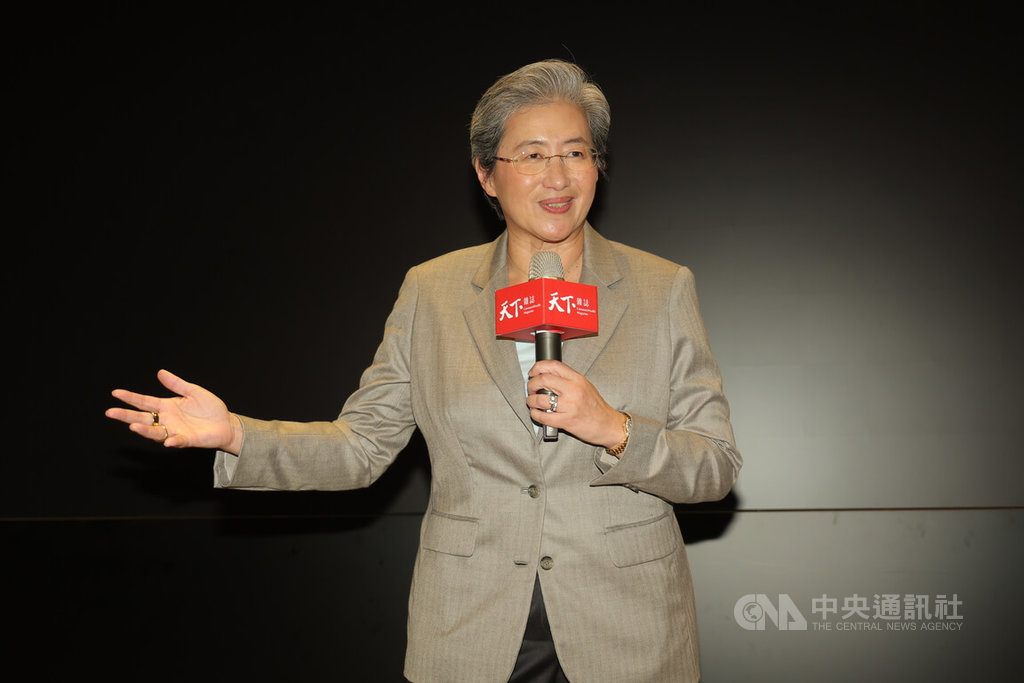
Central News Agency (CNA) reporter Wu Chia-hao, Taipei, May 22. AMD Chair and CEO Lisa Su stated today that AMD has a broad product portfolio for China and that the country remains a very important market. However, given the current US-China situation, AMD likely cannot sell its highest-performance AI chips there, but will maintain close partnerships with the Chinese ecosystem.
Su attended the CommonWealth Magazine 45th Anniversary Forum this morning. In a post-forum interview, she addressed how AMD is navigating US chip bans and China's push for domestic AI chips.
She reiterated that AMD does not include sales of its most advanced chips in China in its financial forecasts. It is a highly volatile market subject to both US export controls and local Chinese regulations.
While she believes China will remain a key market, she admitted that regarding high-performance AI chips, "we probably cannot sell them there" given the current climate.
Su noted that China accounts for about 20% of AMD's revenue, with extensive operations in PC, gaming, and data center segments.
She emphasized that as a US company, AMD must strictly comply with all export controls. While some high-end GPUs are restricted, this does not change AMD's commitment to the Chinese market, provided it remains in full compliance with US law.
Su observed significant progress in China regarding AI PCs and on-device AI. AMD held a developer event in Shanghai this week, drawing thousands to discuss AI PC applications.
"I believe that even under current geopolitical restrictions, AMD still has many channels to maintain very close partnerships with the Chinese ecosystem," Su said.
Regarding CPU shortages driven by AI inference, Su noted that overall demand is significantly higher than forecasts from a year ago. She visited China before coming to Taiwan to speak with major global and Chinese customers.
AMD is rapidly increasing production capacity, and her visit to Taiwan is aimed at ensuring readiness for large-scale CPU production. With support from supply chain partners, AMD plans to increase supply every quarter this year, expecting demand to continue rising for years.
On memory shortages, Su stated that the tight supply forces everyone to prioritize "perfect planning." For High Bandwidth Memory (HBM), AMD is working closely with the world's three major memory manufacturers to map out product roadmaps through 2028.
FACT BOX
- Source: CNA (Central News Agency)
- Category: corporate_strategy
- Organizations: AMD
- Dates in source: 2028