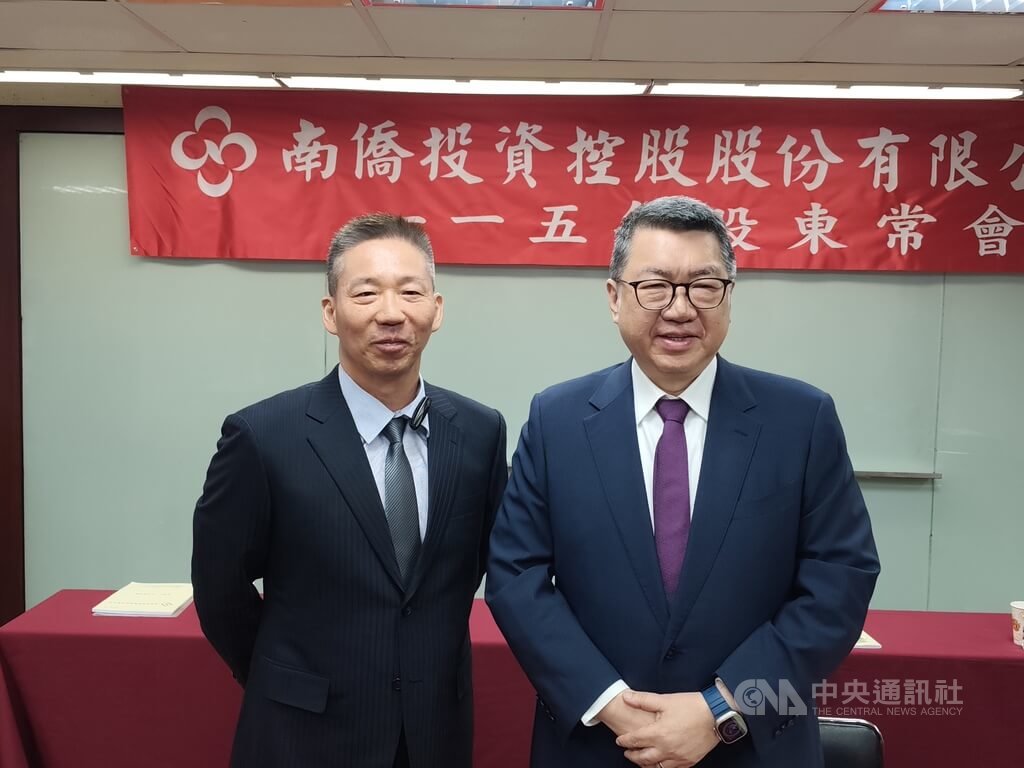
Chen Cheng-wen, the new chairman of major oil and food manufacturer Namchow, stated that the recovery of the Chinese market is slower than expected, with a trend of rational consumption persisting. Beyond increasing the proportion of bakery products in China, Namchow is strengthening its presence in new consumption scenarios such as local convenience stores, membership supermarkets, and tea shops. Furthermore, the company continues to expand production at its Thai plant and has applied to establish an Indonesian subsidiary to bolster its ASEAN market presence, with expectations that this year's operational performance will exceed last year's.
Namchow held its shareholders' meeting today, passing the earnings distribution plan for the previous year, which includes a cash dividend of NT$1.6 per share. This was the first shareholders' meeting presided over by Chen Cheng-wen since he took office as chairman this year. After the meeting, he discussed the company's layout and outlook for the Chinese, Taiwanese, and ASEAN markets.
Regarding the Chinese market, Chen pointed out that the post-pandemic recovery has been sluggish, making the past two years challenging for Namchow. Consumption during this year's Dragon Boat Festival was not particularly strong, and the market remains characterized by rational spending. Competition in the bakery and catering sectors is intense, with many bakeries and catering operators exiting the market, while large dairy companies are entering the bakery sector, attracted by its profit margins.
He noted that bakery consumption scenarios are shifting from traditional storefronts to channels like supermarkets and convenience stores. Namchow is currently collaborating with major Chinese convenience stores and Sam's Club, providing OEM and private-label bakery products, aiming to become a key partner in the bakery supply chains of large clients.
Chen stated that while Namchow previously focused on oil raw material supply, it has gradually increased the proportion of bakery products in recent years. The company is moving from supplying frozen semi-finished goods to developing high-completion products, allowing convenience stores and large supermarkets to sell them after simple reheating, or even providing finished bakery products. Additionally, Namchow is expanding into tea shop channels, offering bakery products for bundled sales.
Regarding Namchow Thailand, he described it as a "global rice product expert." In addition to continued investment in production lines, the company is strengthening automation equipment to improve efficiency and reduce labor costs. Currently, the Thai plant's rice cracker and rice products continue to grow, with infant rice crackers being one of the fastest-growing and highest-value-added products in recent years. Future plans include extending into the snack market for children aged 3 to 5.
He mentioned that although Thailand faces challenges such as rising wages, geopolitical issues, and the appreciation of the Thai baht, which impacted last year's profits, the company maintains resilience due to a diversified client base, with 80% of its business being exports and OEM. Currently, the company is seeing gains in emerging markets such as the Middle East, Africa, and South America.
Furthermore, Chen said that with the support of the late Namchow Chairman Chen Fei-lung, the company has been actively promoting the integration of the Chinese and ASEAN markets. Leveraging the advantage of low trade barriers between regions, Namchow has been selling bread and snacks produced in Thailand to major Chinese supermarkets, while exporting bakery raw materials and finished products from China to Thailand, a strategy that has been in place for two to three years.
FACT BOX
- Source: CNA (Central News Agency)
- Category: corporate_announcement