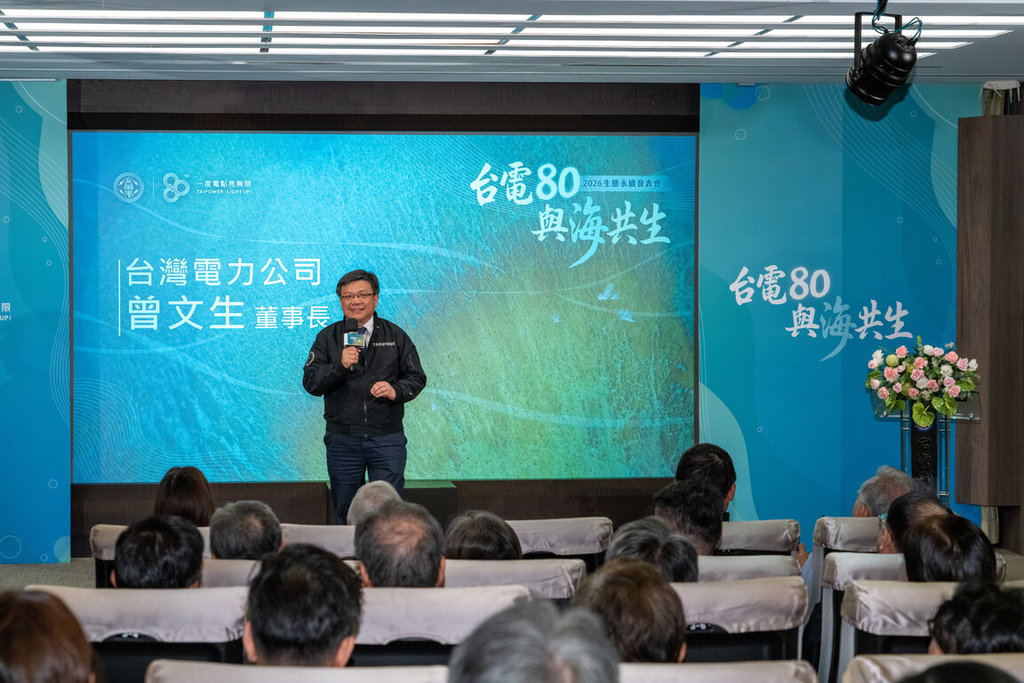
Taipower held the 'Taipower 80: Coexisting with the Ocean' ecological sustainability presentation today, reviewing over 50 years of marine ecological research. Taipower stated that, using the Third Nuclear Power Plant as an example, the research team has long monitored the surrounding marine ecosystem and discovered extremely rare 'heat-resistant corals' at the discharge outlet, providing new possibilities for coral restoration amid global warming. The event was hosted by Taipower Chairman Tseng Wen-sheng, who invited marine ecologists and experts to review marine conservation achievements and premiered the documentary 'What the Ocean Taught Us,' directed by underwater cinematographer Yuan Hsu-hu. Taipower's Changhua Offshore Wind Farm Phase 1 recently received the first 'Other Effective Area-Based Conservation Measures (OECMs)' certification. Tseng pointed out that the promotion of OECMs opens a new direction for Taipower's engineering applications, with ecological coexistence thinking gradually integrated into design. Taipower's goal is no longer just to reduce environmental impact, but to create environments more suitable for biological habitats through engineering planning. Tseng stated, 'Wherever there is a power plant, there is Taipower's marine ecological research,' and expressed hope to continue opening up long-accumulated ecological survey data for cooperation with academia. Taipower explained that the first large-scale marine ecological research project began in 1972, focusing on the waters around the First Nuclear Power Plant, and has since expanded to all power sites. The marine station at the Third Nuclear Power Plant has been operating for over 30 years, accumulating stable Kuroshio current data, which helps in understanding current changes and fishery fluctuations. With the development of new energy sources like offshore wind, Taipower is also investing in research on the coexistence of energy facilities and marine ecosystems. The underwater foundations of the first offshore wind farm have demonstrated an artificial reef effect, attracting various reef-dwelling fish. Taipower continues to promote conservation achievements through video documentation.
FACT BOX
- Source: CNA (Central News Agency)
- Category: Corporate Social Responsibility
- Dates in source: 1972