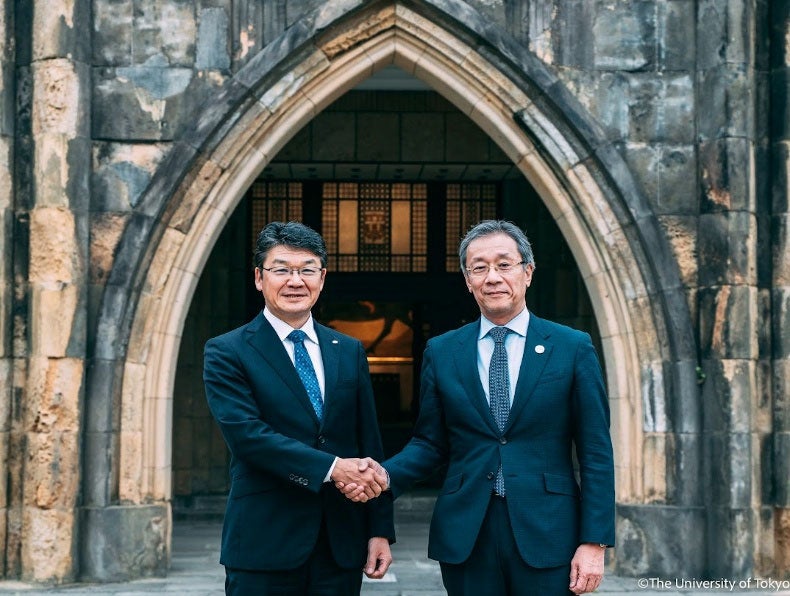
The University of Tokyo (Bunkyo Ward, Tokyo; President: Teruo Fujii; hereinafter referred to as "The University of Tokyo") and DENSO CORPORATION (Kariya City, Aichi Prefecture; President: Shinnosuke Hayashi; hereinafter referred to as "DENSO") will enter into a 10-year industry-academia collaborative creation agreement, effective April 1, 2026. This collaborative creation project will be the first long-term, comprehensive organizational-to-organizational partnership for The University of Tokyo in the field of mobility.
The common vision for this collaborative creation agreement is "Towards a Society Enriched by Driving: Future Societal Value Expanding from Mobility." While mobility has enhanced people's convenience, challenges have included energy consumption and temporal constraints associated with travel. This collaborative creation project aims to address these challenges by evolving mobility itself into a source of new societal value through energy circulation and data accumulation/utilization. Starting from mobility, we will deepen the integration of energy, data, and urban infrastructure, striving to build a sustainable social system that also contributes to the improvement of human happiness.
From left, DENSO President Shinnosuke Hayashi and The University of Tokyo President Teruo Fujii
Background and Objectives: A Turning Point for Mobility The mobility industry is currently at a major turning point due to advancements in electrification and intelligence. Along with the spread of electric vehicles, the overall energy landscape, including charging infrastructure and power supply/demand, is becoming a critical issue. Furthermore, as technological development progresses towards the realization of autonomous driving, securing computational resources and utilizing energy with a view to the future are also required. In this context, mobility, energy, data, and urban infrastructure are interconnected, making overall societal optimization indispensable. Moreover, challenges facing modern society, such as achieving carbon neutrality, the increasing severity of energy constraints, the progression of an aging population with a declining birthrate, and the demand for a society with zero traffic fatalities, are complexly intertwined, making it difficult to respond adequately with only the advancement of individual technologies.
Against this backdrop, this collaborative creation project redefines mobility not merely as a means of transportation, but as a "social system" that connects energy, data, and urban infrastructure, and challenges its realization. The University of Tokyo possesses expertise spanning mathematical optimization, urban design, autonomous driving control, safety assurance theory, and semiconductor design. DENSO, on the other hand, has extensive knowledge and implementation capabilities in electrification and intelligence technologies cultivated over many years in the mobility domain, as well as in automotive semiconductors and software. By collaborating, both parties will jointly work not only on advancing the mobility field but also on fundamental technologies such as semiconductors, AI, and software, as well as nurturing the human resources responsible for them, aiming for sustainable value creation with a view from research to social implementation.
Four Key Themes for This Collaborative Creation Agreement Specifically, the following four key themes will be addressed: (1) Creating Societal Value through Energy Circulation and Data Integration Utilizing wireless power transfer systems for moving vehicles (DWPT, Note 1) and mathematical optimization as core technologies, we will work to build a social infrastructure that integrates energy supply and mobility utilization not only in cities but also in logistics networks, including expressways, while avoiding excessive load on the power grid. Furthermore, we aim to achieve a society where energy and mobility are in harmony by enhancing economic viability through the optimization of infrastructure deployment based on travel demand and traffic flow.
FACT BOX
- Source: PR TIMES
- Category: News