Gekkan Soumu Co., Ltd. (headquartered in Chiyoda-ku, Tokyo; President: Hiroko Usui), the publisher of Japan's only administrative magazine 'Gekkan Soumu,' conducted a survey titled 'Survey on Outsourcing and BPO in Administrative Operations' targeting administrative staff nationwide, receiving responses from 132 individuals.
【Survey Summary】
・47.0% of companies outsource part of their administrative tasks, nearly equal to the 48.5% with no outsourcing experience
・'Payroll and attendance management' is the most commonly outsourced task; future expectations focus on 'system operations' and 'business improvement and process design'
・60% of outsourcing providers only perform assigned tasks; joint process design remains rare
・The primary goal of outsourcing is 'reducing workload,' far surpassing other reasons
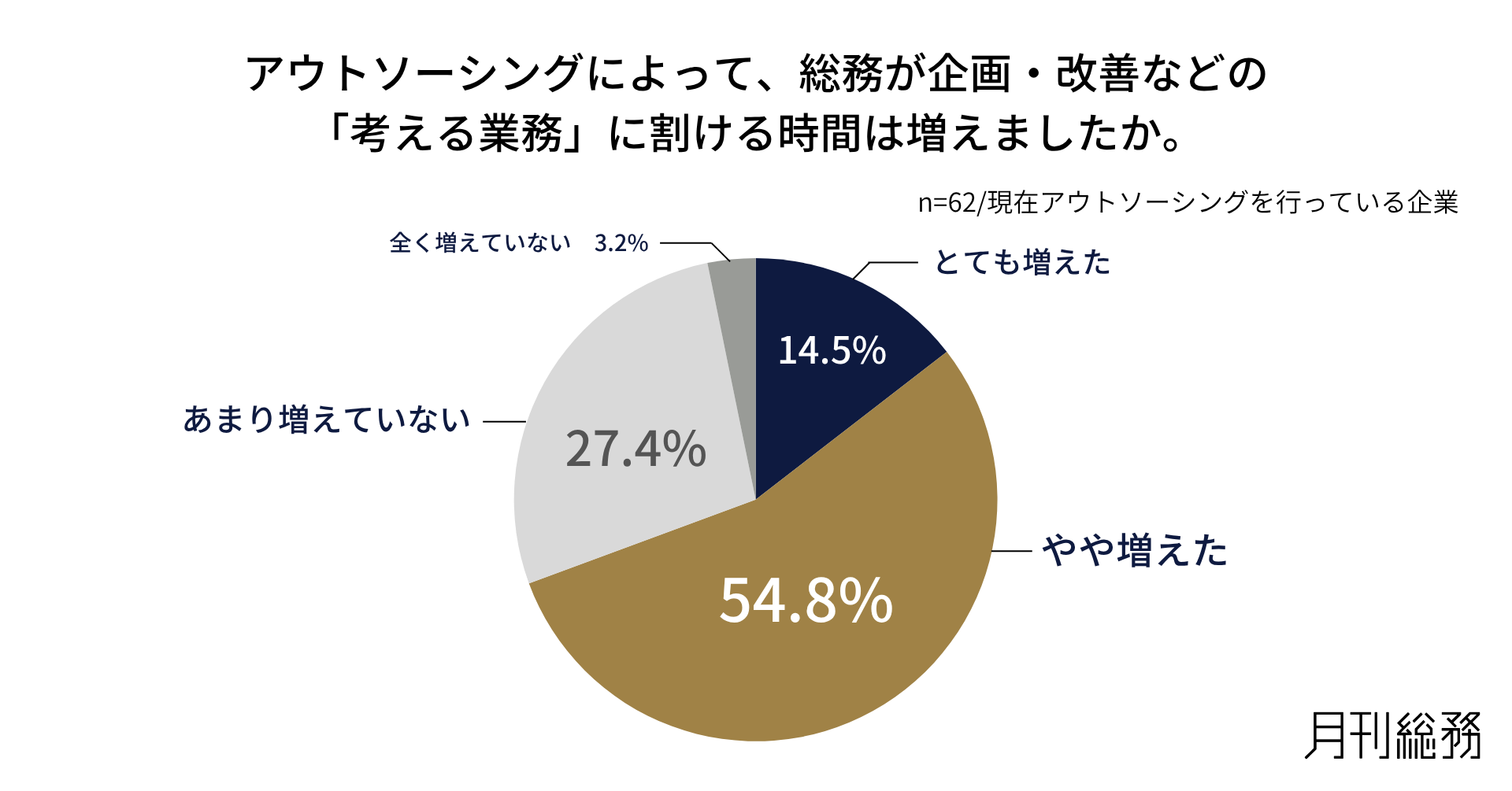
・Approximately 70% report increased time for strategic 'thinking work' after outsourcing
・Top challenges in outsourcing implementation: 1st 'insufficient task documentation,' 2nd 'lack of internal consensus,' 3rd 'communication difficulties'
・About 60% of administrative staff use AI and SaaS, but this has not significantly changed their outsourcing approach
※BPO (Business Process Outsourcing): Outsourcing part or all of a company's business processes, including planning, operation, and improvement. Unlike simple task delegation, BPO may include process design and operational optimization.
※Outsourcing: A broad term referring to delegating part of a company's operations to external parties, ranging from specific task execution to process-level delegation. BPO is one type of outsourcing.
【Detailed Survey Results】
◼️ Only about 20% of administrative staff fully understand 'BPO'; awareness and comprehension remain limited
When asked about their understanding of 'BPO (Business Process Outsourcing),' only around 20% responded that they 'understand it well.' While many grasp the general concept of BPO, few have a deep understanding of its specific components.
◼️ 47.0% of companies outsource administrative tasks; 48.5% have no outsourcing experience
When asked whether they currently outsource any administrative tasks, 47.0% of respondents reported some form of outsourcing, while 48.5% answered 'have never outsourced' (n=132).
◼️ Most outsourcing covers '10–30%' of tasks (51.6%), indicating limited adoption
Among respondents currently outsourcing (including BPO), when asked what percentage of their total administrative workload is outsourced, '10–30%' was the most common response at 51.6% (n=62 / companies currently outsourcing). Even among outsourcing companies, most limit delegation to a small portion of their operations, with very few outsourcing the majority of administrative tasks.
Less than 10%: 38.7%
10–30%: 51.6%
30–50%: 8.1%
50% or more: 1.6%
◼️ 'Payroll and attendance management' is the most outsourced task; future demand focuses on 'system operations' and 'process improvement'
When asked which tasks are currently outsourced, 'payroll and attendance management' was the most common at 54.8%, followed by 'system operations and IT support' at 32.3% and 'reception and facility management' at 29.0% (n=62 / companies currently outsourcing).
Meanwhile, among those who wish to expand outsourcing in the future, when asked which tasks they would like to outsource, 'system operations and IT support' ranked highest at 36.7%, followed by 'business improvement and process design' at 35.6% and 'AI and SaaS implementation and operational support' at 33.3% (n=90 / companies planning to expand outsourcing).
While current outsourcing focuses on routine tasks like 'payroll and attendance,' future intentions highlight growing demand for more specialized areas such as 'system operations,' 'business improvement,' and 'AI/SaaS support,' indicating a shift in the role of outsourcing from mere task delegation to functional enhancement.
◼️ 60% of outsourcing providers only perform assigned tasks; joint process design remains rare
Among respondents currently outsourcing (including BPO), when asked about the level of involvement of their outsourcing partners in administrative tasks, 'only performs assigned tasks' was the most common response at 59.7%, while 'sometimes receives improvement suggestions' accounted for 24.2%, and 'jointly designs processes and improves operations' stood at only 16.1% (n=62 / companies currently outsourcing).
Most outsourcing partners remain limited to executing assigned tasks, and only a small number of companies have established strategic partnerships where providers actively participate in process design.
◼️ 'Reducing workload' is the top outsourcing goal at 71.0%
When asked about the main purpose of outsourcing, 'reducing workload' was the most common response at 71.0%, followed by 'addressing staff shortages' at 59.7% and 'improving service quality' at 40.3% (n=62 / companies currently outsourcing).
The proportion citing 'cost reduction' as a goal was only 33.9%, indicating that outsourcing is primarily used to compensate for internal resource shortages rather than to cut costs.
◼️ 'Track record and reliability' is the top criterion for selecting outsourcing partners at 75.8%
When asked what factors were prioritized when selecting outsourcing partners, 'track record and reliability' ranked highest at 75.8%, followed by 'industry knowledge and expertise' at 46.8%, and 'low pricing' and 'flexible responsiveness' both at 37.1% (n=62 / companies currently outsourcing). Few companies currently expect their partners to go beyond task execution to propose operational improvements.
◼️ About 70% report increased time for 'thinking work' after outsourcing
When asked whether outsourcing has increased the time available for planning and improvement—'thinking work'—approximately 70% responded that it had increased, combining 'significantly increased' and 'somewhat increased' (n=62 / companies currently outsourcing).
◼️ Top outsourcing implementation challenges: 1st 'insufficient task documentation,' 2nd 'lack of internal consensus,' 3rd 'communication difficulties'
Among respondents with current or past outsourcing experience, when asked about challenges faced during implementation, 'inadequate task documentation prior to implementation' was the most common at 35.3%, followed by 'lack of internal understanding and consensus' at 29.4%, and 'communication difficulties' at 27.9% (n=68 / companies with outsourcing experience). Challenges often arise before vendor selection, particularly in internal task documentation and consensus-building.
Only 7.4% responded 'no challenges,' indicating that most companies have encountered difficulties during implementation. Many companies face challenges in pre-outsourcing preparation stages such as 'task documentation' and 'consensus formation,' suggesting that the key to successful outsourcing lies not in post-delegation management, but in internal preparation.
◼️ About 60% of administrative staff use AI and SaaS
FACT BOX
- Source: PR TIMES
- Category: Survey