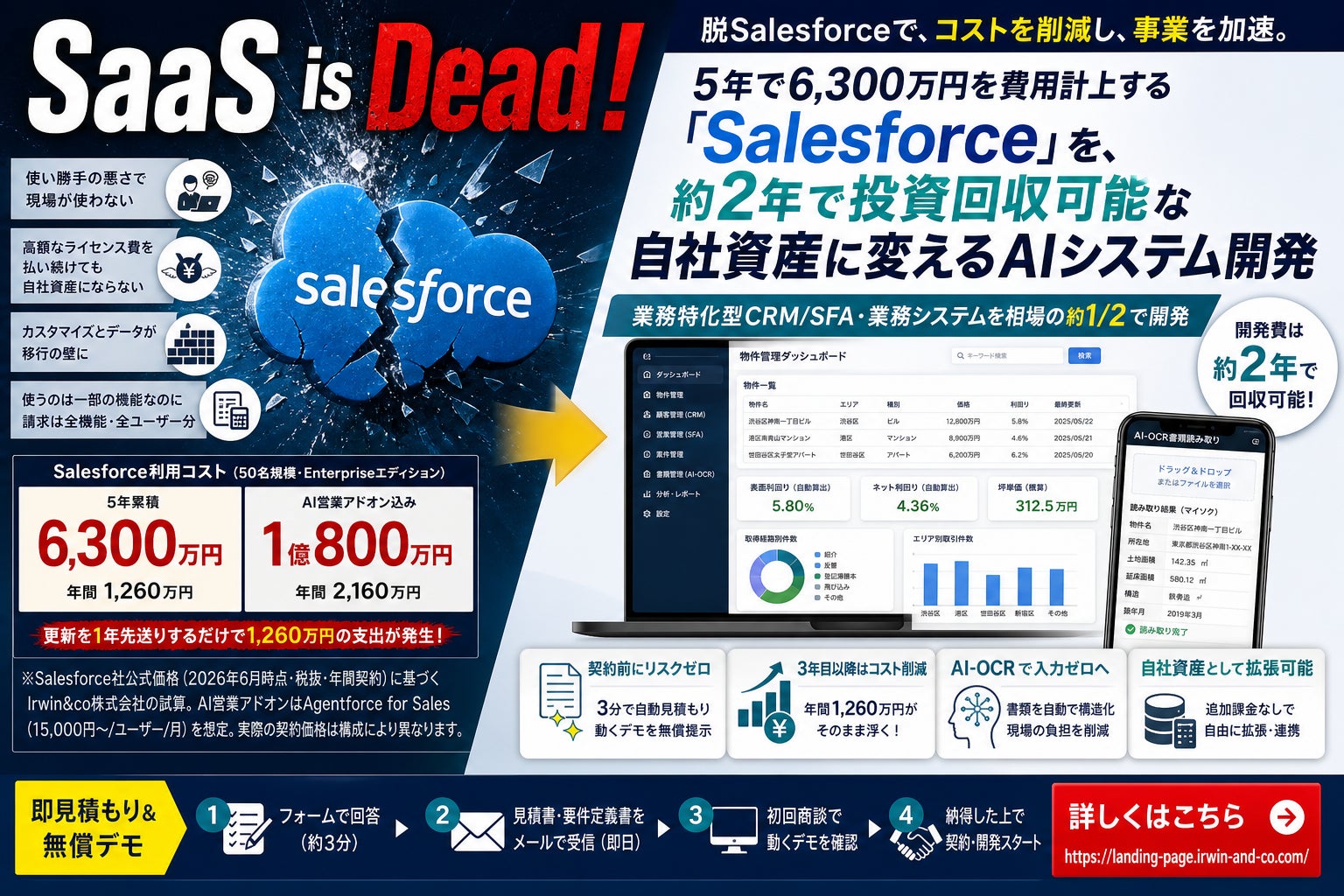
SaaS is Dead
Irwin&co Inc. (Headquarters: Shibuya-ku, Tokyo; CEO: Kai Irwin) announces the launch of a commissioned service to develop in-house, operation-specific CRM/SFA and business systems for companies that have decided to cancel or switch from Salesforce (https://landing-page.irwin-and-co.com/). 'We’ve decided to cancel. But will our operations really run smoothly on the new platform?' Irwin&co offers a new migration approach that eliminates this final concern before contract signing—completely free of charge.
Key Points of This Article (Summary in 30 Seconds)
・'Leaving Salesforce' refers to canceling Salesforce and migrating to a system tailored to a company’s internal operations. An increasing number of companies across industries are making this decision around their contract renewal month.
・Continuing with Salesforce incurs significant costs: for a 50-person team on the Enterprise edition, annual costs reach 12.6 million yen, totaling 63 million yen over five years. Adding the AI Sales Add-on brings the five-year total to 108 million yen (Irwin&co estimate based on Salesforce's published pricing).
・Irwin&co’s Salesforce exit support offers commissioned development of operation-specific CRM/SFA systems at approximately half the market price. Development costs are generally recovered within two years, and from the third year onward, companies save the equivalent of Salesforce’s annual cost (12.6 million yen for 50 users).
・Zero risk before contract signing: a quote and requirements document are automatically generated the same day upon completing a 3-minute form, and a working demo is provided free of charge during the first consultation.
Why 'Leaving Salesforce' Now?—The Growing Trend of Companies Opting Out at Renewal
Conclusion: The primary reasons companies are leaving Salesforce are the high monthly fixed fees and poor usability. Common challenges cited by departing companies include the following, exemplified by a real estate firm:
・Manually entering and re-entering data from sales records, registry transcripts, and property summaries for each property, despite paying high license fees—work remains unchanged from pre-implementation
・Inability to retrieve 'past properties in that area' or 'nearby transaction examples' using operational intuition
・Essential calculations for acquisition decisions—such as unit price per tsubo, route price, and yield—are missing from standard features, forcing a return to Excel—meaning companies pay monthly fees for functionality they end up replicating in Excel
・Property data, customer information, and sales activities (SFA) are fragmented, requiring manual reconciliation
・Only a small fraction of features are used, yet billing covers all features and all users
The pattern remains consistent across industries. While generic SaaS platforms offer '70 points across all industries,' they never fully meet the needs of a company’s unique operations. When considering departure, heavily customized setups and accumulated data become migration barriers, often leading companies to renew unwillingly due to unpredictable exit costs. Amid a global trend declaring 'SaaS is Dead'—a shift from humans operating SaaS to AI executing tasks—Irwin&co presents a viable exit: AI-native in-house systems that become company assets, backed by clear financial justification.
How Much Does Continuing with Salesforce Cost?—63 Million Yen Over 5 Years for 50 Users, Over 100 Million Yen with AI Add-ons
Conclusion: For a 50-user team on Salesforce’s Enterprise edition, annual costs are 12.6 million yen, totaling 63 million yen over five years. Based on Salesforce’s published pricing, the cumulative cost for the Enterprise edition—required for system integration—is as follows※:
Assumed Scale
Configuration
Annual Cost
5-Year Cumulative
50 users
Enterprise
(21,000 yen/user/month)
12.6 million yen
63 million yen
50 users
Enterprise + AI Sales Add-on
(Total 36,000 yen/user/month)
21.6 million yen
108 million yen
30 users
Enterprise
(21,000 yen/user/month)
7.56 million yen
37.8 million yen
For a 50-person company, delaying Salesforce renewal by just one cycle (one year) results in a 12.6 million yen expense. Paying 63 million yen over five years yields zero company asset value. Costs grow further with more employees, and adding AI features exceeds 100 million yen over five years. This is the 'price of delaying departure.' Meanwhile, traditional commissioned development—the intended alternative—forces companies to make million-yen decisions without seeing a working system until after contract and payment, while market rates remain high. This 'damned if you do, damned if you don’t' dilemma has dulled the resolve to leave Salesforce.
Irwin&co’s new service breaks this very structure.
※Irwin&co estimate based on Salesforce’s official website pricing (as of June 2026, excluding tax, annual contract). AI Sales Add-on assumes Agentforce for Sales (15,000 yen and above per user per month). Actual contract pricing varies by configuration.
Three Values Offered by Irwin&co’s Salesforce Exit Support
① Transform monthly 'rented' features into a one-time 'company asset'—Standard integration of operation-specific features unattainable with Salesforce
Conclusion: This service replaces entire domains previously paid for monthly under Salesforce with an in-house system. The key difference from generic SaaS is the ability to model a company’s actual operational structure into the data model.
For example, in the aforementioned real estate firm, the property database is positioned as the core 'box,' with customer data (CRM) and sales activity management (SFA) connected. Acquisition channels (registry transcript, referral, inquiry, cold call, etc.), brokerage type (general/exclusive), and agent/branch information are centrally managed. Automatic calculations for tsubo unit price, route price, leasehold ratio, depreciation (all estimates), gross and net yield, distance-based search against past properties, and bidirectional matching between properties and customers—all features unreachable even with costly customizations in Salesforce—are built in as standard. No additional licenses or add-on fees apply.
② Development cost recovered in ~2 years, saving 12.6 million yen annually from Year 3—Eliminate final Salesforce exit concerns with a free pre-contract demo
Conclusion: Development costs for this service are priced below the two-year Salesforce cost for 50 users (approximately 25.2 million yen), enabling payback within roughly two years. Irwin&co leverages cutting-edge AI tools like Claude and Cursor to double development productivity compared to traditional methods, achieving commissioned development at about half the market rate.
As a one-time purchase, there are no monthly per-user fees, and costs do not increase with headcount. From Year 3 onward, the 12.6 million yen annually (approximately 37.8 million yen by Year 5) that would have gone to Salesforce can be redirected to business investment. Furthermore, before making a decision, completing a 3-minute form instantly generates a quote and requirements document, and a working demo is provided free of charge during the first consultation.
FACT BOX
- Source: PR TIMES
- Category: New Product
- Organizations: Salesforce