A.T. Kearney Co., Ltd. (Minato-ku, Tokyo; Japan Representative: Takeshi Hagayama) has published a perspective paper titled "From Medicines to Everyday Essentials: How Drones Can Revolutionize Logistics," focusing on logistics transformation through Advanced Air Mobility (AAM) and delivery drones.
The paper highlights that while approximately 60% of the global population resides in urban areas, rural communities continue to face challenges in accessing essential services such as healthcare. In this context, small delivery drones can serve as an efficient link between urban and rural areas.
For drone logistics implementation, an integrated operational model is key: leveraging medical deliveries to build social acceptance, then utilizing lower-urgency e-commerce deliveries to absorb excess capacity. In California, the annual market potential for drone-enabled medical deliveries is estimated at approximately $275 million, while the broader e-commerce market reaches $7 billion—25 times larger—underscoring the importance of combining both for scalability.
Approximately 60% of the global population lives in cities, and small drones are poised to lead logistics transformation
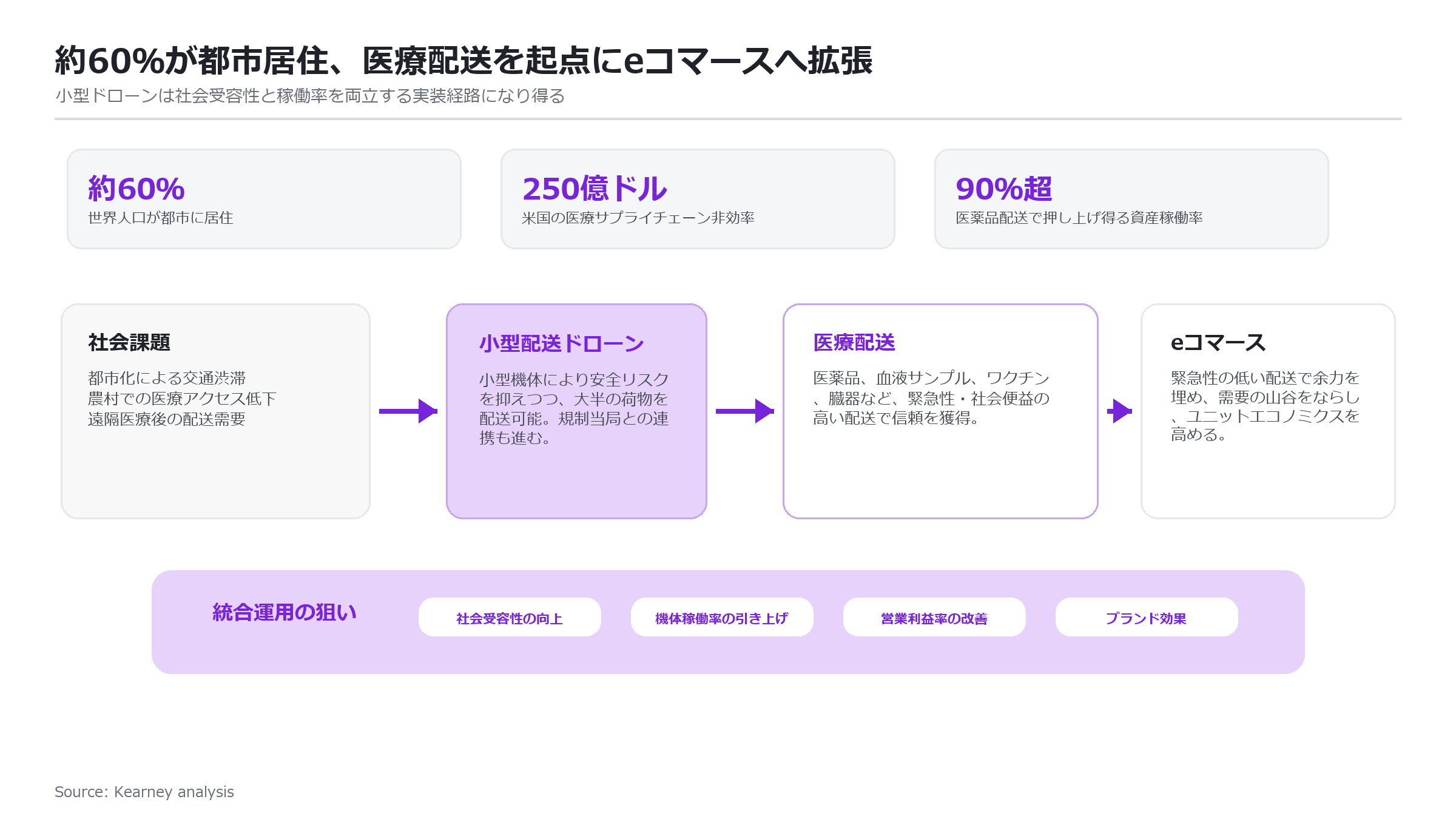
Currently, about 60% of the world’s population lives in urban areas, a significant increase from just one-third 60 years ago, indicating rapid urbanization. While urban growth contributes to economic development and educational opportunities, it also leads to traffic congestion and infrastructure strain. Meanwhile, rural areas facing population decline struggle with access to healthcare and other services.
To address these challenges, Advanced Air Mobility (AAM), including electric vertical takeoff and landing aircraft (eVTOLs) and delivery drones, has the potential to first transform logistics and later passenger transport. In particular, small drones, due to their compact size and lower safety risks, are well-suited to carry the majority of goods and are likely to lead the way in cargo delivery.
Small drones have already demonstrated their ability to deliver high-priority items such as medical supplies, spare parts, and time-sensitive documents. The next challenge lies in expanding these use cases to e-commerce, smoothing out demand fluctuations, and simultaneously achieving social acceptance and unit economics.
Figure 1: Approximately 60% urban population; expanding from medical to e-commerce delivery
In California, e-commerce is 25 times larger than healthcare—integrated operations are key to scaling
The rationale for combining medical and e-commerce drone delivery is evident in market size differences. The paper uses California—a promising market for AAM—as a case study, estimating the state’s annual market potential for drone-enabled medical delivery at approximately $275 million. In contrast, the overall e-commerce market is $7 billion, 25 times larger than medical delivery.
California is considered highly promising for AAM due to its high traffic density, relatively low safety risks from over-water flight routes along the coast, and the presence of 20 operational organ transplant hospitals. Medical deliveries, which can save or significantly improve lives, command high cargo value and delivery prices. However, they also come with stricter service expectations, such as cold chain requirements and hazardous material classifications.
Nevertheless, since payload capacity and range requirements for medical and e-commerce deliveries are similar, fleet pooling is feasible. For example, vaccines and documents weigh under 100 grams, while organs and appliances weigh several kilograms; urban deliveries cover 5 kilometers, while remote community deliveries extend up to 300 kilometers—offering opportunities for cross-use operational design.
Figure 2: E-commerce market in California is 25 times larger than medical delivery
Four healthcare areas and five principles: Balancing social acceptance and profitability
In healthcare, drone delivery presents opportunities in four areas: pharmaceutical delivery, urban transport of blood samples and vaccines, remote community transport of blood samples and vaccines, and organ transport for transplantation. Pharmaceutical delivery, with higher-order frequency, could push asset utilization rates above 90%. However, in areas with high pharmacy density, demand may be insufficient to ensure economic viability.
Organ transport for transplantation faces extremely tight time constraints. Large transplant centers may spend $10,000 to $40,000 per charter flight for organ transport. Replacing some of these flights with drones, where range permits, could reduce costs and provide a competitive advantage for healthcare providers. However, challenges remain, including insurance costs, safety data, and the need for several hundred kilometers of range.
The paper suggests that operators providing drone services for both medical and general e-commerce could achieve higher aircraft utilization rates (currently around 75% in advanced cities), improved operating margins, and brand benefits from high social-impact missions. Five principles are critical for implementation: start small, choose markets wisely, collaborate early with ecosystem stakeholders, schedule deliveries intelligently, and add rapid charging stations.
Figure 3: Opportunities and challenges across four areas; five principles to accelerate implementation
About the Paper
Title: "From Medicines to Everyday Essentials: How Drones Can Revolutionize Logistics"
URL: https://www.jp.kearney.com/issue-papers-perspectives/from-medicines-to-everyday-essentials-how-drones-can-revolutionize-logistics
Supervised by
Takahiro Sakiyama, Senior Partner
Core member in automotive, manufacturing, defense, and aerospace sectors. Focuses on business strategy and transformation centered on product planning, development, and supply chain. With extensive international experience, he leads projects in both English and Japanese. He has supported numerous Japanese clients across Japan, North America, and Europe, focusing on enhancing Japan’s national strength and international competitiveness. Previous roles include business development (in Japan and China) and supply chain transformation at other consulting firms and major trading companies.
About A.T. Kearney
A.T. Kearney (global brand name: Kearney) has been a trusted partner to Fortune Global 500 companies—over three-quarters of which are clients—and government agencies worldwide for over 100 years as a leading global management consulting firm. With a presence in over 40 countries, our greatest strength lies in our people. Committed to impact-first, we tackle our clients’ most complex challenges with innovative thinking and execution, driving transformative change together. Established in Japan in 1972, we provide end-to-end support to leading companies across all major industries, from strategy formulation to execution. For more information, visit our website: www.jp.kearney.com
FACT BOX
- Source: PR TIMES
- Category: Survey