A research group led by Hana Nopia (Doctoral student), Assistant Professor Masahiro Kimura, Daisuke Kurimoto (Completed Doctoral Program), and Professor Jun Sato from the Graduate School of Bio-Media and Technology at Tokyo University of Technology (Hachioji City, Tokyo; President: Yutaka Kagawa) has discovered that a fusion protein of human lactoferrin (hLF, Note 1) and human serum albumin (HSA), termed hLF-HSA, potently inhibits migration (cell movement), which is closely related to cancer cell metastasis. This inhibition is achieved by promoting the expression of Na+/H+ exchanger 7 (NHE7, Note 3) expressed in the Golgi body (Note 2), leading to its alkalinization and activating caveolin-dependent endocytosis signals, which are intracellular uptake signals. This finding is expected to lead to the development of new drug discovery strategies. The research results were published in the international scientific journal 'FEBS Open Bio' by the Federation of European Biochemical Societies (FEBS) on March 24, 2026. The development of biopharmaceuticals using hLF is being advanced by the bio-venture company S&K Biopharma Co., Ltd. (Note 4).
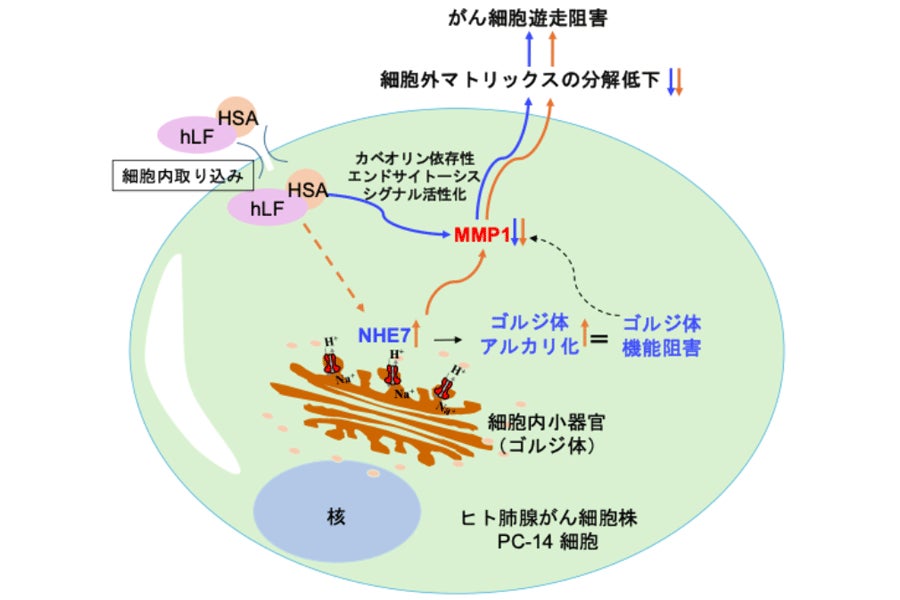
【Research Background】 Cancer metastasis is a critical clinical challenge that affects patient prognosis, and cancer cell migration (cell movement) is a crucial step in metastasis. Matrix metalloproteinase 1 (MMP1) is an enzyme that degrades the extracellular matrix and plays an important role in cancer cell migration. Previous research by the same group reported that hLF-HSA treatment reduces MMP1 expression in the human lung adenocarcinoma cell line PC-14, thereby inhibiting migration (Reference 1). This study revealed that the reduction in MMP1 expression by hLF-HSA treatment is due to the disruption of Golgi body pH homeostasis (functional impairment) mediated by the promotion of NHE7 expression, which is expressed in the intracellular organelle (Golgi body), and by caveolin-dependent endocytosis signals activated during the intracellular uptake of hLF-HSA.
【Social and Academic Significance】 The Golgi body plays an extremely important role in cell migration, and its dysfunction due to the disruption of pH homeostasis is expected to be effective in inhibiting cancer cell migration. In this study, hLF-HSA disrupted Golgi body pH homeostasis and caused its functional impairment by promoting the expression of NHE7, which is expressed in the Golgi body. This functional impairment reduced the expression of MMP1, which plays a crucial role in cancer cell migration, and inhibited migration. Furthermore, it was revealed that caveolin-dependent endocytosis signals, activated during the intracellular uptake of hLF-HSA, lead to a reduction in MMP1 expression independently of the aforementioned effect on NHE7. Through these two mechanisms, hLF-HSA potently inhibits cancer cell migration. Considering the function of the Golgi body in normal cells, hLF-HSA may potentially cause side effects in normal cells. However, it has been clarified that hLF-HSA selectively inhibits the proliferation of cancer cells while having no effect on the proliferation of normal cells (Reference 2). Therefore, the hLF-HSA in this study is noteworthy as an example demonstrating the effectiveness of a drug development concept targeting Golgi body functional impairment for inhibiting cancer cell migration. Figure: Mechanism of hLF-HSA-mediated inhibition of cancer cell migration
【Publication Information】 Paper Title: Suppression of lung adenocarcinoma migration through organelle alkalization by human lactoferrin – albumin fusion Authors: Hana Nopia, Masahiro Kimura, Daisuke Kurimoto &
FACT BOX
- Source: PR TIMES
- Category: News