LiKG Co., Ltd. (Headquarters: Shibuya-ku, Tokyo; CEO: Kondo Mitsuo) conducted a survey of 200 freelancers on the real-world impact of generative AI on income changes. As AI adoption rapidly spreads in freelance work, the survey examined what changes are occurring in income and working styles.
The results revealed that while generative AI has led to significant reductions in working hours, it does not necessarily translate into increased monthly income.
Generative AI adoption exceeds 60%, now the majority
When asked, "Are you currently using generative AI in your work?", 24% responded "using it daily", 20% "using it in some tasks", and 17.5% "have tried it but not continuing". Those consistently using AI totaled 44.5%, and including trial users, over 60% have experience using generative AI in their work.
Most users report reduced working hours after AI adoption
The most significant change observed from generative AI adoption was "reduction in working hours."
Efficiency improvements were particularly notable in research, information organization, and drafting—tasks where freelancers previously invested significant time—leading to clear productivity gains. As a result, simple production tasks are becoming more prone to price competition, increasing the importance of upstream processes such as "planning ability," "proposal skills," "specialized knowledge," and "client understanding."
Moreover, AI-driven efficiency suggests a transformation in work styles, enabling freelancers to handle multiple projects in less time or expand their service offerings.
When asked 124 AI users how their per-project working time changed before and after AI adoption, 17% reported "significantly decreased (over 50% reduction)" and 44% "slightly decreased (20–50% reduction)." A total of 62% reported a reduction of 20% or more in working time, indicating widespread penetration of AI-driven efficiency gains.
AI use is particularly prevalent in information gathering and research (69%), planning and structure design (25%), and writing (21%), primarily streamlining tasks related to research, drafting, and organization.
Only 16% report income growth—efficiency doesn't directly lead to higher income
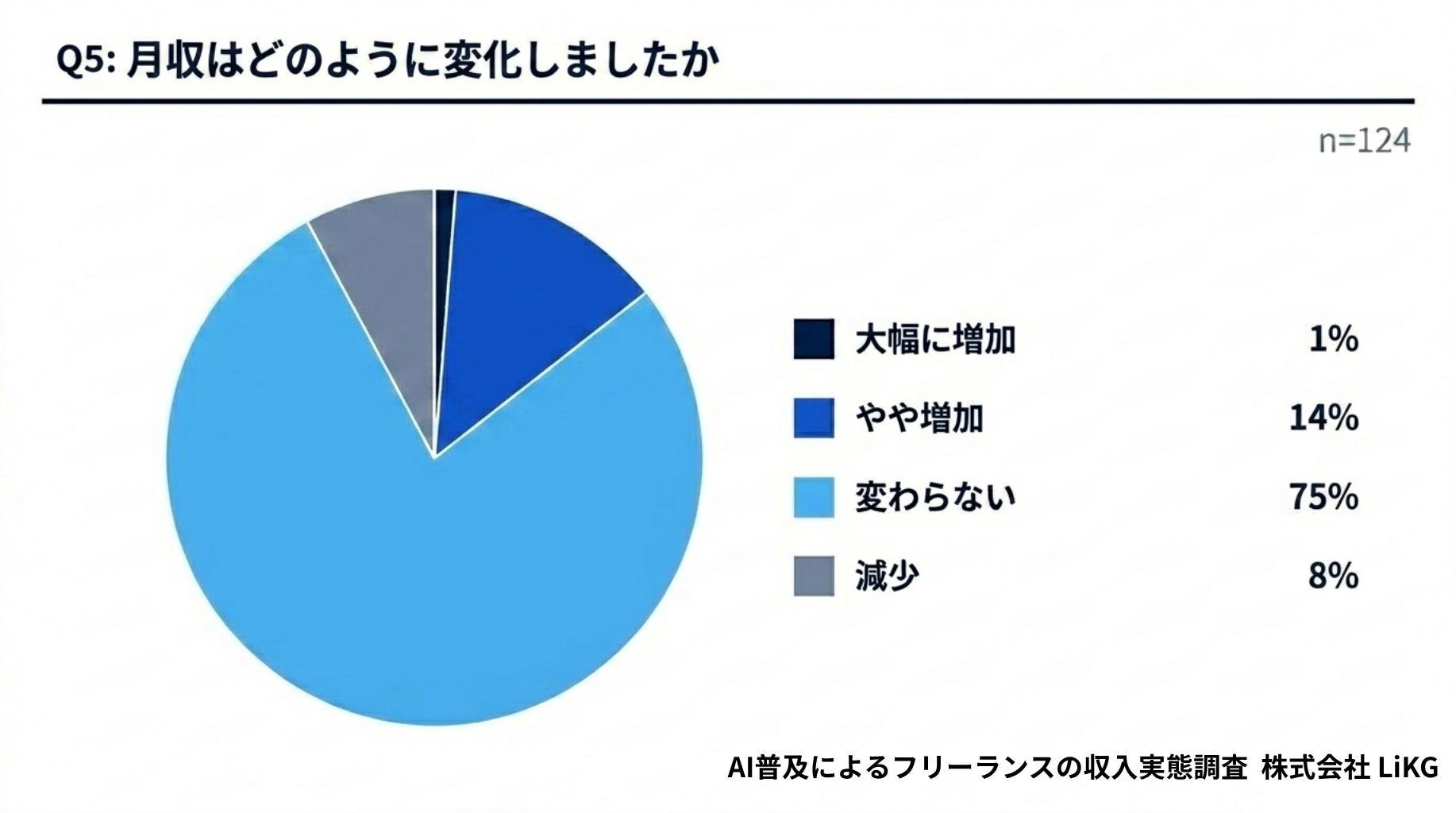
When asked, "How has your monthly income changed?", 1.61% said "significantly increased," and 14.52% said "slightly increased," totaling 16.13% who experienced income growth. In contrast, 75.81% said "no change," the highest proportion, and 8.06% said "decreased."
A key finding of this survey is that despite reduced working hours, income has not significantly increased. While higher productivity is generally expected to lead to higher income, in the actual freelance market, freed-up time does not automatically translate into additional income. Possible reasons include:
Limited overall supply of available projects
Increased competition due to easier market entry enabled by AI, leading to price wars
Prevalence of fixed-price contracts rather than hourly billing
In particular, for roles such as content creation, writing, and design—where deliverables are evaluated—"faster completion" may directly lead to downward pressure on pricing.
Conversely, areas involving client communication and decision-making—such as sales, proposals, direction, and strategic planning—remain highly dependent on human expertise, leaving room for monetization.
When asked about monthly income changes, 1% reported "significantly increased" and 14% "slightly increased," totaling 16% who felt their income had grown.
Additionally, only 23% reported an increase in the number of monthly projects handled, while 71% said "no change." This suggests that even though AI reduces working hours, the surplus time does not necessarily lead to acquiring additional projects.
Income-growth group shifts to upstream work
When 20 freelancers who experienced income growth (n=20) were asked for reasons, the most common responses were "increased number of projects handled / secured high-value projects" (40%) and "increased involvement in upstream tasks" (40%).
There is a clear trend that those who expanded their roles into upstream tasks such as "planning, proposals, and direction" are more likely to see income growth, beyond mere work efficiency.
This survey found that the common trait among those who increased income through AI use was not "faster simple tasks," but rather a "shift in role." Specifically, those who expanded their work scope into upstream processes—such as strategic planning, client negotiation, and direction—were more likely to see income gains. Those who successfully shifted their value proposition upstream, rather than treating AI as merely a "time-saving tool," are better positioned to convert AI benefits into income growth.
For those whose income decreased, "declining project rates" emerged as a major issue. This is not solely due to economic conditions; a trend of reevaluating prices based on reduced labor hours is also beginning.
Therefore, in the future, simply being able to produce deliverables will no longer be sufficient for differentiation. The ability to shift value toward specialization, problem-solving skills, and continuous improvement proposals will become crucial.
Freelancers in the AI era must move beyond being mere "doers"
The results also show that a certain number of respondents reported increased anxiety due to AI adoption, indicating growing concerns about whether their skills and value can be sustained.
Moving forward, the key question will not be "whether to use AI," but rather "what value can you provide in an AI-driven market?" This will become a critical factor shaping freelancers' income and careers.
Survey Overview
Survey Period: May 12–13, 2026
Survey Method: Online survey
Target: Freelancers (full-time and part-time)
Valid Responses: 200
*Note: Percentages are rounded to the nearest tenth, so totals may not add up exactly to 100%.
When quoting or republishing this release, please credit "LiKG Co., Ltd." and include the URL of this press release.
FACT BOX
- Source: PR TIMES
- Category: Survey