Asahi University Marketing Institute (Director: Chihiro Nakahata), an affiliated research institution of Asahi University (Mizuho City, Gifu Prefecture), conducted a survey on rice consumption.
Background of the Survey Amidst labor shortages and rising costs, the retail price of rice has been soaring. The price increase has been substantial, leading many to consider or implement countermeasures. This survey was conducted to understand the actual impact of these price hikes on rice consumption behavior and whether people are moving away from rice.
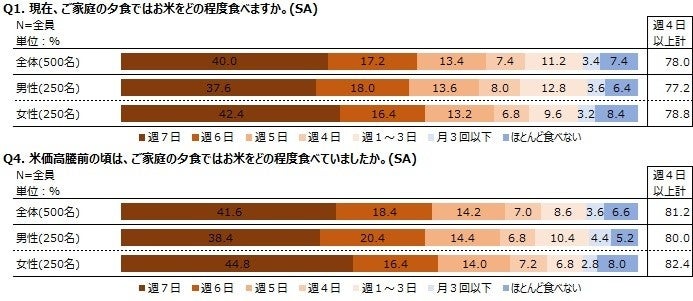
Key Findings of the "Survey on Rice Consumption - Impact of Soaring Prices on Rice Eating Habits" ■ Rice prices have soared, but the frequency of eating rice for dinner has not significantly changed When comparing the proportion of people who eat rice "4 days or more per week" for dinner before and after the price surge, it was 81.2% before and 78.0% after. This is a decrease of 3.2 percentage points, which is not a significant change. The proportion of people eating rice "7 days a week" for dinner also remained at a similar level before (41.6%) and after (40.0%) the price increase. Despite the soaring prices, it appears that many people consider rice indispensable to their meals, leading to no substantial change in consumption frequency at this point.
The proportion of people whose staple food for dinner is rice has also not changed significantly Comparing the proportion of people who choose rice as their staple food for dinner before and after the price surge, the difference was only slight: 85.8% before and 86.2% after. Even with the price increase, rice continues to maintain its role as the staple food for dinner.
Women were more likely to use alternative ingredients to rice In response to the soaring rice prices, the most frequently consumed alternative ingredients were "soba, udon, somen, hiyamugi" (41.2%), followed by "pasta" (32.2%), "bread" (28.2%), and "ramen, Chinese noodles" (25.8%). The proportion of women who consumed these alternatives was higher than that of men. This trend was also observed for other categories such as "pizza" and "beans, barley, grains, potatoes." On the other hand, a larger proportion of men responded "none in particular" when asked about increased consumption of alternative ingredients (Men: 42.4%, Women: 36.0%). In the current situation of soaring rice prices, while women are trying to use alternative ingredients, men have shown a more passive stance. Notably, men aged 60-69 had a lower frequency of rice consumption even before the price surge and were less likely to consider rice as a staple food. Currently, it appears that age has a greater influence on rice consumption patterns than price.
<div class="pr
FACT BOX
- Source: PR TIMES
- Category: research