Asahi University Marketing Research Institute (Director: Chihiro Nakahata), an affiliated research institution of Asahi University (Mizuho City, Gifu Prefecture), conducted a survey on rice consumption.
Amidst labor shortages and rising costs, the retail price of rice has been soaring. The price increase has been substantial, leading more people to take or consider taking measures. This survey was conducted to understand the impact of these changes on rice consumption behavior and whether people are moving away from rice.
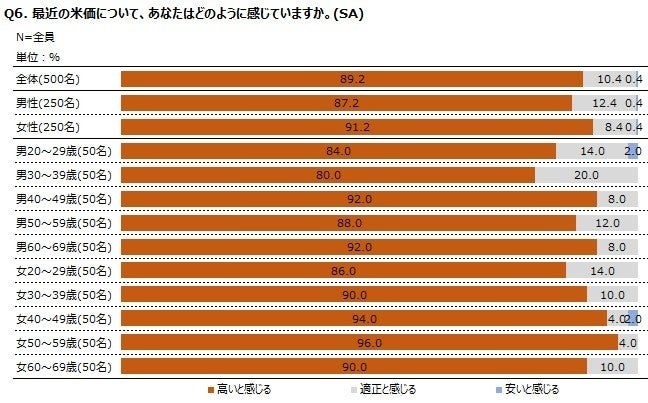
Key Findings of the "Survey on Rice Consumption - Changes in Attitudes Towards Rice" ■ 90% Perceive Recent Rice Prices as High Regarding recent rice prices, an overwhelming 89.2% felt that prices were "high." Only about 10.4% found them "appropriate," and a mere 0.4% considered them "cheap." Rice prices have reached a level where the majority perceive them as high. While there were no significant variations by gender or age, the proportion of women (91.2%) who felt prices were high was 4 points higher than men (87.2%). This perception was particularly strong among women aged 50-59 (96.0%) and 40-49 (94.0%), indicating a strong sense of high prices, especially among housewives.
Majority Accept Foreign Rice In response to soaring rice prices, only 24 respondents (4.8%) increased their frequency of eating foreign rice. However, evaluations of foreign rice were largely positive, with 54.2% "satisfied" and 37.5% "neither satisfied nor dissatisfied." Only 8.3% were "dissatisfied." Over 90% expressed acceptance, with clear dissatisfaction below 10%. Although the number of people eating more foreign rice is currently small, their share is expected to increase if rice prices continue to rise. Consequently, more people who previously avoided foreign rice based on image alone will have opportunities to try it. Given that the majority accept it, it is likely that many consumers will form different opinions of foreign rice through actual consumption. Foreign rice is likely to become a viable option. The current market environment of soaring rice prices, which promotes the consumption of foreign rice, poses a significant threat to Japanese rice.
Over 70% Wish to Continue Current Eating Habits Even if Rice Prices Decrease When asked about their intention to consume rice in a future scenario where rice prices decrease, 72.6% responded "I think it will be about the same." Approximately 70% wish to continue their current habits. In contrast, 18.6% believe their rice consumption will "increase," 5.0% "decrease," and 3.8% "don't know." A majority of consumers wish to maintain the eating habits they adopted during the period of high rice prices. While some changes were observed in the survey, such as increased consumption of foreign rice or choosing non-rice options for lunch, most consumers do not intend to revert to their previous habits. It is highly likely that demand for domestic rice will remain low unless measures are taken to communicate the value and appeal of choosing Japanese rice as a staple, beyond simply waiting for prices to drop. It is necessary to implement strategies to prevent its role from being usurped by foreign rice or other ingredients.
Through This Survey An examination of changes in attitudes towards rice in response to recent price hikes revealed that a majority, particularly housewives, perceive prices as "high." Although less than 10% have increased their consumption of foreign rice, over 90% rated it as "satisfied" or "neither satisfied nor dissatisfied." Furthermore, over 70% of respondents indicated a desire to continue their current eating habits, which were established during the period of high rice prices, even if prices decrease in the future. While it is uncertain when rice prices will fall, if the current situation persists, consumer behavior favoring foreign rice and other ingredients will likely increase. It is crucial to communicate the value and appeal of choosing domestic rice as a staple, rather than using price as an excuse.
Survey Details "Survey on Rice Consumption - Changes in Attitudes Towards Rice" ■ Survey Period: December 15, 2025 (Monday) - December 22, 2025 (Monday) ■ Survey Method: Internet survey using the Asahi University Marketing Research Institute's panel. ■ Target Audience: Nationwide residents Age: 20s, 30s, 40s, 50s, 60s Gender: Male, Female ■ Number of Responses Collected: 500 Survey data can be found here: ➡ http://marketing.asahi-u.ac.jp/wp-content/uploads/2026/03/202603.pdf The Marketing Research Institute independently conducts "Topics Research" on trending services, consumer trends, and emerging societal movements, and widely publishes the data on its portal site as a data repository. Additionally, to smoothly respond to market research requests from companies, it maintains a system that provides access to monitors nationwide, including the Tokyo metropolitan area and the Tokai region. ■ Name: Public Research Data ■ Research Reports: Over 200 ■ Details: http://marketing.asahi-u.ac.jp/data/
About Asahi University Marketing Research Institute 【Company Profile】 Headquarters: 1851 Hozenji, Mizuho City, Gifu Prefecture Director: Chihiro Nakahata (Professor, Faculty of Business Administration) Business Activities: Analysis and research of consumer behavior, management consulting, marketing research, product development support, lectures and seminars for working adults, etc. Established: April 2002 HP: http://marketing.asahi-u.ac.jp/
FACT BOX
- Source: PR TIMES
- Category: Survey