MM Souken Co., Ltd. (Headquarters: Shinjuku-ku, Tokyo; CEO: Haruhiro Hagiwara), a marketing company that supports the digital shift in sales and marketing, operates 'Marucari NEXT CAREER,' a recruitment agency specializing in SaaS sales. They conducted a survey titled 'The Limits of Conventional Models and the Next Evolution Suggested by SaaS is Dead' targeting executives, managers, and those involved in business strategy and promotion at SaaS companies.
The survey revealed that while many SaaS companies are maintaining growth, they are moving away from traditional, uniform expansion models and diversifying their next growth strategies, such as vertical expansion and RevOps promotion.
<Survey Background>
'SaaS is Dead'
In recent years, this phrase, pointing to the limits of past rapid growth models, has been causing a stir in the market.
Rising customer acquisition costs (CAC) and accelerated churn due to customer selection. Furthermore, the emergence of AI, which fundamentally changes the business environment.
With the 'formula for success' no longer applicable, the SaaS industry is being called upon to evolve not just its features but its business model itself.
How will the SaaS industry perceive this 'transition period' and what next growth strategies are they envisioning?
<Survey Results Summary>
- Over half of SaaS companies maintain over 10% annual growth
- Approximately 80% feel the 'limits of conventional SaaS growth models'
- Higher growth companies tend to have a higher rate of RevOps implementation
- AI utilization, vertical expansion, and evolution towards performance-based models are the main drivers of future growth
- The SaaS market is not declining but entering a 'second growth phase' with maturity
The full survey results can be viewed below.
View Details
Not 'SaaS is Dead,' but 'The Limits of Conventional Models.' Despite steady numbers, why do about 80% feel growth hurdles?
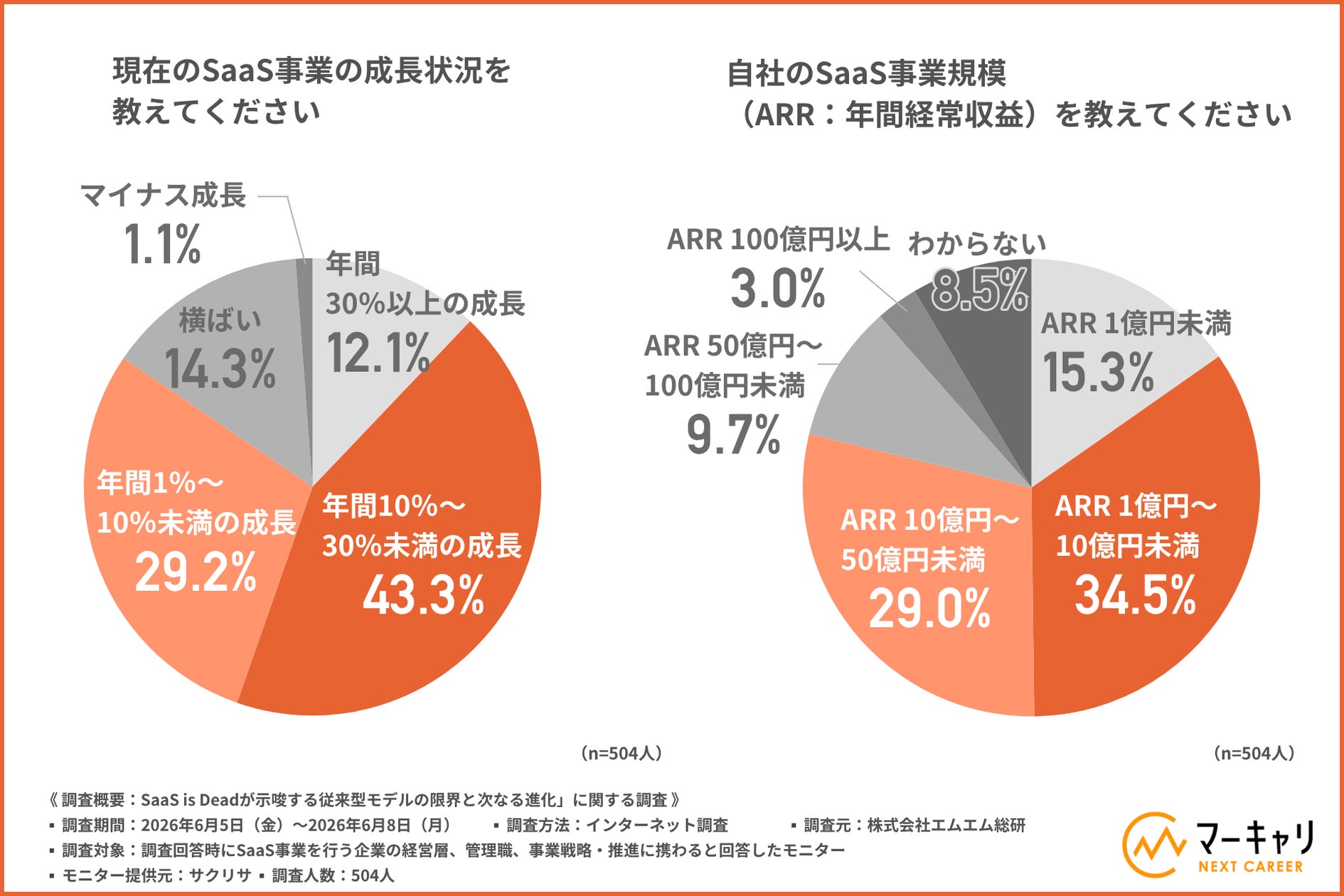
First, when asked about 'the current growth status of SaaS businesses,' the following results were obtained:
'Over 30% annual growth (12.1%)'
'10% to less than 30% annual growth (43.3%)'
'1% to less than 10% annual growth (29.2%)'
'Stagnant (14.3%)'
'Negative growth (1.1%)'
Even in a market environment where 'SaaS is Dead' is whispered, over half of the companies maintain 'over 10% annual' growth, indicating an overall growth trend.
On the other hand, a certain number of companies remain at 'less than 10%' or 'stagnant,' suggesting a potential polarization between those driving growth and expanding scale, and those experiencing sluggishness.
Next, when asked about 'the scale of their SaaS business (ARR: Annual Recurring Revenue),' the following results were obtained:
'Less than 100 million yen ARR (15.3%)'
'100 million yen to less than 1 billion yen ARR (34.5%)'
'1 billion yen to less than 5 billion yen ARR (29.0%)'
'5 billion yen to less than 10 billion yen ARR (9.7%)'
'10 billion yen or more ARR (3.0%)'
'Don't know (8.5%)'
Approximately 60% of the total were concentrated in the mid-tier zone of '100 million yen to less than 5 billion yen ARR.'
SaaS companies of this scale are presumed to have already achieved initial product-market fit (PMF) and established a certain customer base as a business.
In such a context, how do they perceive the trend of 'SaaS is Dead,' which sounds an alarm against the previously upward-trending growth?
When asked 'To what extent do you feel the trend of 'SaaS is Dead,' which points to growth hurdles and other issues in the current SaaS market?', approximately 80% responded 'Strongly feel it (feel growth hurdles and the severity of the business environment) (22.8%)' and 'Somewhat feel it (feel that growth is more difficult than before) (57.9%).'
It became clear that the majority recognize that the conventional SaaS growth model, based on 'quantitative expansion,' is reaching its limits.
Considering the reality that over half of the companies showed over 10% annual growth in the previous question, there appears to be a gap between performance and on-the-ground awareness.
So, what do they consider to be the specific reasons?
When asked 'What do you consider the biggest factor for 'SaaS is Dead'?', the most common answer was 'Deterioration of existing customer churn rate and decline in LTV (Customer Lifetime Value) (28.4%),' followed by 'Rising new customer acquisition costs (CAC) (23.8%)' and 'Disruption of existing business models by new technologies such as AI (18.7%).'
It is evident that fluctuations in the revenue base, such as 'deterioration of existing customer churn and decline in LTV (Customer Lifetime Value),' are recognized as the biggest factors hindering SaaS business growth.
Next, 'rising new customer acquisition costs (CAC)' was mentioned, highlighting the fact that conventional customer acquisition models dependent on marketing investment are reaching their limits.
Furthermore, 'disruption of existing business models by the emergence of new technologies such as AI' was ranked highly. While the rise of AI is a threat to conventional business models, it can also be a variable that provides a strong competitive advantage if adapted quickly.
It is believed that the SaaS industry is now being tested on its speed of response to rapid changes in the external environment.
In response to these market changes, what are the challenges in business operations?
When asked 'What is the biggest challenge in current SaaS business operations?', the most common answer was 'Incorporating the latest technologies such as AI into products (26.6%),' followed by 'Improving productivity in marketing and sales (21.2%)' and 'Strengthening customer success and maximizing LTV (Customer Lifetime Value) (18.7%).'
'Incorporating the latest technologies such as AI' was also cited as the biggest challenge in business operations.
It can be said that how quickly AI can be integrated into proprietary products and how customer value can be updated are crucial keys to future growth.
Next, improvements in the productivity of customer-facing operations such as marketing, sales, and customer success were listed, revealing that alongside product evolution, the efficiency of revenue-generating processes is also being demanded.
About 60% of high-growth companies have already implemented it. 'RevOps,' the turning point for growth, and organizational silos that hinder growth.
Amidst challenges in improving productivity and maximizing LTV (Customer Lifetime Value), what kind of organizational structures do high-growth companies have?
When asked 'What is the current collaboration structure between your company's marketing, sales, and customer success (CS) departments?', the following results were obtained based on the current growth status of SaaS businesses:
Among companies achieving over 30% annual growth, about 60% have already established a 'RevOps system.'
There is a trend that the higher the growth rate, the higher the implementation rate of RevOps.
On the other hand, companies with lower growth rates or stagnant growth have a higher proportion of 'starting data and process collaboration between some departments' or 'each department operates independently and does not collaborate or integrate (conventional division of labor system).'
These results indicate that high-growth companies are making company-wide optimal efforts across marketing, sales, and customer success, and are moving away from the conventional division of labor system.
What are the challenges in promoting collaboration between departments (marketing, sales, CS), and what strategies will be most focused on by growth rate?
The full survey results can be viewed below.
View Details
<Second Growth Phase Strategies> AI Utilization, Verticalization, RevOps. What is the SaaS Market's 'Next Move'?
Finally, when asked 'What form do you think SaaS value proposition will evolve into in 5 years?', the most common answer was 'Providing business outcomes that directly commit to customer KPIs (performance-based fees, etc.) (28.8%),' followed by 'Providing specialized know-how and consulting deeply tailored to specific industries or issues (28.2%)' and 'Providing labor that autonomously handles customer operations (AI agents, etc.) (17.9%).'
It is predicted that the SaaS value proposition will shift from merely making software 'available' to guaranteeing customer 'outcomes.'
Furthermore, it became clear that deeper involvement in customer businesses is required, such as 'providing specialized know-how' and 'autonomous handling of operations by AI agents.'
SaaS providers are expected to increasingly take on the role of business partners for their customers, moving beyond the position of tool providers.
Conclusion: A Transition Period from the Conventional 'Quantitative Expansion' Model - SaaS Companies Move to the Next Phase
This survey revealed that while many SaaS companies are maintaining a certain level of growth, they are also looking towards 'breaking away from and updating' their conventional business models.
Against the backdrop of factors such as deteriorating churn rates and rising customer acquisition costs, approximately 80% of companies felt the 'limits of the conventional SaaS growth model.'
The 'quantitative expansion' model, which used to involve acquiring a large number of leads through marketing investment and selling a single product broadly, is at a turning point.
Furthermore, while about 60% of companies achieving over 30% annual growth have already established a 'RevOps system' that integrates customer touchpoint data and processes, companies with lower growth rates remain in a conventional division of labor system.
Building a foundation of 'execution capability' through a strong collaborative structure is essential, and the next step is to evolve the value proposition to customers.
SaaS initially began with 'providing tools' to improve operational efficiency, and then evolved into entities that support the entire customer business process.
Moving forward, SaaS companies are required to evolve into 'outcome-generating' entities that not only provide features but also delve into creating business results such as increased customer sales and improved productivity, and commit more deeply to solving industry-specific issues and achieving business KPIs.
It's not that 'SaaS is Dead,' but rather that the era of tool-providing SaaS has matured, and it is transitioning to a new phase of value creation.
Redefining one's strengths and expanding the value provided to customers from features to outcomes will be an important theme for SaaS companies to draw their second growth curve.
The full survey results can be viewed below.
View Details
For support with転職 (career change) to a SaaS company, use 'Marucari NEXT CAREER'
MM Souken Co., Ltd., which conducted the survey 'The Limits of Conventional Models and the Next Evolution Suggested by SaaS is Dead,' operates 'Marucari NEXT CAREER' (https://next.mar-cari.jp/), a recruitment agency specializing in SaaS sales.
What is 'Marucari NEXT CAREER'?
In a dramatically changing business environment, including the spread of generative AI and further acceleration of digital transformation (DX), the role of sales professionals is also undergoing significant transformation.
With the advancement of digitalization, sales and marketing organizations have become specialized into marketing, inside sales, field sales, and customer success, leading to the 'specialization' of sales roles in various forms.
In response to these trends, 'Marucari NEXT CAREER' was established with the aim of providing an optimal platform for job seekers and companies to connect, enabling sales professionals, who previously could only advance their careers by becoming managers or getting promoted, to succeed in 'next-generation careers.'
The recruitment agency service of 'Marucari NEXT CAREER' offers free support from career advisors specializing in corporate sales, particularly in career development within SaaS and venture companies, facilitating a smooth job search.
Features of 'Marucari NEXT CAREER'
1. Career registration allows you to inventory your skills
By registering with Marucari, you can register and manage diverse information such as your career history, experience, skills, languages, and qualifications.
2. Discover your aptitude and potential through career consultations
In consultations, we diagnose your aptitude for next-generation careers based on your work experience and desired work style. You can also receive advice for転職 (career change) and career advancement.
3. We introduce job openings primarily for SaaS companies, specializing in 4 job types.
Based on the information gathered during your career consultation, we will introduce job openings that fit you. Aim for your next career by applying to next-generation sales organizations specialized in marketing, inside sales, field sales, and customer success. Our specialized career advisors will listen attentively to even your minor concerns regarding転職 (career change).
View Details
'Marucariplus,' a service supporting career advancement転職 (career change) for current SaaS sales professionals
'Marucariplus' is a転職 (career change) service specializing in supporting career advancement within the industry for current SaaS workers. We support career design with a view to several years ahead and the best転職 (career change) to achieve it, based on your desired conditions such as salary, position, job type, skills, work style, and culture, as well as your future vision.
Service Features
1. Support for optimal career development
We support career design and転職 (career change) that leads to career advancement, considering how to build your career in the SaaS industry.
2. Unique company selection support tailored to positions
Based on information obtained through independent interviews with each SaaS company, we identify positions and provide selection support to help you achieve your desired career.
3. Extensive track record of転職 (career change) support with deep industry knowledge
We thoroughly manage schedules and negotiate conditions to ensure efficient job searching, even while working, to support your転職 (career change).
Reserve a free career consultation
Marucari NEXT CAREER: https://next.mar-cari.jp/
Marucariplus: https://next.mar-cari.jp/plus/
Inquiries about Marucari: https://mmsouken.satori.site/contact-marcari
MM Souken Co., Ltd.: https://www.mmsouken.co.jp/
Inquiries URL: https://www.mmsouken.co.jp/contact/service/
Inquiries TEL: 03-4530-4700 (Main)
Survey Overview: Survey on 'The Limits of Conventional Models and the Next Evolution Suggested by SaaS is Dead'
[Survey Period] June 5, 2026 (Fri) - June 8, 2026 (Mon)
[Survey Method] Internet survey conducted by PRIZMA (https://www.prizma-link.com/press)
[Number of Respondents] 504 people
[Survey Target] Monitors who responded that they are executives, managers, or involved in business strategy/promotion at SaaS companies at the time of survey response.
[Survey Source] MM Souken Co., Ltd. (https://www.mmsouken.co.jp/)
[Monitor Provider] Sakurisa
FACT BOX
- Source: PR TIMES
- Category: Survey結果