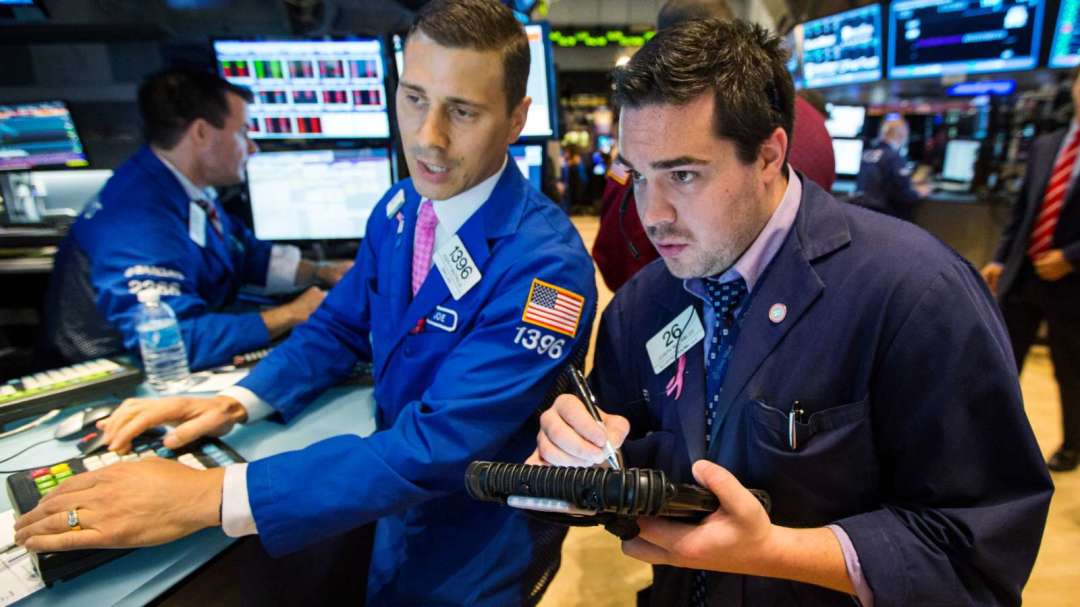
U.S. stocks traded mixed on Wednesday (April 8) as the S&P 500 and Dow Jones Industrial Average closed lower, following President Trump's statement that the temporary agreement aimed at ending the war with Iran had 'ended.' However, recently battered chip stocks rallied, led by Nvidia (NVDA-US) and Broadcom (AVGO-US), supporting a rebound in the Nasdaq and the Philadelphia Semiconductor Index.
The U.S. Central Command announced Wednesday afternoon that U.S. forces had launched a new round of airstrikes against Iran in response to Tehran's attacks on commercial vessels in and around the Strait of Hormuz.
Hours earlier, Trump, speaking at the NATO summit in Turkey, said he had no intention of further negotiations with Iran and warned that Washington might launch additional attacks on Wednesday evening.
Trump's remarks marked the latest setback in the back-and-forth negotiations between the U.S. and Iran. Over recent weeks, both sides have alternated between escalating threats and diplomatic overtures, repeatedly leading investors to misjudge the likelihood of a peace deal.
Among large tech stocks, Microsoft (MSFT-US) and Alphabet (GOOGL-US) both fell over 1%, while Meta Platforms (META-US) dropped 2%.
Broadcom supported the Nasdaq's upward movement, surging 4.8% after Apple (AAPL-US) announced plans to spend over $30 billion as part of a chip supply agreement reached earlier in the week with Broadcom.
"Whenever Apple announces it will use your equipment, it's typically very positive news, especially with 2.5 billion Apple devices in consumers' hands globally," said Art Hogan, market strategist at B. Riley Wealth.
The Philadelphia Semiconductor Index rebounded 2.23%. VanEck Semiconductor ETF (SMH-US) rose about 2%, though it remains nearly 12% below its recent highs.
Nvidia jumped 3.65% after The Information reported that China plans to allow its top AI companies to purchase a limited number of H200 chips.
Nine out of the S&P 500's 11 major sectors closed lower, with industrials suffering the largest drop at 3.41%, followed by materials, down about 2.45%.
Oil prices spiked after Trump's comments, with Brent crude futures closing up 5.2%. U.S. Treasury yields also rose, indicating selling pressure spreading to the bond market.
This latest escalation could undermine the rally that has lifted the S&P 500 about 9% year-to-date. Despite a sharp drop in U.S. stocks following the outbreak of Middle East conflict, the S&P 500 has maintained a positive trend this year.
The renewed surge in oil prices could reignite inflation concerns and complicate the Federal Reserve's (Fed) policy path.
Travel stocks sensitive to energy prices declined as higher oil prices raised concerns about fuel costs and demand. United Airlines (UAL-US) and Delta Air Lines (DAL-US) both fell over 1%.
The International Monetary Fund (IMF) on Wednesday again downgraded its 2026 global economic growth forecast to 3%, warning that risks from the Middle East conflict persist.
Minutes from the Fed's latest meeting, released Wednesday, showed officials' growing concerns about inflation. According to CME FedWatch, traders now expect the Fed may raise interest rates before its December meeting.
U.S. Stock Market Key Indexes, April 8:
Dow Jones Industrial Average: Down 576.76 points, or 1.09%, closing at 52,348.39.
Nasdaq Composite Index: Up 51.96 points, or 0.20%, closing at 25,870.65.
S&P 500 Index: Down 21.14 points, or 0.28%, closing at 7,482.71.
Philadelphia Semiconductor Index: Up 274.45 points, or 2.23%, closing at 12,574.97.
NYSE FANG+ Index: Up 26.48 points, or 0.15%, closing at 17,324.11.
Nine of the S&P 500's 11 sectors closed lower, with industrials seeing the largest decline. (Image: finviz)
Key Stocks
Most NYSE FANG+ tech giants closed lower. Meta (META-US) fell 2.02%; Apple (AAPL-US) rose 0.88%; Alphabet (GOOGL-US) fell 1.39%; Microsoft (MSFT-US) fell 1.41%; Amazon (AMZN-US) fell 0.96%.
Philadelphia Semiconductor Index components all rose. Nvidia (NVDA-US) up 3.65%; Broadcom (AVGO-US) up 4.83%; Micron (MU-US) up 1.11%; Qualcomm (QCOM-US) up 1.96%; Applied Materials (AMAT-US) up 2.89%; Texas Instruments (TXN-US) up 2.73%; AMD (AMD-US) up 0.25%.
Taiwan ADRs mostly gained. TSMC ADR (TSM-US) up 1.02%; ASE ADR (ASX-US) up 0.71%; UMC ADR (UMC-US) up 5.60%; Chunghwa Telecom ADR (CHT-US) down 0.39%.
Corporate News
According to The Information, citing sources, China plans to allow major domestic AI firms such as Alibaba, ByteDance, and DeepSeek to purchase a limited number of Nvidia H200 chips, signaling that amid rising demand for computing power, China is considering modestly easing restrictions on advanced U.S. AI chips.
OpenAI announced it will officially release three next-generation AI models—GPT-5.6 Sol, Terra, and Luna—globally on Thursday, ending the prior restriction of providing access only to a 'select group of trusted partners' at the U.S. government's request. This public release also means OpenAI and rival Anthropic have both resumed full public access to their latest AI models.
Blue Origin, the space company, has launched its first external fundraising since its founding 25 years ago. Sources indicate the company is raising about $10 billion, which would value the company at $130 billion upon completion, marking Blue Origin's formal entry into a new phase of external capital introduction and reflecting continued investor confidence in the commercial space industry.
Waymo, Alphabet's (GOOGL-US) self-driving taxi company, announced it will roll out fully autonomous, driverless ride-hailing services in four U.S. cities—San Diego, Las Vegas, Tampa, Florida, and Denver—over the coming weeks, accelerating its nationwide expansion and further solidifying its leadership in the Robotaxi market.
Wall Street Analysis
Rob Haworth, investment strategist at U.S. Bank Wealth Management, said, "The key is duration. How long will this last? If we see damage to Iranian infrastructure, the market may have to take it more seriously because Iran is likely to retaliate."
Daniela Hathorn, market analyst at Capital.com, noted in a Wednesday report, "Rising tensions in the Middle East have disrupted the increasingly complacent narrative in markets. Investors had priced in a stable, de-escalating situation over recent weeks, but are now forced to reassess geopolitical risks."
Hathorn added, "The latest attacks remind investors that even with a ceasefire in place, a durable agreement between the U.S. and Iran is far from guaranteed. The market had grown accustomed to assuming conflicts would gradually fade from focus, but recent developments suggest this assumption may have been overly optimistic."
All figures are updated as of press time; please refer to actual market quotes.
FACT BOX
- Source: PR Times
- Category: News
- Organizations: Apple / Microsoft / Alphabet
- Products / services: GPT-5.6