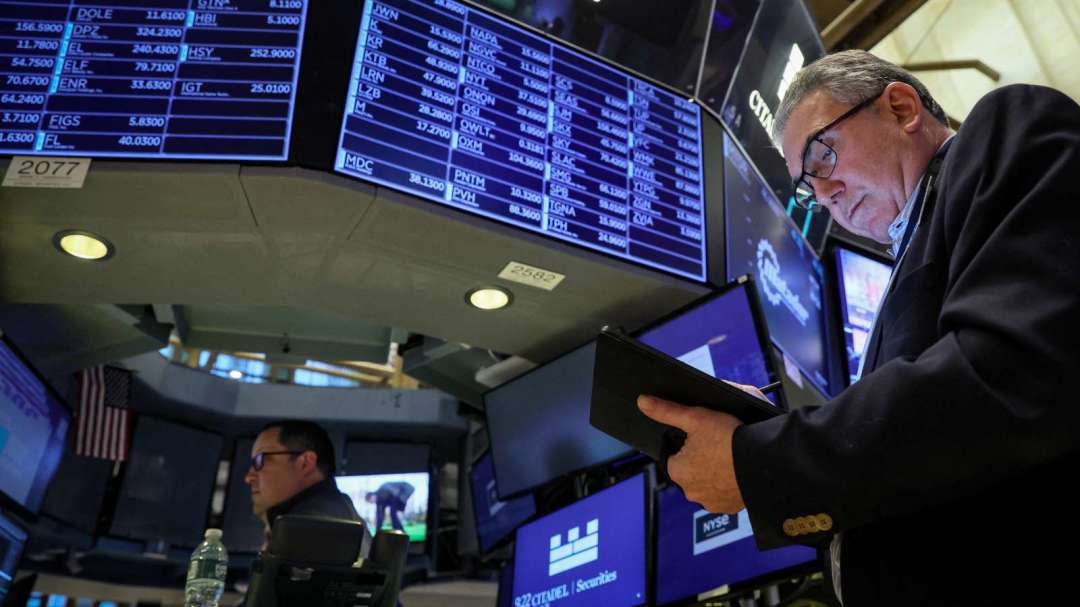
Major U.S. indices opened slightly higher on Thursday (9th), with chip stocks continuing their strong momentum, driving gains in the S&P 500 and Nasdaq Composite, helping markets offset concerns over renewed U.S.-Iran hostilities. Strong pre-listing demand for SK Hynix's U.S. shares boosted global semiconductor sector sentiment, though fresh rounds of attacks between U.S. forces and Iran caused oil price swings. Investors worry that Middle East tensions could derail fragile U.S.-Iran peace talks and increase market volatility.
At press time, the Dow Jones Industrial Average was down over 50 points or nearly 0.1%, the Nasdaq Composite Index was up over 120 points or about 0.5%, the S&P 500 Index was up nearly 0.3%, and the Philadelphia Semiconductor Index surged nearly 5.0%. TSMC ADR rose nearly 1.7%.
Chip stocks continued to lead global equity markets, lifting U.S. futures and tech stocks across Asia and Europe. However, rising Middle East tensions caused oil prices to fluctuate. Markets are monitoring whether U.S.-Iran conflict could worsen, while also digesting Federal Reserve (Fed) policy outlook and the ongoing AI investment boom.
Before the U.S. market open, S&P 500 futures rose 0.3%, and Nasdaq 100 futures surged 1%. The semiconductor sector was strong, with SK Hynix's U.S. Depository Receipts (ADR) seeing intense pre-listing subscription demand—oversubscribed by more than 7 times—expected to raise around $24.5 billion, boosting global chip stocks.
International oil prices were volatile. Brent crude swung between gains and losses, briefly rising about 0.8% to around $78.7 per barrel. Markets fear that U.S. airstrikes on Iran for a second consecutive day could further complicate already fragile U.S.-Iran peace negotiations.
On Wednesday, U.S. forces launched attacks on about 90 Iranian targets, claiming the aim was to weaken Iran’s ability to attack commercial ships in the Strait of Hormuz. According to semi-official Iranian Students News Agency (ISNA), Iran retaliated by attacking U.S. military bases in Bahrain, Kuwait, and Qatar. The exchange of retaliatory strikes casts renewed doubt on ceasefire prospects.
Market strategists say the situation shows ceasefire agreements remain fragile, though it remains to be seen whether parties are willing to return to full-scale war. Mohit Kumar, Chief Economist at Jefferies International, said short-term compromises may still emerge, sufficient to maintain oil supply. But medium-term, Middle East tensions could escalate again.
In bond markets, safe-haven demand lifted global government bond prices slightly. The U.S. 2-year Treasury yield fell 3 basis points to 4.19%, while the dollar remained largely flat. U.S. initial jobless claims for the prior week came in slightly better than expected, indicating labor market resilience.
Investors continue to monitor Fed monetary policy. The Fed’s June meeting minutes revealed some officials believed there was a case for rate hikes at the time. Markets now focus on next week’s U.S. inflation data and Fed Chair Kevin Warsh’s congressional testimony to gauge future rate direction. New York Fed President John Williams is also scheduled to speak later Thursday.
Despite concerns about cooling AI investment enthusiasm, BlackRock investment strategist Helen Jewell remains optimistic, saying the AI theme could last another 2–3 years, driven by tech giants’ continued heavy capital spending. However, she warns that as companies increasingly fund AI infrastructure through debt, investors should diversify beyond AI beneficiaries into healthcare, Latin America, and the UK to manage risk.
As of around 9:00 PM Taipei time on Thursday (9th):
Dow Jones Industrial Average down 74.50 points or 0.14%, temporarily at 52,273.89
Nasdaq Composite Index up 57.41 points or 0.22%, temporarily at 25,928.06
S&P 500 Index up 11.24 points or 0.15%, temporarily at 7,493.95
Philadelphia Semiconductor Index (SOX) up 570.09 points or 4.53%, temporarily at 13,145.06
TSMC ADR up 1.44% to $442.87 per share
10-year U.S. Treasury yield fell to 4.56%
NYMEX light crude down 0.56% to $73.11 per barrel
Brent crude down 0.14% to $77.91 per barrel
Gold up 1.29% to $4,134.90 per ounce
Dollar Index down to 100.94
Key stocks:
AstraZeneca (AZN-US) down 8.31% in pre-market, to $173.56
AstraZeneca’s pre-market plunge of 8% followed its heart disease drug Wainua failing to meet primary endpoints in a late-stage clinical trial, disappointing commercial prospects.
PepsiCo (PEP-US) down 4.63% in pre-market, to $135.77
PepsiCo fell 1% pre-market. Q2 results were mixed: adjusted EPS of $2.20 missed LSEG analyst consensus of $2.21, while revenue of $24.18 billion beat estimates of $23.95 billion.
Salesforce (CRM-US) down 4.02% in pre-market, to $159.88
Salesforce dropped 4% pre-market after KeyBanc downgraded its rating from 'Overweight' to 'Sector Weight'. KeyBanc cited channel checks, customer interviews, and disclosed operating data, finding no evidence to support further stock upside.
Today’s key economic data:
None
Wall Street analysis:
According to Yole Group’s latest research, global semiconductor component revenue is projected to reach $1.6 trillion by 2026 and could approach $2 trillion by 2027. The firm believes this growth is not merely an extension of traditional semiconductor cycles, but a profound transformation of the industry value chain driven by AI infrastructure, high-bandwidth memory (HBM), advanced packaging, and data center investment.
FACT BOX
- Source: PR Times
- Category: News