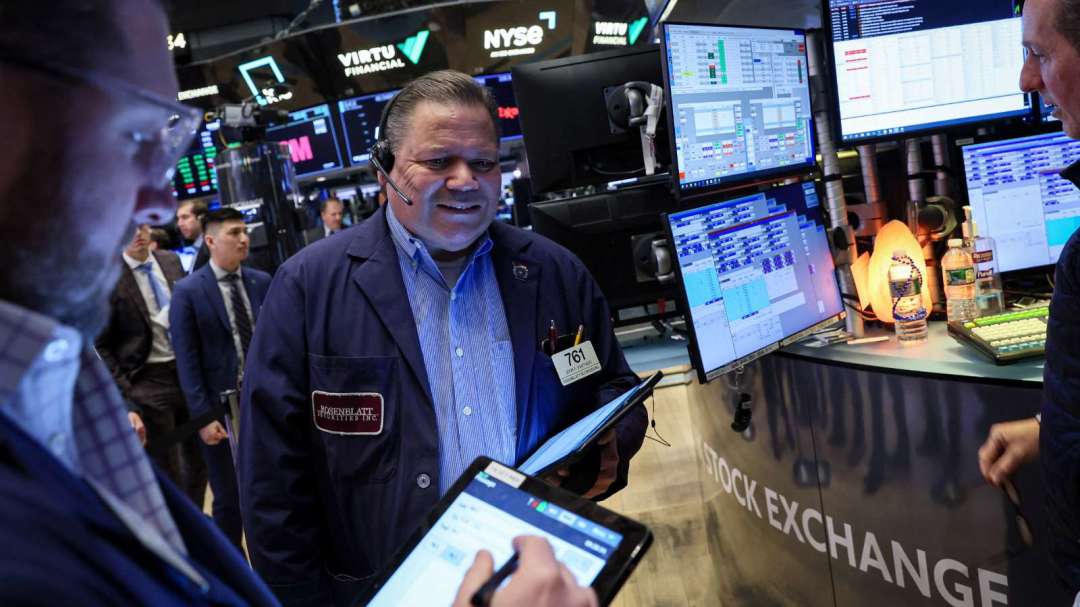
U.S. stocks opened steady on Friday (10th), with major indices fluctuating near flat levels as investors await the highly anticipated Nasdaq debut of South Korean memory chip giant SK Hynix, while also monitoring the latest escalation in Middle East conflict and its potential inflation risks. After a strong rally in the prior session, the S&P 500 is still on track to end the week in positive territory, but markets have turned cautious as they approach record highs ahead of the full launch of the second-quarter earnings season.
As of press time, the Dow Jones Industrial Average was up nearly 50 points or 0.1%, the Nasdaq Composite Index rose nearly 50 points or 0.2%, the S&P 500 Index gained about 0.2%, while the Philadelphia Semiconductor Index fell nearly 1.3%. TSMC ADR declined nearly 1.3%.
Pre-market trading in U.S. equities was choppy, as investors avoided large bets ahead of the weekend, with fragile ceasefire conditions in the Middle East continuing to cast a shadow of geopolitical risk over markets. S&P 500 futures were largely flat, Nasdaq 100 futures down 0.3%, and Europe’s Stoxx 600 index could post its first weekly decline in five weeks.
Chip stocks had previously surged, pushing the S&P 500 to its highest level since mid-June. However, fragile truces between the U.S. and Iran, along with shipping traffic through the Strait of Hormuz having sharply declined due to several days of conflict, have made investors reluctant to take on excessive risk ahead of the weekend.
Brent crude oil prices oscillated around $76.50 per barrel, continuing recent volatile movements. Despite ongoing negotiations between the U.S. and Iran, the possibility of further escalation is expected to keep investors cautious on the final trading day of the week.
Manso, Chief Investment Officer at CaixaBank Asset Management, said negotiations between the U.S. and Iran are expected to continue over the weekend, and oil prices could become a key indicator of investor sentiment and market expectations for the situation.
In other markets, the U.S. dollar index fell 0.1%, marking its third consecutive day of declines; U.S. Treasuries extended their rebound, with the 10-year yield down 1 basis point to 4.54%. The yen strengthened 0.3% against the dollar, outperforming other major currencies. This came after Japan’s Finance Minister Shunichi Suzuki expressed hope that pension funds would increase domestic asset investments.
Although geopolitical risks are temporarily weighing on market sentiment, investor focus will soon shift to corporate earnings as the second-quarter earnings season fully kicks off next week. Massive investments by hyperscale cloud service providers have made AI infrastructure suppliers a market focal point, with strong earnings expectations driving significant gains in chip and other AI-related stocks.
However, after unprecedented rallies in AI-related equities, companies now face a higher bar to prove their earnings can justify lofty valuations; for large cloud providers, the market demands proof that massive AI capital expenditures will ultimately deliver strong returns.
Florian Ielpo, Macro Head at Lombard Odier Investment Managers, said it remains to be confirmed whether economic growth can remain resilient under high oil prices and bond yield pressures, and whether the AI capex cycle can continue to support investment, revenue, and profits. He noted that market expectations are already very high, and the real test lies in whether corporate earnings can continue to justify this expansion.
Additionally, SK Hynix fell 0.3% in Seoul trading on Friday, ahead of its U.S. market debut. The company raised $26.5 billion through American Depositary Receipts (ADRs) and will begin conditional trading on the Nasdaq Global Select Market. With no major economic data or central bank official speeches scheduled for the day, SK Hynix’s U.S. listing performance could become a key focus influencing market sentiment.
As of around 9 p.m. Taipei time on Friday (10th):
Dow Jones Industrial Average down 74.50 points or 0.14%, temporarily at 52,273.89
Nasdaq Composite Index up 57.41 points or 0.22%, at 25,928.06
S&P 500 Index up 11.24 points or 0.15%, at 7,493.95
Philadelphia Semiconductor Index up 570.09 points or 4.53%, at 13,145.06
TSMC ADR up 1.44% to $442.87 per share
10-year U.S. Treasury yield down to 4.56%
New York light crude down 0.56% to $73.11 per barrel
Brent crude down 0.14% to $77.91 per barrel
Gold up 1.29% to $4,134.90 per ounce
U.S. Dollar Index up to 100.91
Key stocks:
Delta Air Lines (DAL-US) pre-market down 1.38% to $87.77
Delta Air Lines pre-market dropped over 3% despite Q2 revenue and profit beating market expectations. CEO Ed Bastian told CNBC that recent surges in jet fuel prices have enhanced pricing power, which he expects to persist even if oil prices fall.
Circle (CRCL-US) pre-market up 13.28% to $71.38
Circle Internet Group surged over 13% in pre-market after the fintech firm received approval from the U.S. Office of the Comptroller of the Currency (OCC) to establish a bank focused on cryptocurrency operations. CEO Jeremy Allaire said the approval is a major milestone in integrating blockchain technology into the core of the financial system.
Netflix (NFLX-US) pre-market down 1.40% to $74.41
Netflix shares edged higher in pre-market. According to The Wall Street Journal, citing sources, Netflix has discussed adding live TV channel streaming to its platform and exploring bundling its offerings with other streaming services. These discussions come as signs of declining user engagement on Netflix have emerged.
Today’s key economic data:
None
Wall Street analysis:
Dylan Patel, founder of SemiAnalysis, a top research firm focused on semiconductors and AI infrastructure, recently appeared on a podcast to systematically outline the core dynamics and investment logic of the current AI infrastructure stack.
Dylan emphasized that storage faces a structural shortage lasting several years, with 2 to 3 times upside potential remaining; meanwhile, although agents and reinforcement learning are boosting CPU demand, the seller’s market has overpriced CPUs, and CPU growth is mainly due to historical “catch-up,” with its absolute value in AI servers still far below that of GPUs.
Dylan also stated that the large-scale rollout of co-packaged optics (CPO), highly anticipated by the market, has been clearly delayed to late 2028 to 2029, unexpectedly extending the copper cable connector’s windfall period.
FACT BOX
- Source: PR Times
- Category: News
- Organizations: Circle / Netflix