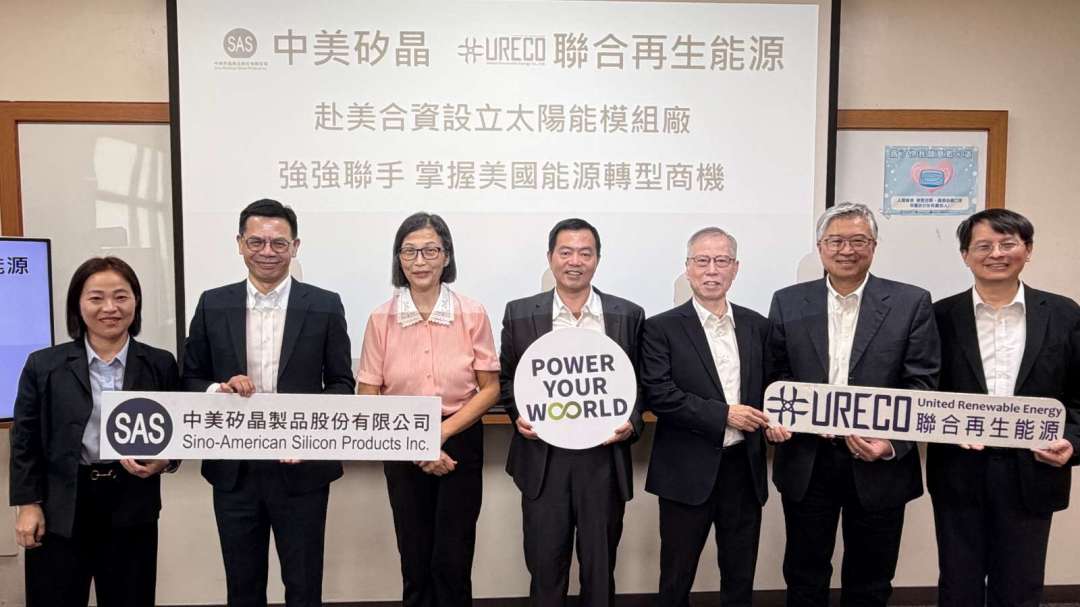
Ming Chi (5483-TW) and United Renewable Energy (3576-TW) jointly announced today (21st) their plan to invest $40 million (approximately NT$1.29 billion) in the United States to establish a U.S.-based solar module manufacturing company. The joint venture will be held 51% by Ming Chi and 49% by United Renewable Energy, led by professional manager Jason Yeh. The facility is planned to have an annual production capacity of 1GW, with mass production and shipments expected to begin within one year after the site is confirmed and lease agreements are signed.
The joint venture will focus on local manufacturing in the U.S., integrating both parties’ expertise in material supply, technology R&D, product manufacturing, sales channels, and brand management to deliver solar modules with high quality, traceability, and bankability. The production will cover both TOPCon and PERC technologies, with TOPCon as the primary focus. By operating locally in the U.S., the company aims to reduce cross-border supply chain and logistics uncertainties, enhancing service capabilities and supply chain resilience for North American customers.
Recognizing the long-term growth potential of the U.S. solar market, Ming Chi and United Renewable Energy highlighted that the U.S. market demands between 40 to 55GW annually. The rapid deployment of AI data centers across various states is driving urgent and substantial demand for low-carbon electricity, reinforcing the need for local manufacturing. The U.S. offers relatively comprehensive policy incentives and predictable regulatory frameworks, supporting overseas expansion and strengthening overall competitiveness.
Ming Chi Chairman Hsu Hsiu-Lan stated that this collaboration extends the company’s long-accumulated solar cell technology and global manufacturing management capabilities, enabling a more direct response to end-market demands.
Addressing concerns about increased production costs in the U.S., Hsu analyzed that solar module manufacturing is highly automated and does not require expensive cleanrooms or wastewater treatment facilities like semiconductor wafer fabs, making facility setup and labor costs relatively controllable. Leveraging the local operational, government engagement, and talent recruitment experience accumulated by its subsidiary GlobalWafers (6488-TW) in Texas and Missouri, the new company is expected to significantly reduce its learning curve.
Historically, Taiwan’s solar industry has been seen as constrained by its limited domestic market, hindering scale expansion. In response, Ming Chi Chairman Hsu Hsiu-Lan and United Renewable Energy Chairman Hung Chuan-Hsien emphasized that the U.S. solar market offers vast depth with annual demand of 40–55GW. By extending decades of technical and manufacturing expertise to North America, Taiwanese companies can break free from domestic market limitations and open up larger international opportunities.
United Renewable Energy Chairman Hung Chuan-Hsien noted that this U.S. plant marks a significant milestone in Taiwan’s solar industry’s internationalization, signaling a new phase in overseas expansion and brand development. With over a decade of深耕 in the U.S. market and being the only Taiwanese module brand listed in BloombergNEF’s Tier 1, the company will integrate its strengths in cell manufacturing, overseas market experience, and downstream system development to complete the final piece of local U.S. manufacturing.
Regarding operational planning and customer positioning, United Renewable Energy CEO Chiang Mao-Hsien explained that the company has maintained a stable customer base in the U.S. since 2019 and has invested in projects across nine states. Combined with demand from Taiwanese companies expanding into the U.S., the joint venture expects to secure over 70–80% of its initial production capacity. The company aims to build a comprehensive renewable energy operating platform by integrating Taiwan’s R&D technology with North American local sales.
FACT BOX
- Source: PR Times
- Category: Partnership
- Organizations: BloombergNEF