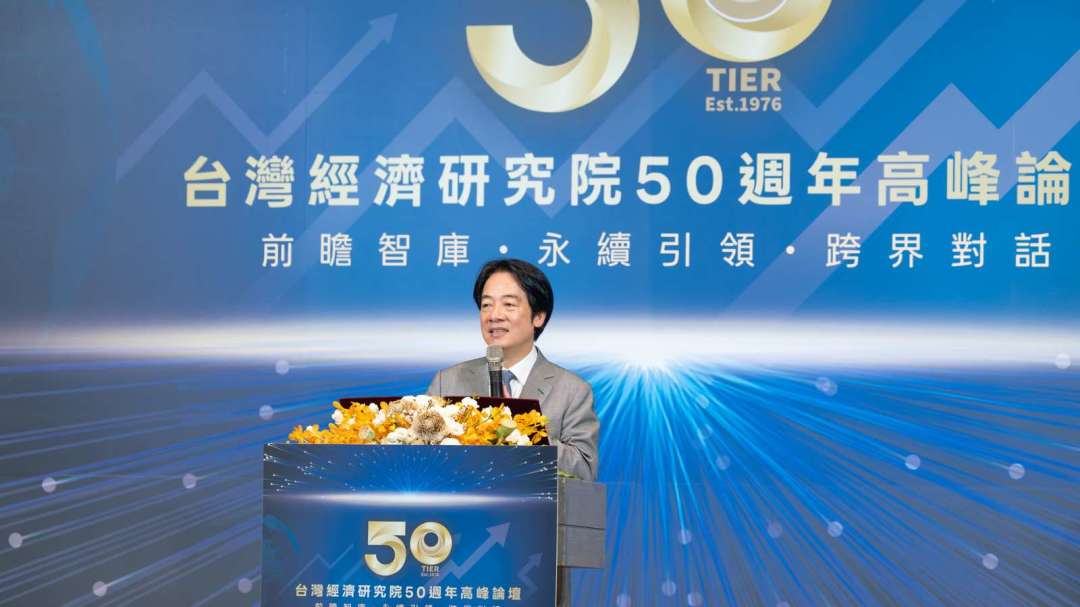
President Lai Qingde attended the 'TIIE 50th Anniversary Summit Forum' today (21st). In his speech, he not only praised the Taiwan Institute of Economic Research (TIIE) for its long-term provision of forward-looking research and policy recommendations, making significant contributions to national economic development, but also emphasized that Taiwan has benefited from global AI infrastructure growth, achieving remarkable economic performance in recent years. To sustain the AI dividend, industries must move beyond hardware manufacturing and comprehensively apply AI across all sectors to create Taiwan's next era of prosperity.
Lai stated that TIIE is Taiwan's first private think tank, successfully serving as a bridge between businesses and the government. It assists the government in analyzing industries, diagnosing challenges, and prescribing solutions, while also helping industries advance at every critical juncture. As a national think tank, it complements government shortcomings. He expressed heartfelt gratitude to Mr. Koo Chen-fu for his visionary establishment of TIIE 50 years ago, and to all past chairpersons, presidents, staff, and researchers for their significant contributions to national economic development over the past five decades.
Lai noted that TIIE has not only played a key role but also advanced policy development. For example, it assisted in integrating various economic and trade issues of the Asia-Pacific Economic Cooperation (APEC), enabling the government to respond appropriately. When Taiwan sought to join the WTO, TIIE helped analyze potential industrial and social impacts, formulated negotiation strategies for government reference, captured industrial development benefits, and mitigated societal shocks. Recently, facing the U.S. reciprocal tariff challenge, TIIE similarly provided industrial analysis, allowing the government's negotiation team to respond effectively.
Lai pointed out that at the dawn of the AI era, Taiwan's economic development is already evident. The country's GDP growth rate reached 5.6% the year before last, 8.76% last year (2025), and 14.55% in the first quarter of this year, with an estimated annual growth rate of 9.64%. Academia Sinica even forecasts that this year's GDP will exceed 10%. Taiwan must not remain limited to manufacturing AI hardware. Just as Watt's invention of the steam engine drove 200 years of European civilization, Taiwan must skillfully use AI to build its future to long-term enjoy the economic growth dividends brought by AI.
To ensure Taiwan maintains a competitive advantage in the AI era, Lai stated that future economic development requires the ability to apply AI, and sustainable development lies in skillfully using AI for construction. Therefore, the government has proposed the 'AI New Ten Major Projects,' which include four foundational initiatives.
Lai explained that the first is computing power. The 'National Network Cloud Computing Center' has officially launched. The second is sovereign AI and data utilization, aiming to provide industries and academia with comprehensive data in fields such as healthcare, law, and finance, along with sufficient power and computing resources for application. The third is talent cultivation, with a goal to train at least 500,000 AI application talents by 2040. The fourth is building a balanced Taiwan, ensuring AI infrastructure is not concentrated in specific regions but spreads across all sectors.
Additionally, Lai emphasized that the government is focusing on developing three key technologies. The first is silicon photonics, where Taiwan's major tech enterprises are currently globally leading. Silicon photonics not only ensures Taiwan maintains its industrial competitive edge but is also an inevitable future development path, offering faster transmission speeds and lower energy consumption. The second is quantum computing. Traditional binary computing is inevitably moving toward quantum computing, and Taiwan already possesses the capability to build quantum computers.
The third key technology is robotics. The 'Taiwan AI Robotics Industry Alliance' has been established in central Taiwan. The government's broad definition of robotics includes drones, unmanned surface vessels, and underwater unmanned vehicles. This is also the reason the government proposed a special defense budget—to strengthen national defense, protect national security, and simultaneously drive industrial development. Lai expressed hope that opposition parties in the legislature will support the related budget.
Lai stated that in facing the AI era, the government aims to achieve three socioeconomic development goals. First, assist at least one million small, medium, and micro enterprises in digital transformation and AI adoption. The government allocates over NT$10 billion annually to promote the 'SME Diversified Revitalization and Development Program' and plans to establish a NT$100 billion fund to assist SMEs in upgrading and transforming. If the budget passes smoothly, approximately NT$25 billion will be available annually to support SME transformation, enabling the tech industry to drive SMEs and form a complete industrial ecosystem.
The second goal is to leverage AI and emerging technologies to create an innovation and entrepreneurship ecosystem for youth. The third goal is to integrate artificial intelligence into all aspects of life—food, clothing, housing, transportation, education, entertainment, and all professions—building an AI lifestyle circle. This will not only sustain Taiwan's economic development and social progress but also make people's lives more convenient.
FACT BOX
- Source: PR Times
- Category: Event