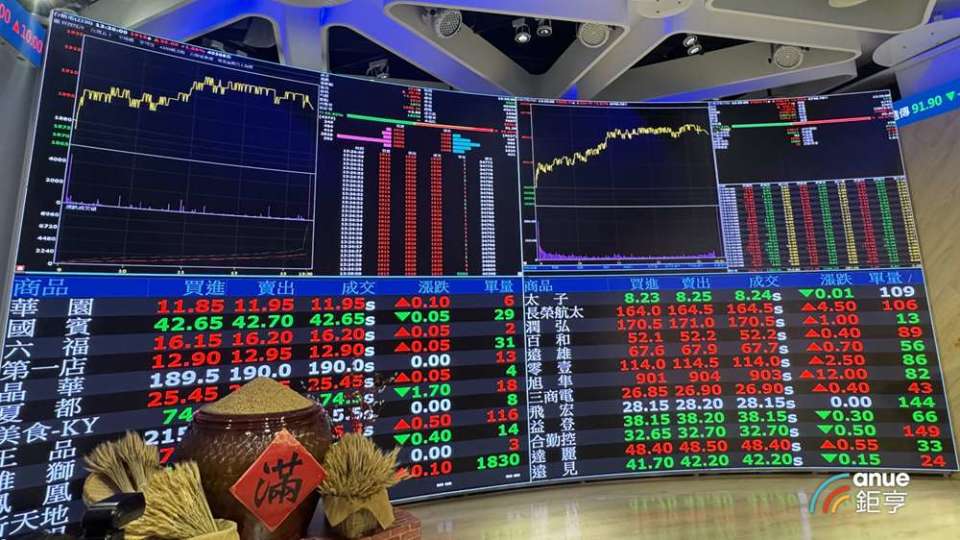
Taiwan's stock market staged a strong rebound today (21st), with the weighted index surging 1,783.17 points to close at 44,232.87, marking the largest point gain in history. The rally was led by heavyweight electronics stocks such as TSMC (2330-TW), the world's largest contract chipmaker, and MediaTek (2454-TW), a major IC design house. However, trading value reached only NT$835.6 billion, suggesting that market confidence has not yet fully recovered.
Financial institutions point out that while the long-term trends in AI and semiconductors remain clear, betting heavily on individual stocks carries high valuation risks. They recommend investors consider gradually building positions in semiconductor-themed ETFs to balance exposure to supply chain growth opportunities with risk diversification.
On the market front, sectors that had suffered deeper corrections—such as AI hardware, semiconductors, PCBs, and passive components—saw a synchronized strong rebound today, with capital flowing back into tech stocks and driving broad gains across the electronics sector. Institutions believe the sharp rebound reflects investors' continued confidence in the medium- to long-term growth prospects of the AI industry and the semiconductor cycle.
Chang Kuei-hui, portfolio manager of CTBC Key Semiconductor ETF (00891-TW), stated that the market's sharp rebound after a steep correction indicates that the long-term development trend of AI and semiconductors remains intact. However, trading volume has not significantly expanded during this rebound, and whether the rally can continue will depend on the strength of capital inflows and whether corporate earnings can justify current valuations.
Chang noted that after recent market volatility, investor stock-picking strategies have gradually returned to fundamentals, focusing less on thematic momentum and more on corporate profitability, gross margin trends, and whether future growth potential can support current stock valuations. If a company's operational performance fails to keep pace with its stock price, short-term volatility risks remain significant.
From an industry perspective, Chang believes the AI investment wave has not cooled despite recent market corrections. Whether in cloud data centers, AI servers, high-performance computing (HPC) chips, advanced packaging, or semiconductor testing, Taiwan continues to play a critical role in the global AI hardware supply chain, and its long-term beneficiary status remains unchanged.
However, as valuations of AI-related stocks continue to rise, investors concentrating on individual stocks may face risks such as elevated P/E ratios, earnings misses, declining margins, and concentrated positioning. In contrast, investing via ETFs offers a better chance to mitigate the impact of individual company volatility on the overall portfolio.
Looking at the holdings of 00891, the ETF spans key areas including foundry, IC design, packaging and testing, memory, silicon IP, and semiconductor testing. Major holdings include TSMC, MediaTek, ASE Holding, UMC, Winbond, Nanya Technology, Wealthtek, Creative Electronic, Realtek, and King Yuan Electronics. Chang emphasized that a basket-based investment approach allows investors to capture multiple beneficiary segments across Taiwan's semiconductor supply chain, rather than betting solely on individual AI 'star' stocks.
Additionally, for investors concerned about geopolitical risks and seeking cross-market diversification, CTBC Asset Management recommends considering the CTBC Upstream Semiconductor ETF (00941-TW). This ETF focuses on the global semiconductor equipment and materials supply chain, with constituents from the U.S., Japan, South Korea, Taiwan, the Netherlands, France, and Germany, enabling participation in global semiconductor capital expenditure expansion and supply chain upgrading trends.
*Disclaimer: The individual stocks, funds, and futures products mentioned in this article are for reference only and do not constitute investment advice. Investors should make independent judgments, carefully assess risks, and bear their own profits and losses.
FACT BOX
- Source: PR Times
- Category: News