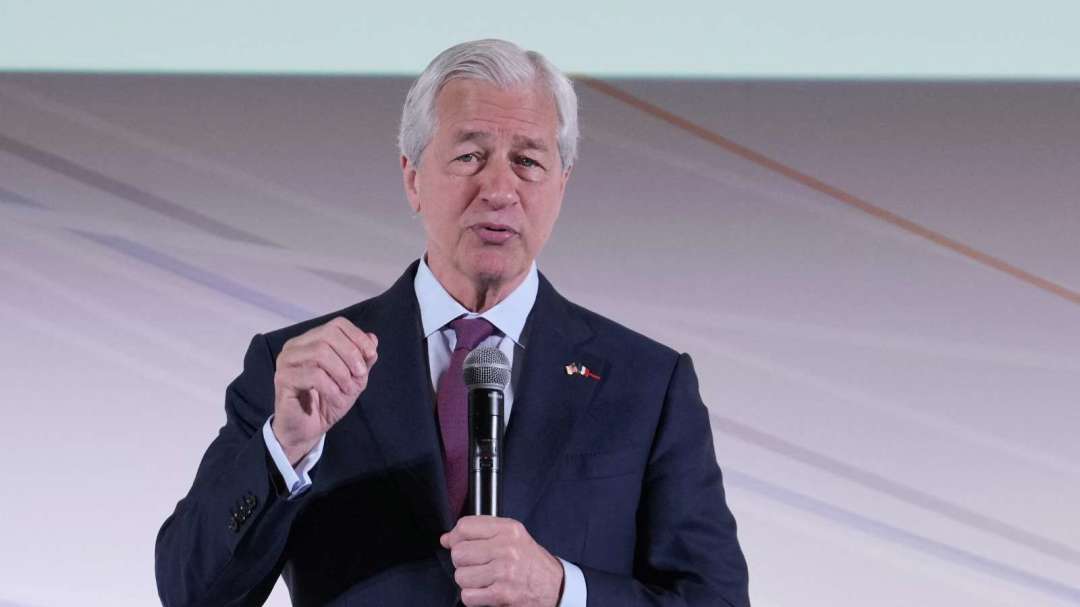
Jamie Dimon, CEO of JPMorgan Chase (JPM-US), recently stated publicly that investors may be seriously underestimating the risks facing the global economy. In his view, at current price levels, neither stocks nor long-term U.S. Treasury bonds are worth buying.
According to CNBC, in a nearly one-hour interview released Monday evening this week, Dimon told host Wilfred Frost that the market has not fully reflected growing geopolitical and fiscal concerns.
He cited the wars in Ukraine and the Middle East, U.S.-China tensions, and rising military spending amid expanding fiscal deficits around the world, saying these risks "may be more severe than people imagine."
When asked whether the market is underestimating the probability of a major shock, Dimon admitted it's difficult to judge how much risk is already priced into assets. He said: "Perhaps some of it is already reflected, but what's actually happening hasn't yet been digested by the market."
Dimon has never hesitated to warn about economic risks, and this latest statement again contrasts sharply with the market's recent optimism.
Despite successive shocks such as war, tariffs, and other disruptions, investors seem to be choosing to look away. The S&P 500 Index has risen nearly 10% this year, consumer spending remains robust, inflation is cooling, and the ongoing AI investment frenzy has further boosted market momentum.
Last week, quarterly earnings from JPMorgan and its peers were exceptionally strong, with significant revenue growth in trading and investment banking, reinforcing the belief that the U.S. economy's resilience through recent geopolitical turmoil is stronger than many initially expected.
Still, Dimon acknowledged that while the global economy is indeed more resilient than in past decades due to reduced dependence on energy, this does not mean the risk of sudden turning points has disappeared.
He described it: "It may take more straws to break the camel's back. Even if this war escalates again, it might still not be the final straw."
Dimon believes that the U.S.'s persistent fiscal deficits will eventually force the market to face reality and could further push interest rates higher.
"I think this will eventually become a problem," he said, predicting that as so-called "bond vigilantes" demand higher yields to bear the risk of financing U.S. government debt, interest rates will rise further.
Cautious on Stocks and the AI Investment Cycle
When asked whether he would buy long-term U.S. Treasury bonds, Dimon said bluntly: "Personally, I wouldn't."
He stated that even if inflation falls back to the Federal Reserve's (Fed) 2% target, "the 10-year Treasury yield should still be in the 4% to 4.5% range," adding that he sees almost no room for U.S. Treasury prices to rise significantly.
He is similarly cautious about the stock market. Dimon said he would still consider buying individual stocks if they are "excellent investment opportunities," but at current valuation levels, he would not buy into the overall stock market.
On AI, Dimon took a more restrained stance, comparing the current AI investment boom to the early days of the internet.
"The scale of investment right now is enormous. Overall, will these investments eventually pay off? I think they will, just like the internet did back then."
However, he pointed out that during the internet bubble, early market leaders like Yahoo and Netscape eventually faded, while the real winners—such as Google (GOOGL-US) and Meta (META-US)—emerged only later.
Dimon said: "Will AI ultimately be realized in the way and on the timeline the market expects? The answer is absolutely no."
FACT BOX
- Source: PR Times
- Category: News
- Organizations: Google / Meta / CNBC