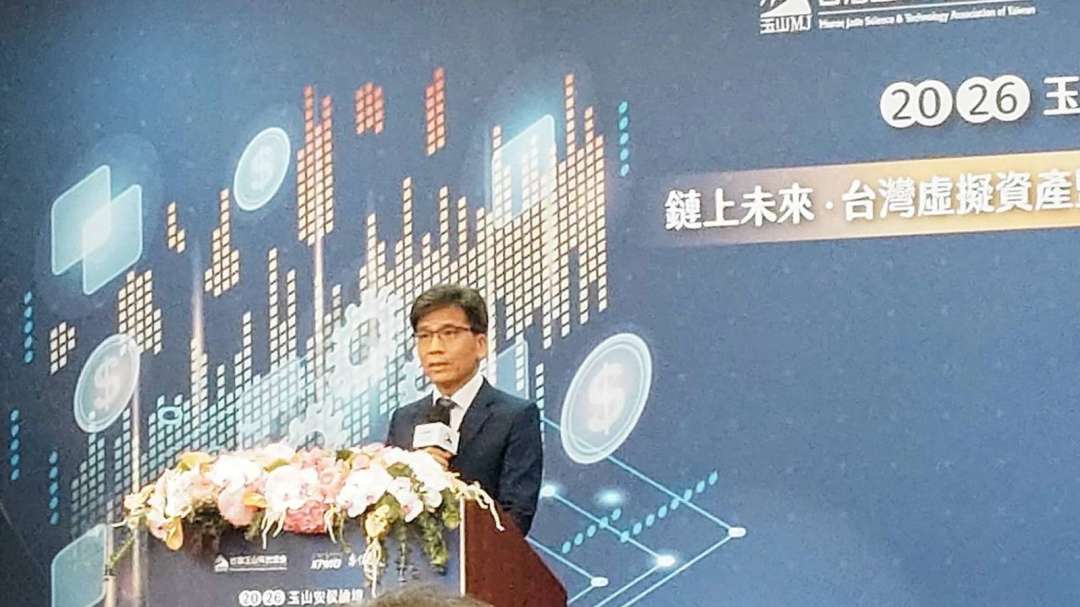
KPMG Taiwan (An侯 Jian Ye United CPAs) and the Taiwan Yushan Technology Association co-hosted the '2026 Yushan KPMG Forum' today (21st) to discuss the industrial landscape in Taiwan's inaugural year of virtual asset regulation. FSC Chairperson Peng Jin-Long emphasized in his keynote speech that Taiwan's Virtual Asset Services Act was passed on June 30 of this year, marking a new phase in regulatory development.
Peng stated that the FSC will implement the integration of 'Three-Financial Systems'—traditional, digital, and blockchain finance—by promoting three key areas: VASPs, stablecoins, and RWA. This framework aims to provide a predictable and secure environment for industry growth while enhancing Taiwan's international financial competitiveness.
Peng noted that the global virtual asset industry is moving toward institutionalization and scale. Reflecting on Taiwan's regulatory journey—from early self-regulation to the registration system and criminal liability established in 2024, and now the enactment of a dedicated law—he acknowledged the persistent challenges overcome.
He emphasized that the new law goes beyond preventing past concerns like money laundering or fraud; it elevates supervision to ensure comprehensive operational soundness and supports innovation through clear legal frameworks. Peng highlighted that the FSC has opened lending services and allowed traditional financial institutions to apply for dual operations in virtual asset businesses, aiming to foster deep integration between legacy and emerging financial systems.
Yushan Technology Association Chairman Tong Tzu-Hsien, drawing from decades of experience in the digital industry, lamented the shift from queuing for prize money to 24/7 digital transactions, noting technology's dramatic efficiency gains. He believes blockchain-enabled tokenization and securitization of assets is an irreversible trend, but warned that amid increasingly complex cybersecurity threats, fintech must balance innovation and efficiency with security and trust to truly safeguard public assets.
KPMG Taiwan Chairman Chen Chun-Kuang analyzed that the global financial system is undergoing a profound transformation. Virtual assets are no longer theoretical but possess the potential to become financial infrastructure. KPMG's Deputy General Manager of Digital Innovation Services, Lin Ta-Chung, added that the revolution lies beneath the surface—payment, settlement, and circulation mechanisms. He urged enterprises to leverage Web3 technologies to improve operational efficiency in cross-border payments, treasury management, and supply chain finance.
During the forum, National Taiwan University Law School Associate Professor Yang Yueh-Ping stated that the passage of the dedicated law formally recognizes virtual assets as financial products, ushering Taiwan's legal system into a new era. He particularly noted that compared to international standards, Taiwan's Virtual Asset Services Act offers a relatively flexible environment for cross-border stablecoin circulation, which will help Taiwan's traders integrate into the global payment system.
Vice Chairman Han Kun-Chu of the Virtual Asset Business Trade Association emphasized that virtual asset firms and traditional financial institutions are transitioning from competition to partnership. The forum concluded with a panel discussion moderated by Lai Wei-Yen, Chief Operating Officer of KPMG's Advisory Division, featuring experts Wang Li-Ling, Tsai Yu-Ling, Chen Kuan-Hsueh, and Chen Chun-Yueh.
Experts unanimously agreed that Taiwan's push for RWA (real-world asset tokenization) and stablecoin regulation is a critical step toward global alignment. They expressed hope that the macro vision of 'Three-Financial Integration' will generate the next wave of growth momentum for Taiwan's financial industry.
FACT BOX
- Source: PR Times
- Category: Event