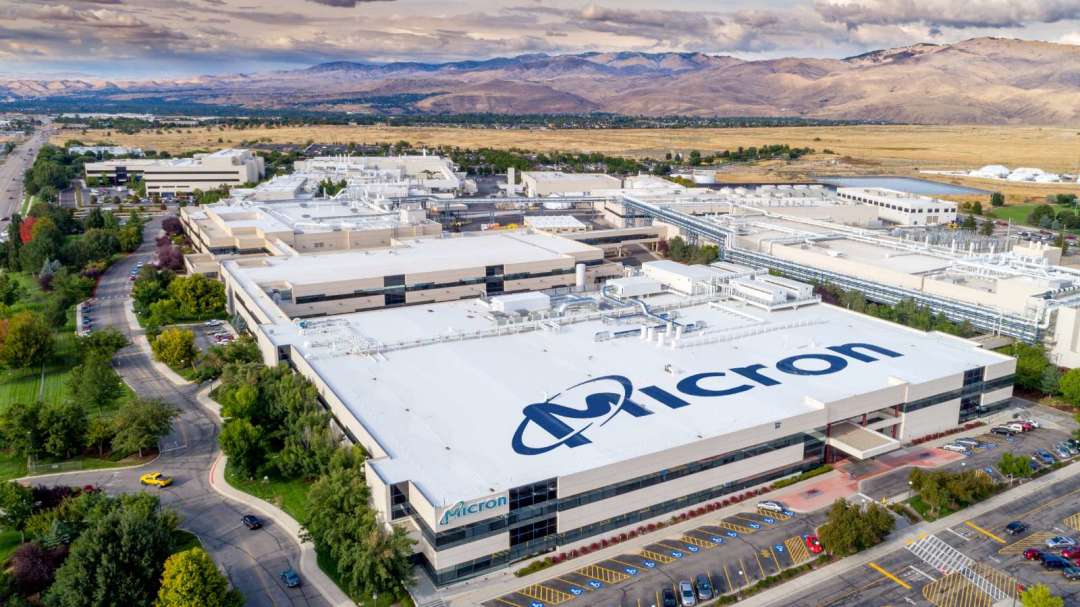
According to Barron's, shares of Micron Technology (MU-US) and SK Hynix ADR surged on Tuesday (21st), as market attention shifts toward upcoming earnings reports from major tech firms, with Alphabet (GOOGL-US) set to release its latest results on Wednesday.
Memory chip stocks are caught in a tug-of-war driven by AI development. While tech companies continue to increase investments in AI—potentially boosting memory demand—these same firms are also actively developing new technologies that could reduce the need for memory chips in AI systems.
Micron closed up 12.2% on Tuesday at $970.82, reclaiming a market capitalization above $1 trillion and shaking off recent pullback pressures. Over the past 12 months, Micron's stock has surged nearly 800%.
SK Hynix ADR showed even stronger momentum, jumping 13.8% to $171.94. While the single-day gain was impressive, the price remains only about $1 above its $170 opening price on its July 10 listing day. SK Hynix's Korean-listed shares rose 4.1% on Tuesday.
Investors appear confident that tech firms will further ramp up AI investments, thereby driving demand for HBM (High Bandwidth Memory) and other related components.
However, shareholders are closely watching whether tech companies will introduce new software or hardware technologies to reduce memory dependency, helping to control the rising costs of these components.
For example, The Information reported Monday that Google is developing a new chip codenamed 'Frozen v2,' designed to integrate parts of AI models directly into silicon, enabling more efficient AI computation and reducing data transfer needs—thus lowering reliance on HBM.
The chip is expected to be deployed by 2028, though it remains unclear how extensively Alphabet will adopt it or how it will integrate with other AI chips. To support multiple generations of AI technology, the underlying AI model architecture must remain stable, potentially limiting the chip's availability to external customers.
A Google Cloud spokesperson stated in a release: "Our teams continuously research and test new technologies... While not every project will reach mass production, this rigorous exploration is at the core of our full-stack strategy."
Micron had declined 16% over the past month, partly due to concerns over whether memory prices can sustain their high levels. South Korean media reported that SK Group Chairman Choi Tae-won said last week that current memory prices are "not normal" and will eventually return to normal levels.
Still, Wall Street analysts broadly expect memory prices to continue rising through 2027.
JPMorgan analyst Mixo Das noted in a research report: "Recent market skepticism questions memory demand, suggesting technological and process breakthroughs could reduce memory usage. But we have yet to see this materialize in actual markets. The supply of memory-related stocks should not be conflated with the supply of physical memory."
Ulrike Hoffmann-Burchardi, Head of Equity Strategy at UBS Wealth Management, said in a Monday report that AI agents with autonomous decision-making and self-learning capabilities will drive a "dramatic increase" in computing power demand.
She wrote: "By our estimates, over 90% of AI activity will be performed by AI agents by 2030. We believe this pullback presents a strategic entry point for advanced chips and semiconductor equipment stocks."
FACT BOX
- Source: PR Times
- Category: News
- Organizations: Micron Technology / SK Hynix / Alphabet
- Products / services: DRAM / SSD