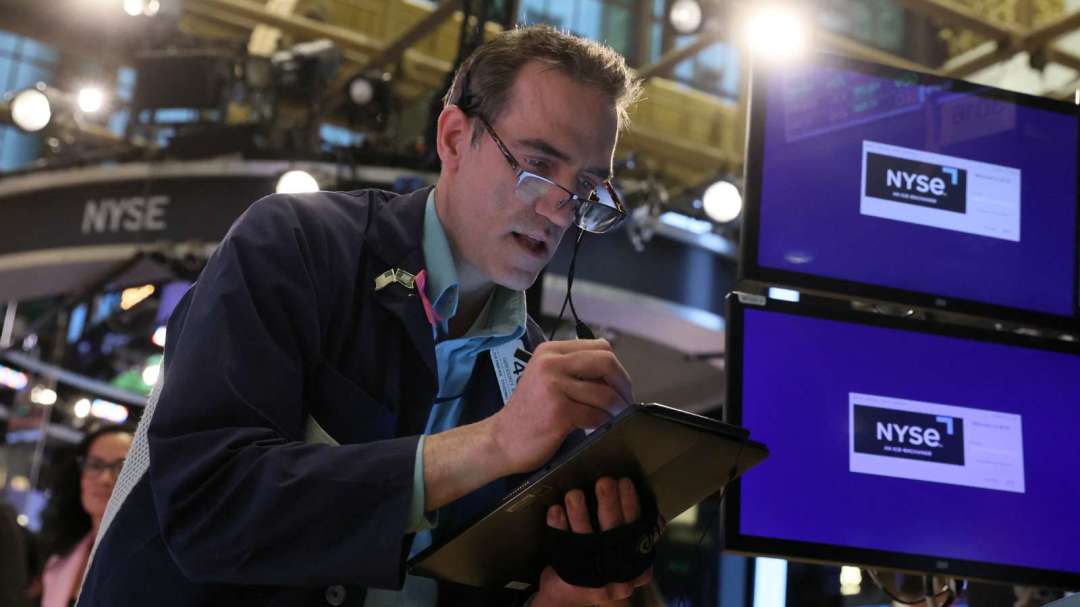
U.S. stocks opened lower on Wednesday, with the S&P 500 and Nasdaq Composite both declining, dragged down by weak performance in chip stocks. Investors are cautiously awaiting earnings reports from major tech companies, including Alphabet, the parent company of Google, to evaluate whether Wall Street's AI-driven rally has room to continue. Meanwhile, escalating tensions between the U.S. and Iran have pushed international oil prices higher, with Brent crude briefly surpassing $95 per barrel, further dampening market risk appetite.
As of press time, the Dow Jones Industrial Average was up nearly 80 points, or about 0.2%, while the Nasdaq Composite fell 140 points, or nearly 0.5%, and the S&P 500 declined by nearly 0.2%. The Philadelphia Semiconductor Index dropped close to 1.0%. TSMC's American Depositary Receipts (ADR) fell nearly 1.5%.
Ahead of the market open, investors were closely watching Alphabet (GOOGL-US) for its earnings report, seeking clarity on whether heavy investments by major cloud providers in artificial intelligence (AI) are beginning to yield returns. At the same time, Brent crude briefly broke above $95 per barrel, fueling inflation concerns and weighing on market sentiment.
The Nasdaq 100 Index halted its two-day rebound, with futures down 0.9%, while S&P 500 futures declined 0.3%. South Korea's Kospi and other Asian markets with high tech exposure saw early strong gains narrow. Europe's Stoxx 600 Index showed tech stocks underperforming notably.
Expanded U.S. airstrikes on Iran, coupled with both nations indicating no intention to restart negotiations, pushed Brent crude to briefly exceed $95 per barrel. Rising oil prices have reignited inflation worries, sending U.S. Treasury yields to a two-month high, while the dollar remained largely unchanged.
Alphabet announced last quarter it plans to raise its capital expenditures this year to as much as $190 billion—more than double its 2025 level. Investors are now not only focused on whether the company will continue expanding AI investments but also whether these expenditures are starting to generate tangible returns.
This earnings release comes as chip stocks, which have led the market rally, face volatility over concerns about the sustainability of AI spending. Global AI infrastructure suppliers rely on continued high spending from major tech firms to justify current lofty valuations, but the market also fears that overinvestment could eventually lead to oversupply.
Amanda Lyons of Energy Group Capital stated that Alphabet's report is less about quarterly results and more of a health check for the entire AI investment cycle. Any sign of wavering commitment from management could not only punish Google's stock but also cast doubt on the longevity of the broader AI construction boom. However, capital expenditure size is no longer the sole focus—investors increasingly demand proof that these investments are generating returns.
Tesla (TSLA-US) is also set to report earnings after the close on Wednesday. Unlike most tech giants, an increase in Tesla's capital spending and an upward revision in AI investment outlook could actually boost its stock. The company's shares have declined 16% year-to-date. IBM (IBM-US) and Texas Instruments (TXN-US) are also scheduled to report after the market closes.
On individual stocks, Super Micro Computer (SMCI-US) surged in pre-market trading on strong server demand, while software company Pegasystems (PEGA-US) plunged due to weaker-than-expected profits.
Market strategists note that following Alphabet, Microsoft (MSFT-US), Meta (META-US), Apple (AAPL-US), and Amazon (AMZN-US) will report earnings next week, with all eyes on AI capital expenditures. Overly optimistic guidance could trigger concerns about AI overbuilding, while significant spending cuts might be interpreted as cooling demand, further dragging down tech stocks.
Additionally, the Japanese yen strengthened slightly. According to sources, persistent yen weakness has raised inflation risks, and Bank of Japan officials are open to raising interest rates faster than economists had anticipated.
As of Wednesday (22nd) around 9:00 PM Taipei time:
- Dow Jones Industrial Average: Up 57.24 points, or 0.11%, at 52,281.88 - Nasdaq Composite: Down 115.66 points, or 0.45%, at 25,721.54 - S&P 500: Down 12.39 points, or 0.17%, at 7,496.81 - Philadelphia Semiconductor Index: Down 136.04 points, or 1.10%, at 12,220.12 - TSMC ADR: Down 1.99% to $416.00 per share - 10-year U.S. Treasury yield: Up to 4.64% - New York Light Crude: Up 2.22% to $86.21 per barrel - Brent Crude: Up 2.55% to $93.33 per barrel - Gold: Up 1.51% to $4,138.10 per ounce - U.S. Dollar Index: Down to 101.044
Key Stocks:
- Super Micro Computer (SMCI-US): Pre-market up ~17%. The server manufacturer reported better-than-expected preliminary Q4 earnings, offsetting concerns over revenue near the lower end of guidance. - Dell Technologies (DELL-US): Pre-market up over 4%. Strong server demand and SMCI's rally boosted sentiment. - Hewlett Packard Enterprise (HPE-US): Pre-market up over 4%. - AT&T (T-US): Pre-market up 3%. Adjusted EPS of $0.65 beat analysts' average estimate of $0.59 from FactSet, despite mixed Q2 results.
Today’s Key Economic Data: None
Wall Street Analysis: Concerns over AI's impact on software companies have led an increasing number of Wall Street analysts to recommend selling Adobe (ADBE-US) and Salesforce (CRM-US) stocks—a bearish sentiment not seen in years. Since early June, at least five institutions, including Morgan Stanley, have downgraded Adobe, and over a dozen have downgraded it since 2026.
FACT BOX
- Source: PR Times
- Category: News
- Organizations: Alphabet / Google / Tesla