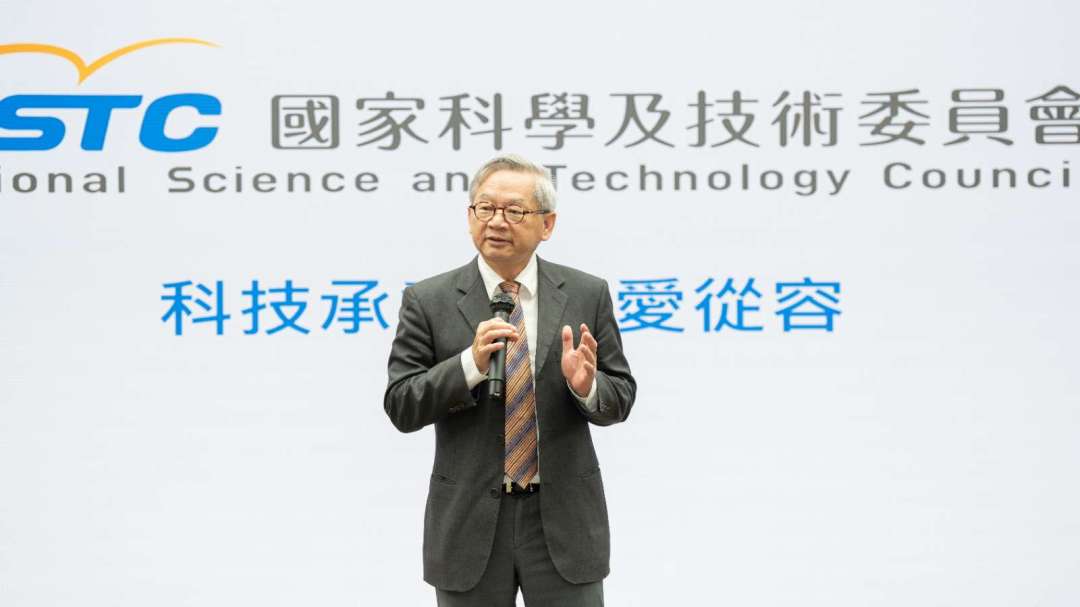
Smart technologies are gradually integrating into the daily lives of older adults, transforming healthcare and caregiving models. Since the Executive Yuan launched the 'Aging Technology Industry Action Plan' over two years ago, it has reached more than 550,000 people. Coordinated by the National Science and Technology Council (NSTC) across ministries, the initiative advances aging-related technologies—from R&D and field validation to service applications—embedding innovation into everyday life. The NSTC held a成果 (achievement) press conference today (23) to share results, demonstrating how technology is becoming a vital support for seniors and caregivers.
Wu Cheng-wen, Minister and Chair of the NSTC and Executive Yuan Policy Advisor, emphasized that Taiwan’s strengths in semiconductors, ICT, and AI, combined with its healthcare system and inter-ministerial collaboration, form a solid foundation for advancing aging technology. After two years of field validation in aging and home-care technologies, practical usage data has helped identify user needs, establish common specifications, and develop data exchange standards. The next phase will support industries in developing scalable, widely deployable products and services to accelerate real-world adoption.
Wu noted that in elderly life support, the program has reached over 550,000 people cumulatively through 236 medical and care institutions, 404 community hubs, and 109 Indigenous Health Stations across Taiwan, establishing replicable and scalable service models to meet the demands of an aging society.
In life support, over 200 digital learning service sites have been established, over 1,000 volunteers trained, and local support services coordinated across 41 townships and districts. These initiatives help seniors enhance digital literacy through digital learning, health promotion, and social engagement. In care applications, AI-powered smart care systems have been introduced in residential long-term care centers to streamline documentation and administrative tasks for caregivers.
The NSTC highlighted that the aging technology program has also driven industrial development, fostering over 140 cross-sector collaborations and accelerating product commercialization and market expansion. In 2025, the health and wellness industry achieved revenues of NT$336.4 billion, with a compound annual growth rate of 8% from 2023 to 2025—demonstrating the program’s role in boosting industrial growth.
Looking ahead, Wu emphasized that to meet emerging needs from an aging society, the government will continue integrating cross-ministerial efforts, expand technology service deployment, improve resource integration and supply-demand matching, support more products and services in reaching the market, and expand into domestic and international markets. This will ensure technology continues to address the needs of an aging society and create new opportunities for Taiwan’s aging technology industry.
FACT BOX
- Source: PR Times
- Category: Event