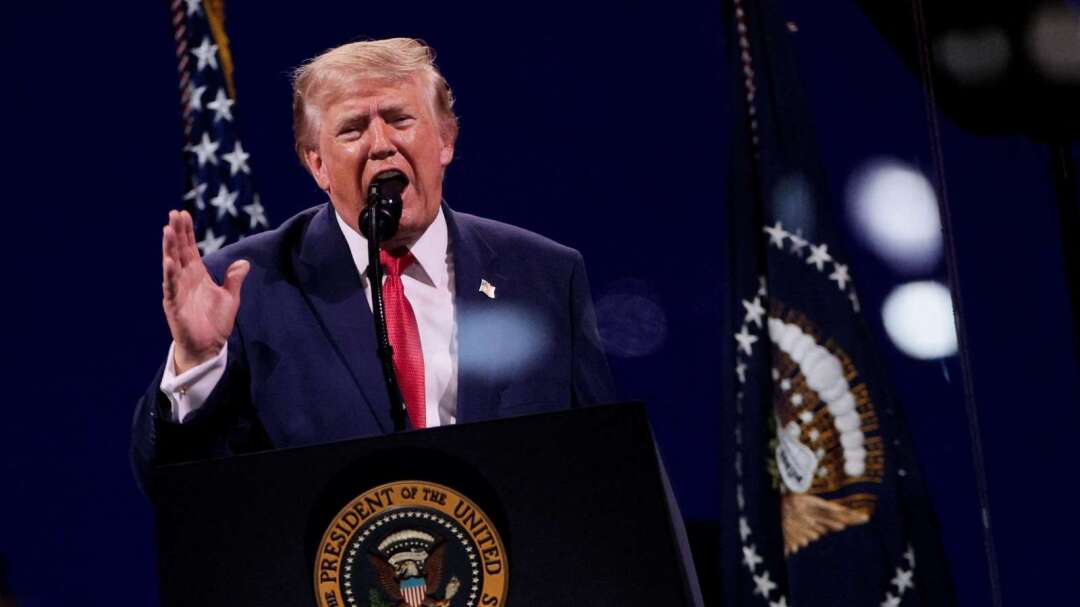
US President Trump said on Friday (24th) that the US military is 'locked and loaded' and prepared to launch a new round of large-scale airstrikes on Iran, but emphasized that no decision has been made to act, as negotiations between the US and Iran continue.
According to Bloomberg, Trump made these remarks at the White House as the US and Iran have engaged in limited military strikes against each other for nearly two weeks, breaking a brief ceasefire aimed at pausing the conflict, and escalating hostilities once again.
Iran has further strengthened its control over the Strait of Hormuz, a critical international shipping route. The US Central Command conducted airstrikes against Iran for the 13th consecutive night on Thursday (23rd), aiming to weaken Iran’s ability to attack commercial vessels transiting the strait. In retaliation, Iran has attacked US military bases in the region, including facilities in Kuwait and Bahrain.
In the Oval Office, when asked whether a major new military operation had been decided, Trump gave a negative answer. He said: 'We are negotiating with them right now. I think, as each day passes, for an obvious reason, they are getting more serious.'
Trump added: 'We are locked and loaded and ready to go. But we're still negotiating with them, so I think as long as the negotiations are ongoing, we'll see what ultimately happens.'
The report notes that these remarks highlight Trump's current dilemma. After the collapse of the temporary ceasefire agreement, the Strait of Hormuz has nearly fallen into a state of closure.
Additionally, on Thursday, Trump warned on his social media platform Truth Social that if Iran and Yemen’s Houthi militants continue attacking commercial vessels, the US will respond with 'major military punishment.'
It remains unclear whether these military decisions are being coordinated with Israel. Israel has been jointly attacking Iran with the US since the conflict erupted in late February. A statement from Prime Minister Netanyahu’s office said he will travel to Washington on Tuesday (28th) to meet with Trump.
On Friday, Trump also warned Russia and China on social media that selling weapons to Iran would 'absolutely not be good for them.' However, he also stated that, to his knowledge, the two countries are currently 'not involved' in this war.
Nonetheless, US and Western intelligence agencies have previously accused China and Russia of providing targeting intelligence and components to Tehran, though both countries deny the allegations.
When asked about who is involved in negotiations with Iran, Trump named Vice President Vance and Secretary of State Rubio. He also said that although soaring oil prices driven by the war could lead American voters to punish the Republican Party at the upcoming November midterm elections, he is not in a hurry to end the conflict.
The Yemeni Houthi militants claimed this week to have attacked a Saudi oil tanker, opening a new front beyond the existing battlefield, causing international oil prices to briefly surpass $100 per barrel and pushing US retail gasoline prices above $4 per gallon. Although Brent crude futures dipped slightly on Friday, they are still up around 10% for the week due to the ongoing conflict.
Earlier this week, Trump also warned Tehran: 'Any damage done to ships, cargo, or related property will be paid for by Iranian funds under US control.'
The US currently holds around $2 billion in frozen Iranian assets, but a much larger portion of Iran’s assets are held in other countries, restricted from transfer due to US sanctions. Estimates of this amount range from $24 billion to over $100 billion.
In response, Iranian Foreign Minister Araghchi posted on X, criticizing that 'using another country’s assets to pay for future claims unrelated to that country sets an extremely dangerous precedent.'
Since the collapse of last month’s ceasefire agreement, the war has entered a new phase of escalation. Although the intensity of fighting is not as high as at its peak, Iran has warned that if Trump carries out his threat to 'destroy one bridge or power plant for every attack on shipping in the Strait of Hormuz,' Iran will retaliate by targeting regional infrastructure, including energy facilities.
The Houthis’ actions this week have extended the conflict to the Bab el-Mandeb Strait, another critical maritime chokepoint connecting Europe and Asia to the Red Sea and Suez Canal. Some vessels have begun avoiding this narrow passage, although two Chinese oil tankers carrying Saudi crude successfully navigated through the strait and exited the Red Sea.
Last month, Trump agreed to a ceasefire with Iran, citing the risk of global economic collapse. With midterm elections approaching, and Republicans hoping to retain their congressional majority, the political pressure on him is mounting.
Polls show that this war is broadly unpopular among the American public. On Thursday, the US House of Representatives passed a resolution for the second time calling on Trump to end the war, though the resolution is symbolic and carries no legal force.
According to Iran’s official Islamic Republic News Agency (IRNA), citing the head of the country’s Health Ministry Information Center, US airstrikes on Iran since June 27 have resulted in 59 deaths and 666 injuries.
The Houthis are part of Tehran’s so-called 'Axis of Resistance,' controlling large parts of northern Yemen, including the capital Sanaa and the Red Sea port of Hodeidah.
Since Israel and Hamas began fighting in Gaza in 2023, the Houthis have repeatedly used drones and missiles to disrupt shipping in the Red Sea.
Trump ordered airstrikes against the group last year, which were later halted after a partial ceasefire agreement was reached.
FACT BOX
- Source: PR Times
- Category: News