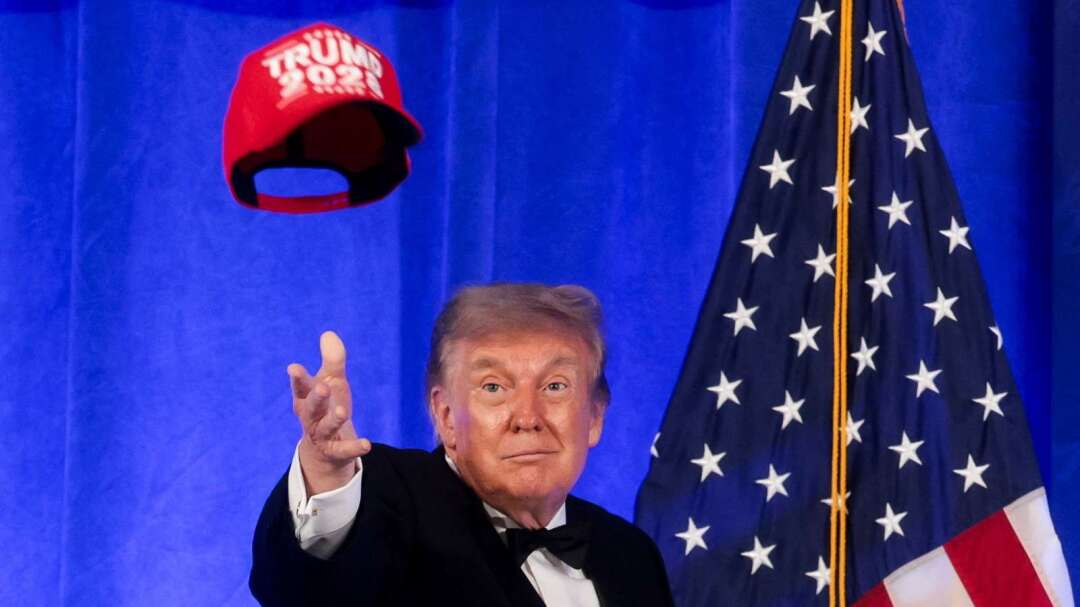
The White House Correspondents' Dinner is traditionally a stage where U.S. presidents showcase humor and self-deprecating wit. However, former President Donald Trump's recent remarks have left observers momentarily unsure whether he was joking or serious. During his speech, he mentioned running for president a 'fourth time' and then put on a pre-prepared red hat emblazoned with 'Trump 2028,' sparking speculation about whether this was a political signal of his intent to seek a third presidential term.
According to France 24, although the U.S. Constitution prohibits a president from serving more than two terms, Trump jokingly revived the idea of pursuing a third term.
Trump said, 'Just like my presidency, the second time is always better, and the third time is even better.' He then added, 'I'm just kidding.'
Yet, he doubled down afterward, pulling out a red 'Trump 2028' hat and declaring, 'I'm very happy to announce—and this is exclusive news—that I intend to run for a fourth term as President of the United States.'
However, as Trump made this high-profile move, several U.S. media outlets released new polls revealing rising voter dissatisfaction with his handling of Iran.
A joint survey conducted by The Washington Post and Ipsos Group from July 8 to 13, polling 2,648 American adults (with a margin of error of ±1.9 percentage points), found Trump's overall approval rating had dropped to just 37%, while disapproval stood at 61%.
The proportion of those who 'strongly support' him has fallen to a new low of 15%, down significantly from 19% in February.
The Iran issue has become a focal point of voter discontent. The survey showed that as many as 69% of respondents disagreed with Trump's handling of Iran, and 68% explicitly stated that the Iran conflict 'was not worth fighting,' a level of dissatisfaction exceeding public sentiment toward the Iraq and Afghanistan wars at the time.
Additionally, about 67% of respondents expressed skepticism about whether U.S. military actions and U.S.-Iran negotiations could effectively prevent Iran from developing nuclear weapons.
Notably, Trump has repeatedly criticized the Iran nuclear deal signed during former President Obama's administration as 'a disaster' and boasted that he would deliver a 'much better' new agreement.
However, poll results show that only 23% of respondents believe the agreement negotiated by the Trump administration would be better than the Obama-era version, while 37% believe the situation would be worse—even among Republican supporters, optimism remains limited.
Beyond foreign and military issues, American public sentiment toward the economy is also deeply pessimistic. Approximately 67% of respondents expect the economy to continue weakening over the next year, and 43% frankly say their current standard of living is 'worse' than when Trump first returned to the White House—a figure that has surged 10 percentage points since February.
Additionally, about six in ten Americans question whether the outcomes of U.S.-Iran negotiations will truly bring oil prices back to pre-conflict levels.
CNN analysis points out that this poll confirms a fact from multiple angles: the Trump administration has consistently failed to build a convincing policy narrative for its military actions against Iran, causing this ongoing conflict to gradually become a heavy political burden on Trump's path to governance.
Looking back at the timeline, the U.S. and Iran originally signed a memorandum of understanding remotely in June, after which Iran reopened the strategically significant Strait of Hormuz, and the U.S. lifted its maritime blockade.
However, the situation took a sudden turn. On June 26, the U.S. military resumed military strikes against Iran, citing Iran's attack on commercial ships transiting the Strait of Hormuz. Trump then announced on July 13 the reinstatement of the maritime blockade on Iran.
The New York Times reported on the 13th that Trump had formally notified Congress that the Iran conflict had resumed. Trump himself took a hardline stance in a Fox News interview the next day, stating that U.S. military action against Iran would continue 'until I say stop.'
FACT BOX
- Source: PR Times
- Category: News
- Organizations: France 24 / Washington Post / CNN