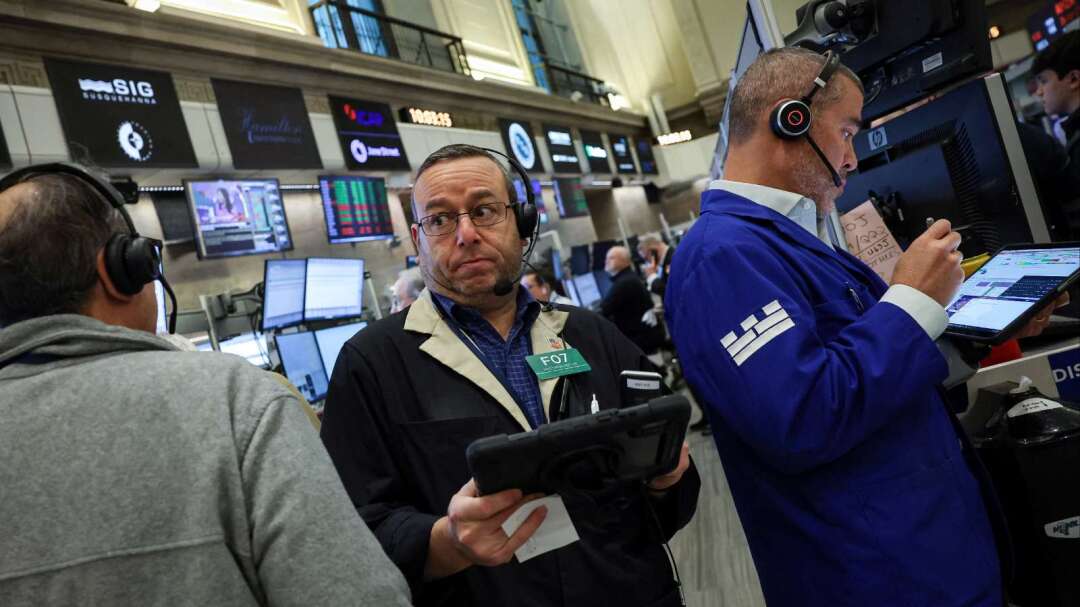
US stocks ended last week with significant volatility, but market participants widely believe the real stress test is just beginning.
International oil prices surged nearly 10% in a single week, institutional investors heavily adjusted tech stock positions, and US Treasury yields hit year-to-date highs—three forces that have yet to be fully absorbed.
However, this week brings even denser variables. Approximately 34% of S&P 500 constituents are scheduled to report earnings, including four of the 'Magnificent Seven' tech giants. Microsoft (MSFT-US) and Meta (META-US) are set to release results after market close on Wednesday (29th), followed by Apple (AAPL-US) and Amazon (AMZN-US) on Thursday (30th).
Simultaneously, the Federal Reserve's Federal Open Market Committee (FOMC) will announce its interest rate decision on Wednesday. Markets currently price in about a 30% chance of a rate hike at this meeting. The convergence of earnings and policy signals makes this week a pivotal moment for Q3 market direction.
Options traders have already positioned themselves ahead of expected post-earnings volatility. Implied volatility data shows expected single-day moves of 7.4% for Meta, 6.6% for Amazon, 6.4% for Microsoft, and a relatively mild 3.7% for Apple. Overall, the S&P 500's implied weekly volatility stands around 1.85%. Goldman Sachs has advised clients to increase hedging positions.
AI Capital Expenditure in Focus as Big Tech Stocks Tumble
Investor patience over whether mega-cap tech firms can deliver returns on massive AI investments is rapidly thinning—a key theme for this earnings season.
Alphabet (GOOGL-US), which reported first, exemplifies this. Its core business performed solidly—cloud revenue grew 82% year-on-year and search revenue rose 17%. Yet, the company raised its 2026 capital expenditure guidance to $195–205 billion and reported a rare negative free cash flow, causing its stock to plunge about 8% that week.
Tesla (TSLA-US) disappointed investors further, missing non-GAAP EPS expectations in Q2 and seeing its stock drop nearly 20% weekly. The market is losing patience with the pace of monetization for its AI-related themes like humanoid robots and autonomous driving.
Ken Mahoney, CEO of Mahoney Asset Management, noted that investors' biggest concern is that these companies are funneling nearly all cash flow into AI and data center construction, leaving little room for buybacks or dividends. The actual return on these massive investments remains stuck in the 'proof-of-concept' phase.
Notably, the US Magnificent Seven ETF (MAGS-US), tracking the seven tech giants, fell over 5% last week, while semiconductor ETFs rose.
Analysts suggest this reflects a loosening market logic: semiconductor stocks' bullish case was built on the assumption of sustained spending by big tech. Now that these 'funders' are being punished for over-spending, the foundation for chip stocks may weaken.
Credit markets are also flashing warning signs: CDS spreads for mega-cap tech firms have reached record highs.
Year-to-date, AI-related corporate bond issuance has hit $489 billion, up 50% year-on-year, with 60% coming from non-traditional mega-cap tech issuers.
Additionally, markets are starting to watch the potential impact of the growing open-source model camp.
NVIDIA (NVDA-US) CEO Jensen Huang and Tesla CEO Elon Musk have recently voiced support for open-source approaches, raising concerns among traders. If this trend solidifies, model costs could fall, reducing capital expenditure needs, weakening return expectations, and triggering a reflexive contraction in AI-related spending—potentially reverting semiconductor stocks to traditional cyclical logic.
Goldman Sachs trading desk flow data is also concerning: overall net selling dominates, with selling pressure at 12.6%, and long-term capital net selling reaching 21%, concentrated in consumer and real estate sectors.
The desk described the market as 'seeing almost no buying interest.' The S&P 500 has broken below its 50-day moving average, market makers have shifted to negative Gamma, and hedge fund strategy-related inquiries have spiked—technical indicators continue to weaken.
Fed Decision Uncertainty Looms: 30% Hike Probability in Focus
Beyond earnings, the FOMC will announce its latest rate decision on Wednesday.
The consensus still expects a September hike, but fed funds futures currently price in a 30–35% chance of a hike this week.
Brian Garrett, Goldman Sachs derivatives strategist, noted that if the Fed holds steady, it would deliver the strongest 'dovish surprise' since its 50-basis-point cut in 2024.
With oil-driven inflation expectations rising, whether the Fed acts preemptively is the week’s biggest macroeconomic question.
Key data including Q2 GDP advance, core PCE price index, personal income, and spending will also be released.
Volatility markets ask: Has the rally peaked?
Bloomberg analysts Neil Campling and Christian Dass recently posed three sharp questions:
Has the AI capex trade already peaked?
Is the excess return from dispersion trading strategies ending?
Is risk properly priced?
Currently, implied stock correlation is extremely low, raising concerns among investors that sentiment could reverse at any moment. Some traders are shifting to 'reverse dispersion trades'—buying index volatility while selling individual stock volatility.
Analysts warn that if a macro surprise triggers synchronized stock declines and forced liquidations, crowded strategies could amplify index volatility.
Sebastian Raedler, European strategy head at Bank of America, is more direct: profit margin expectations, 5-year earnings growth forecasts, and global equity market cap-to-GDP ratios are all at historical highs, while risk premiums sit at 20-year lows—suggesting markets are pricing in a 'perfect world' scenario.
Yet, bullish factors remain. S&P 500 Q2 earnings are forecast to grow 38% YoY—far exceeding initial expectations—making corporate earnings the strongest bull argument.
Citi’s global macro strategist Dirk Willer remains bullish but admits risks are 'far from negligible,' describing the market as 'climbing a wall of worry.'
Notably, if July ends in decline, historical patterns suggest August and September—typically the weakest months in US midterm election years—could see average S&P 500 drops of 0.4% and 0.8% respectively.
Goldman Sachs’ internal market panic indicator has risen to levels last seen during the Iran tensions earlier this year. As 34% of S&P 500 market cap reports earnings, four tech giants face scrutiny, and the FOMC decision lands, the long-anticipated battle between bulls and bears may finally be resolved.
FACT BOX
- Source: PR Times
- Category: News
- Organizations: Alphabet / Tesla / Microsoft
- Products / services: ETF