South Korea is rapidly solidifying its position as a key player in the global artificial intelligence (AI) supply chain. Through unprecedented-scale chip supply and infrastructure collaboration agreements with major U.S. tech companies, South Korean firms such as Samsung Electronics and SK Hynix (SKHY-US) are not only securing massive long-term orders but also forging tighter strategic partnerships with the United States in the AI industry.
According to a Reuters report, Kim Yong-beom, economic advisor to South Korea’s president, stated on Saturday (25th) that Samsung Electronics and SK Hynix will sign memory chip supply agreements totaling approximately $950 billion with U.S. tech firms, including NVIDIA (NVDA-US).
Of this, SK Hynix will supply around $750 billion worth of long-term memory products to U.S. companies, while Samsung Electronics will deliver approximately $200 billion worth of chips to Broadcom (AVGO-US).
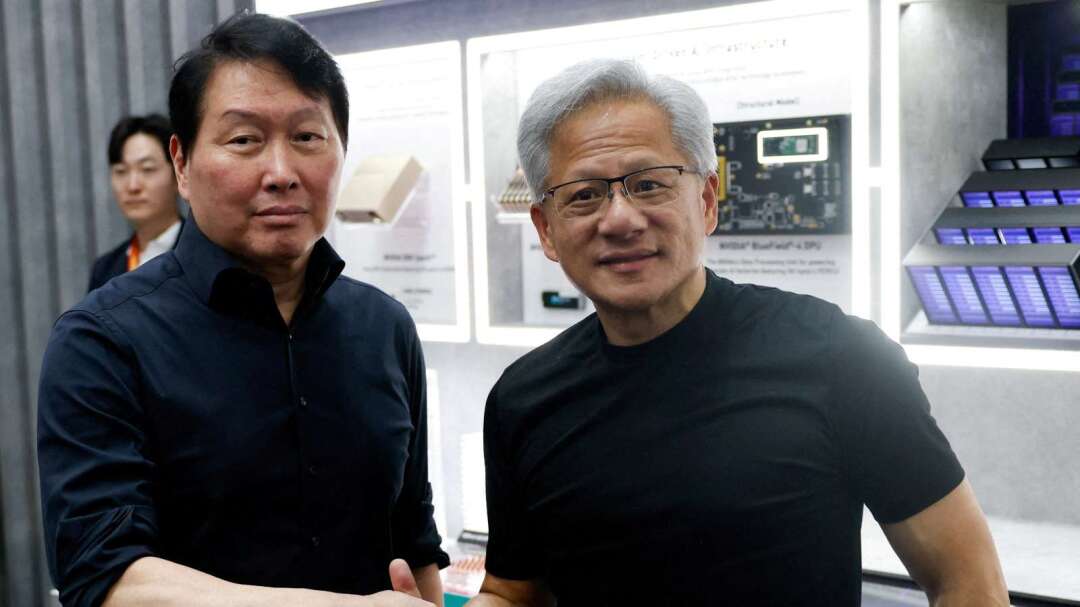
In addition to the massive supply agreements, NVIDIA and the SK Group have announced an AI infrastructure investment plan exceeding $500 billion, covering large-scale data centers and the joint development of next-generation high-bandwidth memory (HBM) technology.
Market analysts believe these collaborations will help alleviate the current critical HBM supply bottleneck in the AI industry while providing stable long-term revenue for South Korea’s memory chip giants.
Long-Term HBM Supply Locked In: SK Hynix Expands Production for AI Demand
With the rapid growth of generative AI, AI agents, and robotics applications, HBM has become an indispensable component for AI chips and one of the most constrained segments in the current supply chain.
As NVIDIA’s largest current HBM supplier, SK Hynix’s long-term supply agreement with U.S. partners ensures stable delivery of advanced memory and includes joint development of next-generation HBM products targeting emerging applications such as AI training, AI agents, and physical AI.
To meet rising demand, SK Hynix plans to double its wafer production capacity by 2030 and align future HBM production timelines more closely with NVIDIA’s AI chip development schedules.
Meanwhile, Samsung Electronics’ collaboration with Broadcom has evolved beyond simple supply. According to Bloomberg, the two companies have signed a strategic memorandum of understanding (MOU) with a cooperation scale exceeding $200 billion over the next five years, covering both memory and foundry services.
Specifically, in storage, Samsung will supply advanced memory products for Broadcom’s next-generation AI accelerators. The two will jointly develop next-generation chips using 2-nanometer and below process technologies and integrate advanced packaging technologies such as 2.3D and 2.5D to enhance the performance and energy efficiency of AI and networking chips.
NVIDIA and SK Invest Over $500 Billion in AI Data Centers
Beyond chip supply, the U.S. and South Korea are also expanding investments in AI infrastructure.
The over $500 billion plan announced by NVIDIA and the SK Group includes building large-scale AI data centers and advancing HBM4 technology development.
Specifically, SK Telecom will construct a 2GW (gigawatt) AI data center in South Korea. The first facility will use NVIDIA’s latest Vera Rubin platform and SK Hynix’s HBM4 memory, with operations expected to begin in 2027.
This project is a key step in SK Telecom’s plan to build large-scale AI cloud infrastructure, with future funding expected to come from global tech firms, overseas capital, and other strategic partners.
Additionally, NVIDIA continues to expand its investment in South Korea’s AI market. According to Bloomberg, NVIDIA has announced a $1 billion investment in Naver to help expand its AI data center, enabling Naver to scale up its NVIDIA-powered AI computing platform data center to more than three times its original size.
President Lee Jae-myung Announces 'San Francisco AI Declaration' to Advance U.S.-South Korea AI Strategic Cooperation
The rapid warming of industrial cooperation reflects South Korea’s government actively promoting its national AI strategy.
On Friday (24th), South Korean President Lee Jae-myung hosted an AI summit in San Francisco and formally unveiled the 'San Francisco AI Declaration,' announcing plans to deepen cooperation with the United States in AI and open South Korea’s AI ecosystem to global enterprises, aiming to establish the country as a world-class AI industrial hub.
During the summit, President Lee held talks with NVIDIA CEO Jensen Huang, OpenAI CEO Sam Altman, Anthropic CEO Dario Amodei, and Broadcom CEO Hock Tan.
On the South Korean corporate side, Samsung Electronics Chairman Jay Y. Lee, SK Group Chairman Chey Tae-won, Hyundai Motor Group Chairman Euisun Chung, and Naver founder Lee Hae-jin also attended the summit.
In an interview, Jensen Huang stated that South Korea is entering a 'golden era.' Not only is its semiconductor industry continuing to grow, but its comprehensive industrial system equips South Korea with the critical capability to assist in building global AI infrastructure, positioning it to play an increasingly vital role in the global AI supply chain.
FACT BOX
- Source: PR Times
- Category: Partnership
- Organizations: Naver / OpenAI / Anthropic