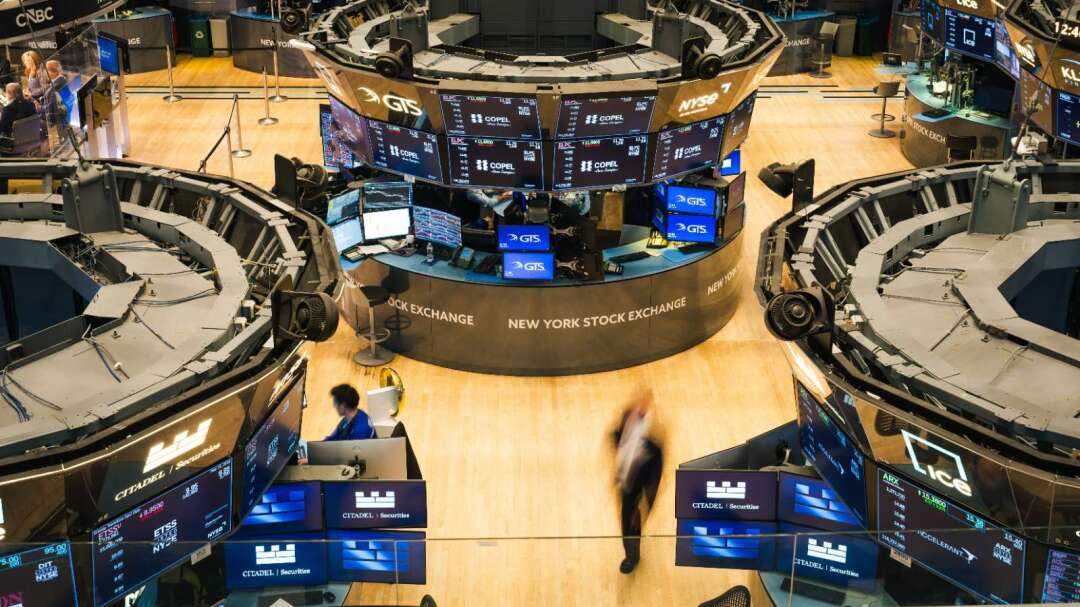
U.S. stocks traded mixed on Tuesday (28th), as better-than-expected earnings from companies like Coca-Cola and a sharp drop in global oil prices drove capital into consumer, financial, and healthcare sectors, sending the Dow Jones Industrial Average soaring over 500 points—the third consecutive day of gains.
The semiconductor sector, however, saw another wave of heavy losses. The Philadelphia Semiconductor Index (SOX) plunged nearly 5%, with memory chip stocks hit hardest—Micron and SK Hynix ADRs dropped over 8%, and SanDisk tumbled 13%.
Investors are concerned that NVIDIA (NVDA-US) may fund OpenAI-related data center projects with approximately $250 billion, potentially deepening circular financing risks in the AI industry.
Meanwhile, China's progress in AI models, memory chips, and domestically produced immersion deep ultraviolet (DUV) lithography machines has intensified competitive fears, triggering sharp sell-offs in Asian and European chip stocks, which later spread to U.S. semiconductor equities.
South Korea's Kospi index fell 8% during the session, triggering its eighth circuit breaker this year. After trading resumed, selling pressure intensified, closing down 10.8%—further shaking global confidence in the semiconductor market.
However, falling oil prices supported broader U.S. markets. The U.S. and Iran maintained a ceasefire that began over the weekend, sending West Texas Intermediate (WTI) crude futures down about 4% to $79.26 per barrel. Brent crude futures dropped 4.8% to $84.09 per barrel.
Discussions between Iran, Saudi Arabia, and Oman on issues related to the Strait of Hormuz eased market concerns over potential oil supply disruptions. Still, President Trump reiterated on Tuesday that the U.S. could attack Iran's bridges and power plants if Tehran refuses to reach a deal.
The Federal Reserve is set to announce its interest rate decision on Wednesday. Markets widely expect no rate change, but investors will closely watch the statement and officials' comments for clues on future monetary policy.
According to the CME Group's FedWatch tool, federal funds futures currently reflect a potential 25-basis-point rate hike in September.
Corporate earnings remain another key focus this week. Amazon (AMZN-US), Apple (AAPL-US), Meta Platforms (META-US), and Microsoft (MSFT-US) will release their latest results, with investors scrutinizing AI capital expenditures, cloud business growth, and profit outlooks to assess whether tech stock selling pressure may ease.
U.S. major indices on Tuesday (28th):
Dow Jones Industrial Average rose 537.24 points, or 1.03%, to 52,747.32.
Nasdaq Composite fell 55.17 points, or 0.22%, to 24,876.91.
S&P 500 gained 15.60 points, or 0.21%, to 7,428.78.
Philadelphia Semiconductor Index dropped 519.20 points, or 4.49%, to 11,035.68.
NYSE FANG+ Index fell 132.21 points, or 0.78%, to 16,776.71.
Key individual stocks:
Tech giants in the NYSE FANG+ Index showed mixed performance. Meta (META-US) dipped 0.08%; Apple (AAPL-US) rose 0.94%; Alphabet (GOOGL-US) gained 2.19%; Microsoft (MSFT-US) climbed 1.09%; Amazon (AMZN-US) fell 0.23%.
Philadelphia Semiconductor stocks remained weak. AMD (AMD-US) plunged 8.15%; Broadcom (AVGO-US) fell 0.60%; NVIDIA (NVDA-US) rose 0.25% against the trend; Applied Materials (AMAT-US) dropped 7.82%; Qualcomm (QCOM-US) fell 4.21%; Micron (MU-US) sank 8.85%.
Taiwanese ADRs mostly closed lower. TSMC ADR (TSM-US) fell 1.70%; ASE ADR (ASX-US) plunged 7.17%; UMC ADR (UMC-US) collapsed 9.01%; Chunghwa Telecom ADR (CHT-US) rose 0.37% against the trend.
Company news:
Amid broad semiconductor weakness, Apple (AAPL-US) rose over 0.9% to $340.08, briefly surpassing a $5 trillion market cap.
Beverage giant Coca-Cola (KO-US) reported Q2 revenue and earnings above expectations and raised its full-year forecast, sending shares up 4.97% to $88.27—the best single-day performance since 2009.
Boeing (BA-US) surged 4.76% to $221.56 after reporting quarterly revenue above expectations and generating $600 million in positive free cash flow.
PayPal (PYPL-US) jumped over 4% to $58.32, boosted by an upward revision to its full-year profit forecast and cost-cutting initiatives.
Corning (GLW-US) plunged over 12% to $126.01. Despite strong revenue and earnings driven by robust demand for AI data center infrastructure, its conservative guidance sparked concerns about sustained growth.
Wall Street analysis:
The semiconductor selloff did not drag down the broader market, instead highlighting a trend of capital rotating from high-valuation tech stocks to traditional sectors.
The SPDR Technology Sector ETF (XLK-US) fell to its lowest level since May 7, while the SPDR Healthcare ETF (XLV-US) and Financial Sector ETF (XLF-US) both hit record highs, with financials driven by insurance stock gains.
Ross Mayfield, investment strategist at Baird, noted the rotation is broad-based and momentum trading has been fading for 6 to 8 weeks—driven more by technical market factors than fundamental shifts in corporate performance.
However, he cautioned that whether cyclical sectors like financials, industrials, and consumer discretionary can sustain gains depends on whether interest rates and oil prices remain stable. If both short- and long-term Treasury yields rise and oil reapproaches $100 per barrel, these sectors may struggle to maintain investor support.
Kevin Gordon, strategist at Charles Schwab, said multiple factors have cushioned the impact of chip stock declines on the broader market, but investors must remain vigilant for signs that the current market-supporting trends might reverse.
(All figures are as of press time and subject to change based on actual market quotes.)
FACT BOX
- Source: PR Times
- Category: News
- Organizations: Coca-Cola / NVIDIA / OpenAI