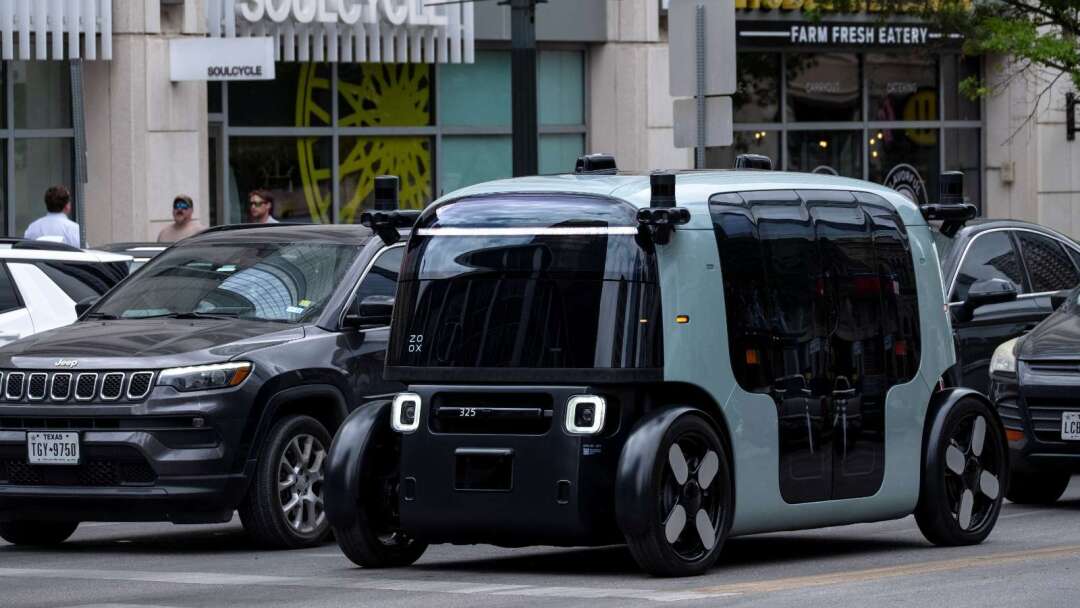
According to Reuters on Thursday (30th), Zoox, the self-driving car company under Amazon (AMZN-US), has received U.S. government approval to limited commercial deployment of autonomous taxis without human-operated devices such as steering wheels or brake pedals, marking the first case in the U.S. autonomous ride-hailing industry. Zoox stated it will begin charging passengers in Las Vegas, and expand services to other markets once it complies with state regulations.
The National Highway Traffic Safety Administration (NHTSA) announced on Thursday that it is granting Zoox an exemption from certain federal regulations requiring human-operated controls. This decision is significant, indicating that vehicles specifically designed for full autonomy no longer need to fully comply with safety standards originally created for human-driven vehicles before autonomous technology existed.
Zoox’s self-driving vehicle features a cabin-like design with no traditional driver’s seat. It has two rows of face-to-face seating and can reach a top speed of 75 mph (approximately 120 km/h). The company is already conducting passenger-carrying tests in parts of Las Vegas and San Francisco. The newly granted exemption will allow Zoox to begin charging passengers once it receives approval from state and local authorities.
Deployment of Up to 5,000 Vehicles Over Two Years
Jonathan Morrison, NHTSA Administrator, told Reuters that Zoox is authorized to deploy up to 2,500 self-driving vehicles annually for the next two years, with a total cap of 5,000 vehicles. Zoox is prohibited from selling these vehicles to the general public and may only use them for its own autonomous ride-hailing operations.
NHTSA determined that Zoox’s vehicles are as safe as comparable vehicles meeting current federal motor vehicle safety standards. Morrison noted that Zoox’s system clearly exceeds certain performance requirements of conventional vehicles, but regulators must still verify that the autonomous system functions properly in real-world road conditions.
As a condition of the exemption, Zoox must comply with additional reporting requirements, including reporting collisions, improper roadside stops, and other abnormal behaviors. NHTSA will adjust the exemption terms based on the fleet’s actual performance and reserves the right to revoke the approval if significant safety issues arise.
All of Zoox’s remote operators must be located within the United States. The company must also publicly disclose maps of its vehicle operating areas so the public can understand where the autonomous taxis are operating.
This approval marks a significant advancement for Zoox in the autonomous ride-hailing race. Tesla (TSLA-US) and Alphabet’s (GOOGL-US) Waymo are also accelerating the expansion of their autonomous ride-hailing services in the U.S. Tesla has already begun production of its Cybercab, which similarly lacks traditional human-operated controls, but has not yet explained how it will obtain regulatory approval.
Safety Concerns Remain
U.S. regulators are working to modernize outdated regulations to balance relaxing restrictions on autonomous technology while maintaining road safety. Morrison said NHTSA expects to establish the first federal safety standards for autonomous driving systems before the end of the Trump administration and plans to revise existing rules based on human-driven assumptions, such as brake pedals and rearview mirrors.
However, concerns remain about autonomous vehicles’ behavior on roads. Morrison recently sent a letter to autonomous vehicle developers, urging them to immediately address incidents where driverless vehicles obstruct police, firefighters, and other first responders.
Past incidents include autonomous taxis bypassing stopped school buses, entering construction zones, suddenly stopping on flooded roads or busy intersections, and violating traffic rules. These have raised public safety concerns and prompted some companies to recall vehicles.
Zoox recently issued a recall of 105 of its self-driving vehicles to update software, due to a potential failure to correctly detect smoke in emergencies such as fires. Morrison warned that if similar issues persist, NHTSA will not hesitate to exercise its full enforcement authority.
While Zoox has become the first to overcome federal regulatory barriers for fully driverless vehicles without human controls, its ability to smoothly expand paid services will depend on the pace of state approvals and the vehicles’ safety performance in real-world conditions.
FACT BOX
- Source: PR Times
- Category: News
- Organizations: Amazon / Tesla / Alphabet