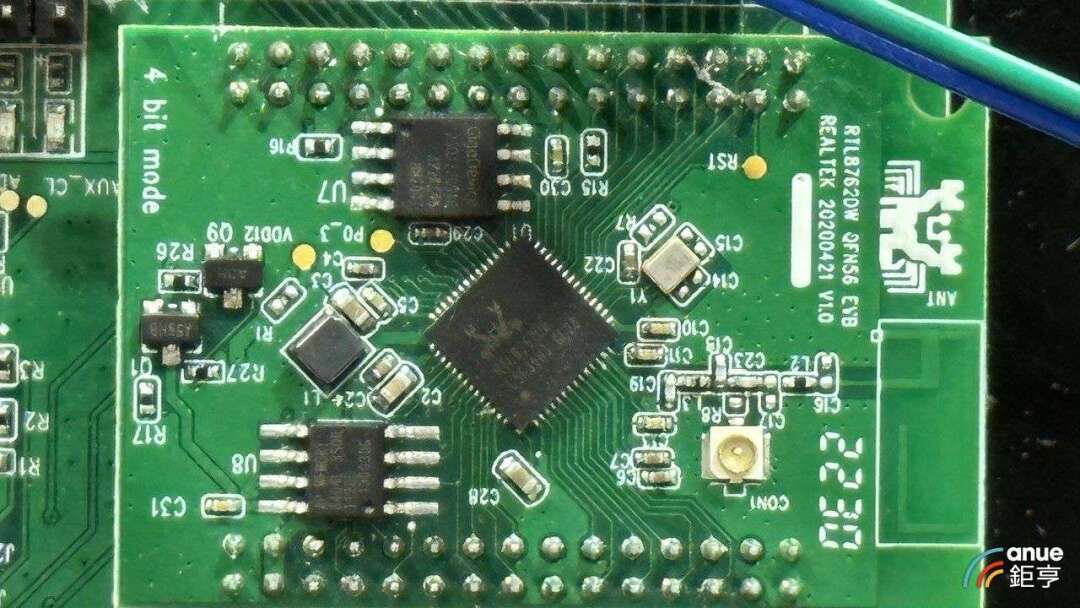
Realtek (2379-TW) held its earnings conference call today (30th), stating that due to supply chain supply-demand adjustments, continuously rising memory and wafer costs, and weakening demand in certain end markets, it maintains a cautious yet stable outlook for short-term operations. Despite varying visibility across application markets, Realtek still expects all major product lines to achieve revenue growth compared to last year in 2024.
Realtek's Q2 revenue reached NT$37.553 billion, up 3.1% quarter-on-quarter and 17.7% year-on-year. Gross margin was 47%, down 2.7 percentage points quarter-on-quarter and 3.2 percentage points year-on-year. Operating margin was 9.9%, down 2 percentage points quarter-on-quarter and 2.7 percentage points year-on-year. Net profit after tax was NT$3.805 billion, down 12.1% quarter-on-quarter and 2.7% year-on-year, with earnings per share at NT$7.42.
Facing continuously rising costs, Realtek acknowledged that the current cost pressures include rising memory prices, constrained wafer supply, increased manufacturing costs, and the potential for further price hikes in mature process wafers in the second half. Due to the broad impact, almost no product can remain unaffected. Therefore, since early June, the company has initiated price negotiations with customers, with new pricing terms gradually taking effect starting in Q3.
Realtek emphasized that over the past period, it has improved product cost structures and absorbed part of the unexpected costs internally. However, the current memory price increases and wafer supply pressures have reached a level that cannot be fully absorbed by the company alone. Therefore, price adjustments will be negotiated case by case based on product category, supply conditions, and long-term customer relationships.
Looking ahead to the second half, Realtek expects continued divergence in performance across different product lines. The PC market continues to face demand pressure due to early inventory builds in the first half, rising memory and CPU costs, and higher end-product pricing. Performance in the second half may be lower than in the first half.
Realtek's PC-related product revenue accounted for 33% of total revenue in Q2, while non-PC products rose to 67%. The company expects PC-related shipments in the second half will not significantly exceed those in the first half, especially in price-sensitive entry-level consumer PC and notebook markets, which may face greater impact.
However, commercial PCs, mid-to-high-end notebooks, and AI PCs are undergoing continuous specification upgrades, which are expected to increase the per-unit value of high-speed networking, audio, USB, camera, and peripheral control chips. Enterprise PC refresh cycles, Windows 11 migration, AI PC deployment, and digital transformation continue to support relatively resilient demand in commercial and enterprise PC segments.
The networking market fundamentals remain relatively stable. In the broadband market, 10G PON is gradually becoming the mainstream specification, with major telecom operators beginning to test 25G PON architectures. Enterprise switches continue to benefit from equipment upgrades in campuses and branch offices, while consumer routers are upgrading toward high-end products such as mesh, tri-band, and Wi-Fi 7.
Realtek estimates that Wi-Fi 7 penetration in the notebook market will reach about 30% in 2024, though actual adoption speed will be affected by cost, inventory, and brand strategy. Upgrading to Wi-Fi 7 requires higher DDR capacity and system costs, so some broadband applications still primarily use Wi-Fi 6, which will not exit the market rapidly in the short term.
Wi-Fi 8 is expected to become the industry's primary technical focus next year, with manufacturers already conducting interoperability testing. Commercialization may first appear in PCs and routers, with the earliest end products expected to launch in Q1 2028. Major telecom operators in Europe and the U.S. may also begin deploying Wi-Fi 8 routers in 2028.
In consumer electronics, TV demand has begun to slow after the World Cup, but Realtek's TV SoC grew faster than the company average in the first half. Home appliances maintain steady growth, benefiting from heatwaves, energy efficiency regulations, and replacement demand. The gaming console market has a weaker short-term outlook due to rising memory and storage costs and higher end-product prices.
In the automotive market, Realtek expects demand to remain stable to strengthening in the second half, primarily driven by growth in European electric vehicles and the continued adoption of automotive Ethernet. The company noted that automotive Ethernet is gradually transitioning from a luxury car feature to a core automotive architecture, with ADAS and smart cabin systems continuously increasing demand for high-speed, low-latency, and highly reliable connectivity.
Realtek is also continuing its expansion into AI servers and high-speed networking, initially entering through 10G Ethernet, I3C Hub, USB Hub, PON, and server control plane switches, and later expanding into Smart NICs, optical communication PHYs, and high-speed data switches.
Among these, the 100G Optical PHY is expected to be ready for mass production as early as Q1 2027, initially targeting the 100G optical transceiver module and active optical cable markets. The SSD controller chip has already been adopted by a leading GPU AI platform through module customers.
FACT BOX
- Source: PR Times
- Category: 財務報告
- Products / services: 100G Optical PHY