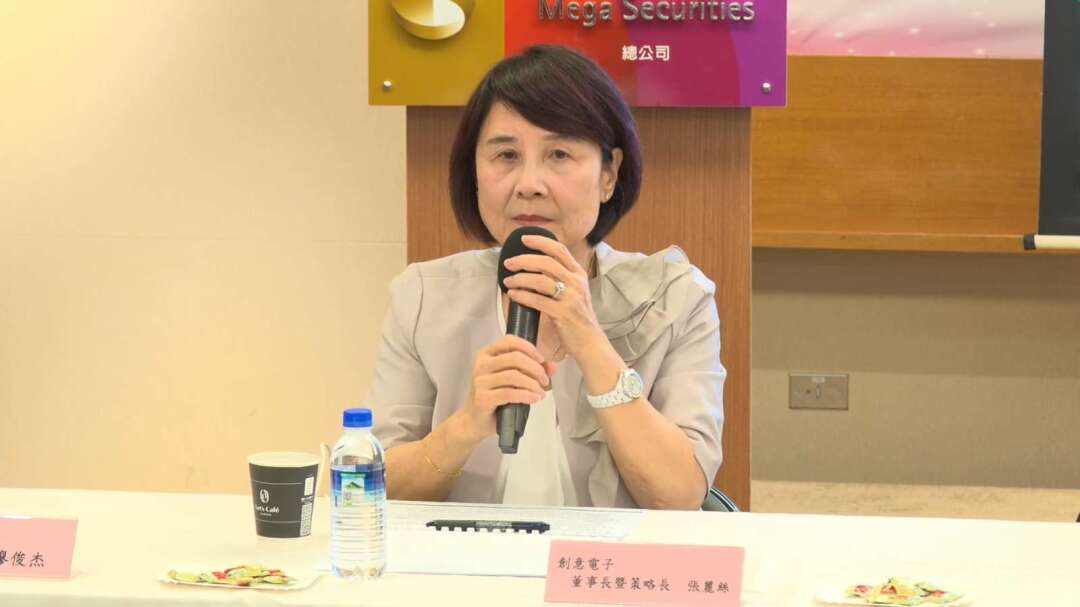
Creativity (3443-TW) held its earnings conference today (31st), where analysts inquired about the company's access to advanced process and advanced packaging capacity for next year. CEO Tai Shang-Yi stated, 'We are very optimistic, very optimistic' about capacity acquisition for next year based on current conditions. The market believes that as a subsidiary of TSMC (2330-TW)(TSM-US), which holds approximately 35% of Creativity, the deep-rooted relationship between the two companies enables Creativity to receive preferential capacity support amid the current global shortage.
Creativity's Q2 revenue increased by approximately 20% quarter-on-quarter this year, exceeding initial expectations, driven by additional capacity allocation.
Looking ahead to the second half of the year, Creativity expressed higher optimism for revenue momentum compared to the first half. Revenue mix is expected to remain similar to Q2, primarily driven by cloud and AI-related businesses, although cryptocurrency applications will gradually be replaced by automotive applications.
Regarding capacity, Tai explained that following TSMC's historical practices, next year's capacity allocations are typically confirmed within the next one to two months. 'We are very optimistic, very optimistic' at this stage, but actual operations next year will depend on two factors: whether TSMC can ultimately meet the required capacity demand, and whether customer demand forecasts will materialize.
On the major North American customer, Tai noted that Creativity has secured the customer's next-generation project, expected to enter mass production by the end of this year to early next year. Revenue contributions will gradually reflect this, and the project's long-term continuity is high, leading to an optimistic outlook for this customer.
Regarding the North American automotive customer, Tai mentioned that the customer's CEO has publicly stated plans to expand beyond electric vehicles into robotics. Creativity remains optimistic about the project's outlook and is actively pursuing deeper collaboration on existing-generation products, with high confidence in securing the next-generation project. The NRE project timeline and progress are already very clear.
Addressing market concerns that large CSP customers may gradually bring chip design capabilities in-house, Tai acknowledged that it is an inevitable trend for ASIC customers to strengthen internal design capabilities, especially for core product lines, which may eventually be taken over by customers. However, internal resources cannot cover all SKUs, so even with increased in-house design, customers will continue to outsource some projects to external ASIC partners.
Tai emphasized that Creativity possesses strong technical capabilities in advanced packaging, even surpassing some large IC design companies. As major software and cloud companies build chip design capabilities from the top down, Creativity is expanding upward from packaging and backend design, enabling both sides to connect in the middle design service segment.
New Chairman and Chief Strategy Officer Lisa Chang stated that she will identify Creativity's value and leverage her 29 years of experience at TSMC to deepen collaboration with TSMC's R&D, process, manufacturing, and engineering teams. She aims to promote Design-Technology Co-Optimization (DTCO) to differentiate Creativity from other ASIC players.
Chang emphasized that Creativity does not want to remain a general service provider but aims to develop unique, niche, high-value-added solutions. By discussing customer needs in depth and combining them with TSMC's process and technology capabilities, the company will push the performance, power, and area (PPA) of next-generation products to the extreme, giving customers a clear rationale for supplier selection.
In advanced packaging, Creativity is proactively preparing resources such as CoWoS, HBM, and package substrates to ensure customers' products can achieve timely mass production. If HBM prices rise, final packaging product prices will be adjusted accordingly, with costs原则上 borne by customers, not absorbed by Creativity.
Beyond cloud and AI, Creativity is actively expanding into automotive, Arm architecture processors, and optical interconnect applications. While AI remains the primary growth driver for the next few years, the company recognizes it cannot rely solely on AI. Although automotive applications require long certification periods and are difficult to penetrate, once adopted, they offer longer product lifecycles and higher customer stickiness, positioning them as a stable long-term business pillar.
FACT BOX
- Source: PR Times
- Category: Event
- Organizations: TSM-US