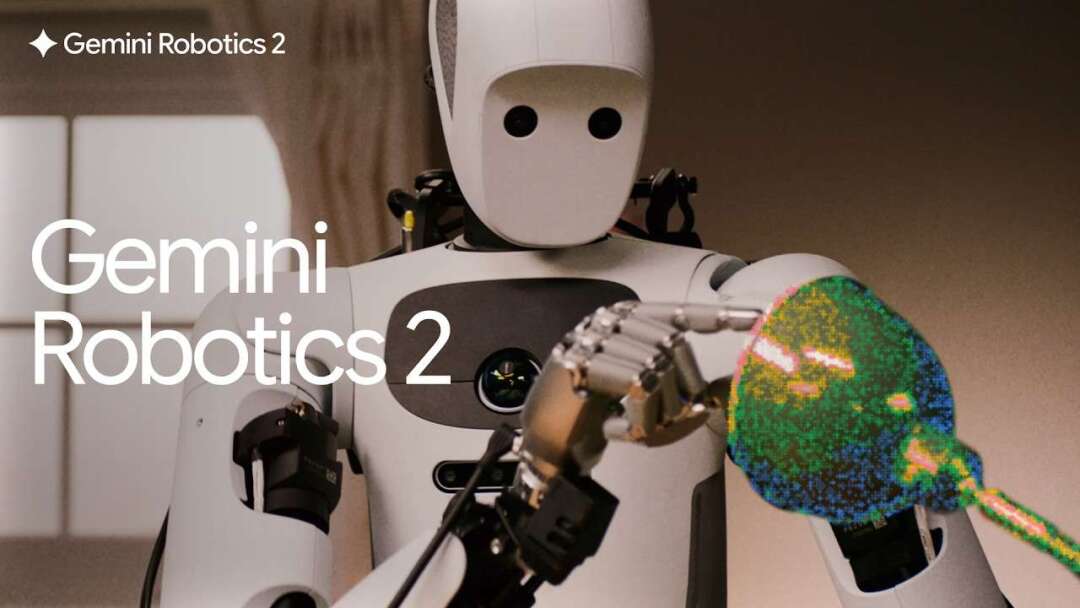
Alphabet (GOOGL-US) subsidiary Google DeepMind officially launched its next-generation robotics AI model, Gemini Robotics 2, this week. This breakthrough advancement enables humanoid robots to achieve coordinated full-body movement from head to toe, signifying a critical step forward for the tech giant in the race to extend artificial intelligence capabilities into the physical world.
The key technical highlight of Gemini Robotics 2 is the expansion of control over humanoid robots from previously limited upper-body operations to full-body coordination. This means robots can now simultaneously perform complex reasoning tasks while executing high-difficulty actions such as walking, crouching, and precisely manipulating objects.
In a recent demonstration for the media, the model successfully controlled Apptronik's Apollo humanoid robot to autonomously navigate around obstacles, cross a room, accurately pick up a watering can, and place it on a lower shelf—completing the entire workflow and demonstrating a high degree of autonomous coordination.
At the same time, Google DeepMind also unveiled two companion models: Gemini Robotics ER 2 and On-Device 2. These new products can operate independently or work in tandem, aiming to support robots in planning multi-step tasks and coordinating multiple robots to perform operations together, further enhancing its robotics AI software ecosystem.
While this release showcases Google's strong capabilities in embodied artificial intelligence, the company maintains a cautious internal assessment of the current technology. Carolina Parada, Vice President of Robotics at Google DeepMind, emphasized that the company's long-term goal is to bring AI into the physical world and build a universal and efficient robotic intelligence layer.
However, Kanishka Rao, Director of the Robotics Division, acknowledged that achieving true robotic flexibility remains a long-term challenge.
Currently, the robot's movement process still appears relatively slow and deliberate, as the machine must pause to process and think through judgments that humans complete intuitively—providing a more cautious perspective on the commercialization timeline for humanoid robots.
This model release not only reflects Google's continued deepening of its robotics strategy but also rekindles its over-a-decade-long ambition in robotics. Since launching the first-generation Gemini Robotics in 2025, Google has reaffirmed its development direction of transforming language and visual information into robotic actions.
Looking back, Google's journey in robotics has not been smooth. After a series of intensive acquisitions in the early 2010s, followed by business contraction and the closure of its Everyday Robots division in 2023, this recent wave of frequent and high-intensity technical announcements signals Google's renewed and intensified investment in the field.
As the AI battlefield expands, Google faces fierce external competition in robotics. OpenAI is actively exploring general-purpose foundation models that integrate vision, language, and action, while NVIDIA supports developers in training AI-driven robots through powerful software toolchains.
Caught between technological competition and market expectations, Google is striving to secure a technological high ground in the future humanoid robotics industry through its Gemini Robotics series models.
FACT BOX
- Source: PR Times
- Category: New Product
- Organizations: Alphabet / Google DeepMind / Apptronik
- Products / services: Gemini Robotics 2 / Gemini Robotics ER 2