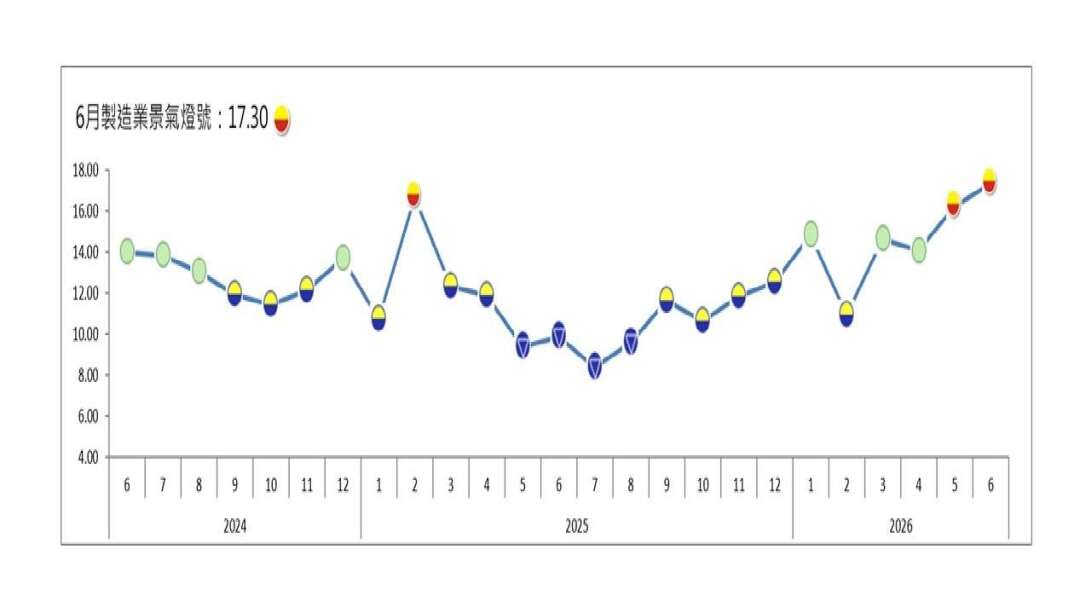
The Taiwan Institute of Economic Research announced today (31st) that the June manufacturing industry business climate index reached 17.30, an increase of 1.08 points from the previous month, maintaining the second consecutive amber-red light. The combined proportion of industries under amber-red and red lights reached over 60%.
Examining the major components of the June business climate signal, three indicators increased while two decreased. Demand, raw material input, and pricing aspects rose by 0.69, 0.61, and 0.11 points respectively, while operating environment and cost aspects declined by 0.29 and 0.05 points respectively.
In terms of changes in industry-specific signal lights, the proportion under blue light dropped from 0.89% to 0%, yellow-blue light decreased from 16.85% to 6.03%, and green light declined from 35.46% to 25.73%. Meanwhile, amber-red light increased from 19.94% to 35.56%, and red light rose from 26.86% to 32.68%.
The Institute noted that with the U.S. and Iran signing a memorandum of understanding, global energy supply risks have eased. In June, the manufacturing PMIs for the Eurozone, Japan, and China not only remained in expansion territory but also improved month-on-month. Although the U.S. manufacturing PMI slightly declined, it remained in expansion territory, indicating continued resilience in the global manufacturing sector.
Domestically, strong demand for AI, high-performance computing, and cloud services, combined with rising export product prices, led to expanding year-on-year growth in export orders and production indices, boosting indicators in demand, raw material input, and pricing.
However, the Institute also mentioned that some traditional industries remain affected by weak end-user demand and competitive pressures, leading to more conservative outlooks for the current month's business climate, negatively impacting the operating environment indicator.
FACT BOX
- Source: PR Times
- Category: Survey