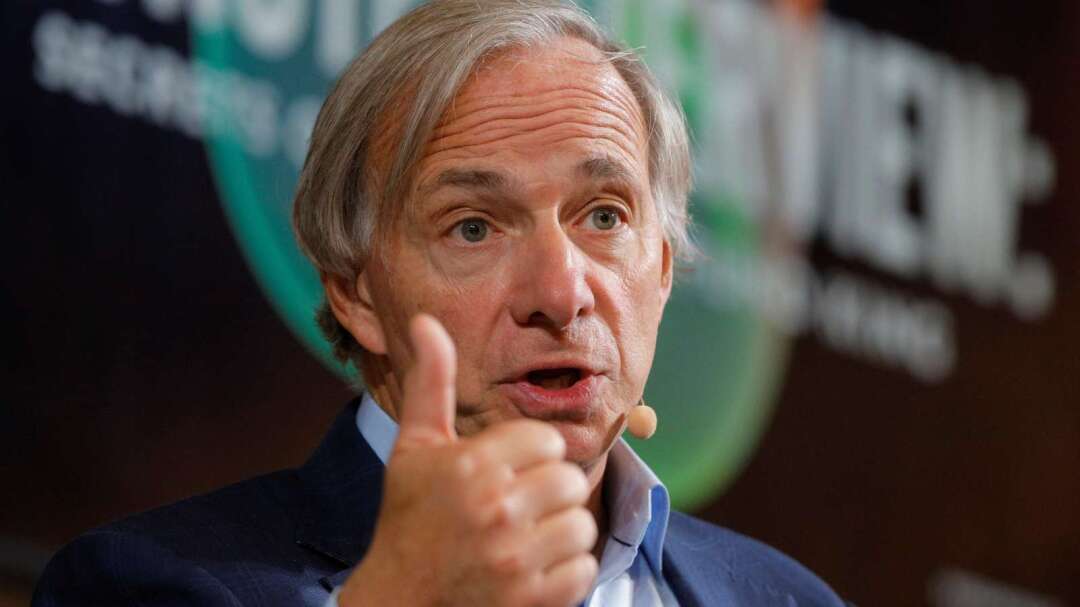
Ray Dalio, founder of Bridgewater Associates, recently delivered a stark warning on the 'The Diary of a CEO' podcast, stating that the US intervention in the Iran conflict was a strategic misstep. He argued that rather than reinforcing America's global standing, the move exposed deep vulnerabilities of the superpower. Dalio further warned that if China were to act against Taiwan, it could trigger a global stock market collapse.
According to a report by Benzinga, Dalio compared the current situation to the 1956 Suez Crisis. Back then, Britain attempted to maintain control of the canal by force, but the effort only accelerated the decline of the British Empire.
In his view, the US now faces a similar predicament. The 'show of strength' that once deterred adversaries now appears increasingly ineffective.
Dalio referenced his long-studied '80-year cycle' theory, noting that multiple major powers, including the US, are now in the latter stages of this cycle. When asked whether the US has entered a 'collapse phase,' he assessed that it is currently in a state of 'decline.'
Dalio analyzed that American public sensitivity to rising oil prices and troop casualties makes it difficult for the US to sustain prolonged military operations. He questioned whether the US could truly control the strategic Strait of Hormuz without long-term military presence and indefinite resource commitment—political will for which currently does not exist.
As such, he described control over the Strait of Hormuz as a 'litmus test' of American power.
Financial markets appear to validate Dalio's observations. On the prediction platform Polymarket, the contract on 'Will the US invade Iran before 2027?' has attracted over $50 million in trading volume, with the market assigning roughly a 25% probability.
Meanwhile, traders generally do not expect shipping through the Strait of Hormuz to normalize by the end of August. Oil prices and US gasoline retail prices remain elevated, reflecting persistent market concerns over supply disruptions.
Dalio warned that Asian nations have drawn an unsettling conclusion from the Iran incident: when regional crises erupt, it is uncertain whether the US will actually intervene.
He specifically highlighted Taiwan, arguing that if China chooses to impose a blockade, the US government's response would be the ultimate test of America's global commitments.
More notably, Dalio pointed out that China has already built significant geopolitical leverage through trade relationships—even without using military force. For most countries today, China has replaced the US as the largest trading partner.
On the economic front, Dalio emphasized the critical role of Taiwan's semiconductor industry in the global supply chain.
He believes that if a Chinese blockade halts Taiwan's semiconductor exports—even for just five days—it could trigger severe volatility in global financial markets. Even a brief supply disruption could delay the expansion of AI data centers and disrupt production schedules in the electronics and automotive industries.
Dalio noted that a blockade or military conflict disrupting Taiwan's exports could prevent global customers from accessing advanced chips produced by TSMC (2330-TW), which are heavily used by NVIDIA (NVDA-US) and the broader technology sector.
In the closing moments of the interview, Dalio questioned the current international order. The idea of a 'rules-based international order' sounds ideal, he said, but in practice, it ultimately relies on power. When rules clash with power, it is often power—not rules—that prevails.
FACT BOX
- Source: PR Times
- Category: News
- Organizations: Bridgewater Associates / TSMC / NVIDIA