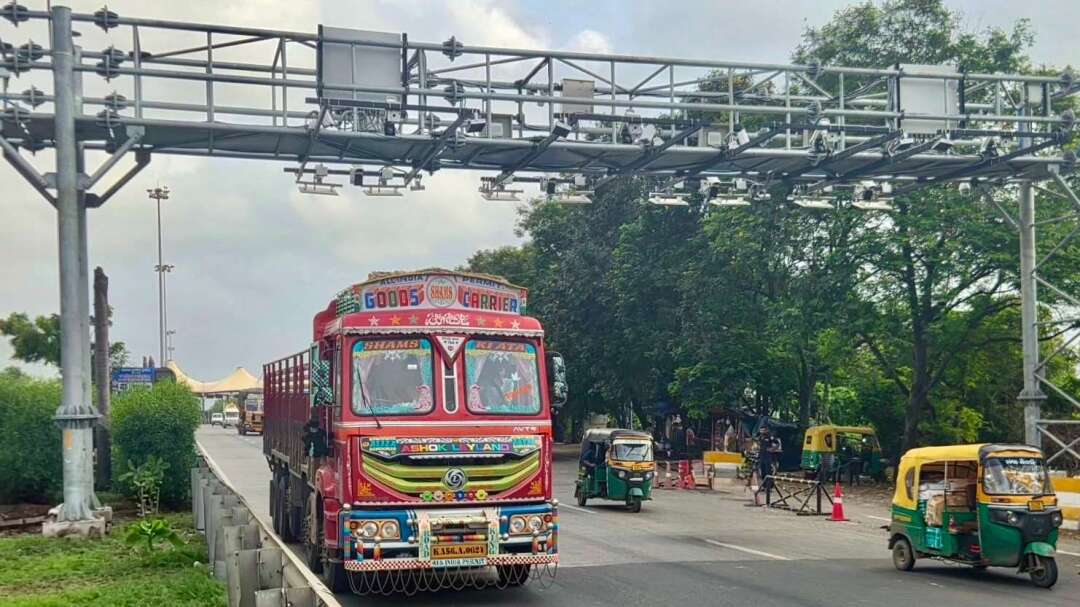
The ETC Taiwan Team has achieved another breakthrough in its New Southbound expansion. Far Eastern International Toll Collection, a subsidiary of telecom operator Far EasTone (4904-TW), announced that India's first 'Multi-Lane Free-Flow' (MLFF) electronic toll collection system—co-developed by a cross-border 'ETC Taiwan Team'—has officially commenced operations.
Far Eastern stated that the first landmark gantry is located in Surat, Gujarat—the hometown of Indian Prime Minister Modi—with nearby gantries also successfully opening in June 2026. This marks another successful overseas deployment of Taiwan's ETC technology, following Thailand, and represents a significant milestone in the New Southbound Policy.
Wu Chung-chieh, Deputy General Manager of Far Eastern, said this breakthrough not only demonstrates Taiwan's strength in intelligent transportation systems but also benefited from strong support from Taiwan's Public Construction Commission and Highway Bureau in policy guidance and international promotion. This successful public-private partnership export model will continue to be leveraged as the team participates in India's plan to convert 10% (approximately 140 sites) of its 1,400 traditional toll stations nationwide into MLFF ETC systems within one year, promoting Taiwan's successful highway digital transformation experience globally.
Wu emphasized that India's national highway network exceeds 45,000 kilometers, ranking second globally and approximately 48 times the size of Taiwan's. The Indian government plans to deploy over 1,000 electronic toll zones nationwide and accelerate digital transformation starting in 2026.
India's first MLFF electronic toll gantry and system were jointly developed by Far Eastern, FarSight Intelligence, the Institute for Information Industry (III), 404 Technology, Advantech (6579-TW), VIVOTEK (3454-TW), Mairui Ling Technology, Eagle Force Technology, and Fuxiang Trading. From design and planning to system construction and full operation, the project showcases Taiwan's integrated strength in ICT and intelligent transportation, carrying high symbolic significance.
Wu pointed out that India began adopting the same RFID-based FASTag tolling technology as Taiwan about 10 years ago. However, before the full transition to free-flow tolling, vehicles still had to enter traditional toll plazas and relied on barriers, often causing congestion due to payment failures or human factors. Taiwan has fully implemented barrier-free MLFF electronic tolling since 2013, allowing vehicles to pass without deceleration. Leveraging Taiwan's proven success, FarSight Intelligence passed a Proof of Concept (POC) test in Garhwaunda, India, in 2020 and officially secured the construction project in 2025.
According to Indian government statistics, on the first day of operation in May, the Surat toll gantry guided over 41,500 vehicle trips through at high speed with 'seamless' passage, significantly alleviating previous bottlenecks. The second gantry in Garhwaunda officially opened in June, further realizing a no-deceleration highway travel experience. Santosh Kumar Yadav, Chairman of India's National Highways Authority, publicly stated that the introduction of the MLFF system is a crucial milestone in India's highway modernization, helping build a more efficient, transparent, and user-friendly electronic tolling ecosystem and promoting the widespread adoption of smart transportation in India.
Wu noted that India's traffic environment differs greatly from Taiwan's, and the deployment process had to overcome two major challenges: vehicle complexity and extreme climate. Unlike Taiwan's relatively uniform highway traffic, Indian roads include everything from four-wheel passenger cars to 20+ wheel heavy-duty trucks, with some vehicles like two-wheel auto-rickshaws exempt from tolls. Therefore, the gantry system must integrate high-speed license plate recognition, AI-powered axle and vehicle type classification, and LiDAR sensors to instantly identify various vehicle types and filter out toll-exempt vehicles in high-speed traffic.
Additionally, India's summer heat poses a severe challenge to the stability of outdoor precision equipment. FarSight Intelligence specifically engineered the gantry equipment with high-temperature resistance, heat dissipation, and weatherproofing designs to ensure stable system operation under extreme conditions—demonstrating Taiwan's intelligent transportation systems' high adaptability in complex overseas environments.
FACT BOX
- Source: PR Times
- Category: Partnership