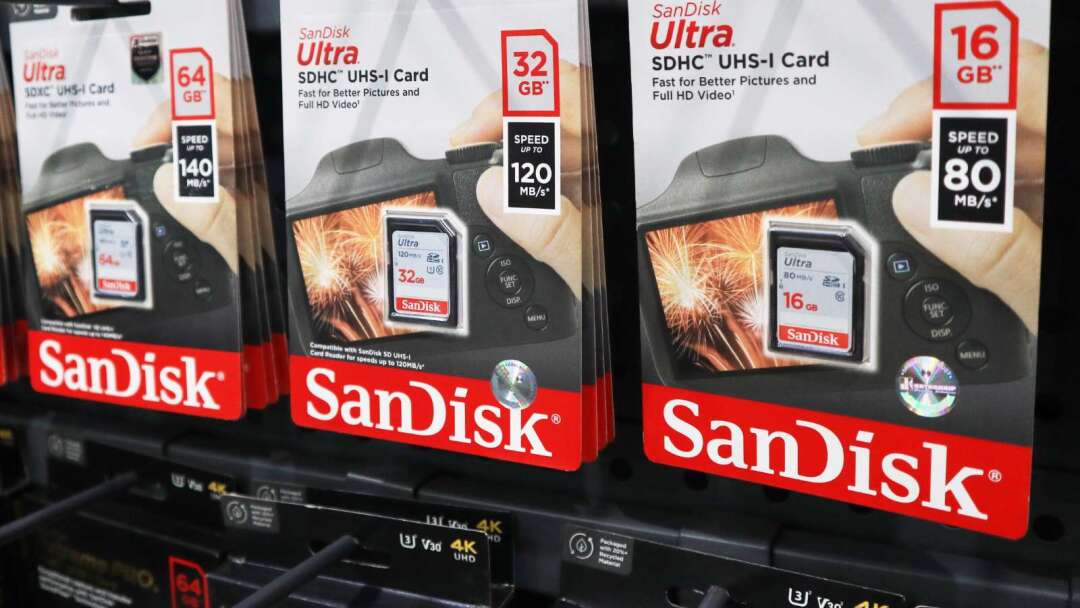
Memory stocks, which have been on a tear for the past year, took a beating in July. Market observers believe this rapid correction has brought overheated valuations back to more reasonable levels, which may not be a bad thing for investors looking to enter the market.
According to Barron's, among U.S. memory giants, SanDisk (SNDKV-US) saw its stock price plummet 47% in July, marking its worst monthly performance since its spin-off from Western Digital (WDC-US) in February 2025. Micron Technology (MU-US) also fell 29% during the same period, marking its worst month since 2015.
Korean rivals were not spared either. SK Hynix (KR000660) and Samsung Electronics (KR005930) fell 35% and 21% respectively in July.
The Roundhill DRAM ETF (DRAM-US), which tracks the dynamic random access memory (DRAM) industry, fell 32% in the month, reaching a new low since mid-May.
Analysts point out that behind this correction, there are elements of speculative trading gone wrong. However, because of this, analysts believe that the valuation of memory stocks has been reshuffled, and the attractiveness for new capital has actually increased.
Looking back over the past year, driven by both supply tightness and the explosive demand for artificial intelligence (AI), memory stock prices once soared by triple digits, repeatedly hitting new highs. Taking Micron as an example, its June financial report showed that its quarterly profit doubled from the previous quarter, with an operating profit margin of 81%.
However, because of this, in South Korea, where memory stocks support half of the market, many retail investors borrowed heavily to invest in AI themes, fueling the dramatic volatility of stock prices.
The report points out that while the U.S. market does not have the same level of concentrated risk, this speculative frenzy could still spread across the ocean. In particular, SK Hynix (SKHY-US) listed on Nasdaq on July 10, further exacerbating this speculative behavior.
Marta Norton, Chief Investment Strategist at Empower Investments, said that the recent atmosphere of memory stocks is 'a bit like cryptocurrency,' implying that regardless of how the outside world evaluates virtual currency, its high volatility always attracts speculators looking for quick profits.
Interestingly, just a few minutes after Norton made the above remarks, the Wall Street Journal immediately reported that the hedge fund Situational Awareness, after suffering significant losses, had sold most of its positions to the hedge fund Citadel, and SanDisk was Situational Awareness's largest holding.
Barron's warns that investing in memory stocks may still require preparing for significant volatility. Over the past three months, the beta coefficient of the Roundhill DRAM ETF (a commonly used indicator to measure the volatility of stock prices relative to the market) has reached 5.2, representing a volatility range approximately five times that of the market.
However, the report also points out that if you can tolerate high volatility, August may be a relatively cost-effective time to enter the market. Currently, the stock price of the DRAM ETF is only 4.8 times the estimated profit for the next 12 months, far below the high point of over 10 times at the end of June.
Multiple signs indicate that this memory industry cycle, driven by AI demand, is still on an upward trajectory. SK Hynix's second-quarter financial report, released earlier this week, although not as expected by analysts, still saw operating profit increase by 257% year-over-year.
Although the market expects that as new production capacity is gradually put into operation, increased supply will eventually compress profit margins, for now, memory suppliers still hold pricing power and are signing long-term supply agreements with customers.
Norton pointed out that there are currently no signs that AI-related demand will 'disappear overnight.'
The market will next focus on August 5, when SanDisk will release its fourth-quarter financial report, which will be the next important indicator to test the overall industry's demand strength. Wall Street estimates that the company's revenue and average selling price will grow more than four times year-over-year.
FACT BOX
- Source: PR Times
- Category: Survey
- Organizations: SanDisk / Roundhill DRAM ETF / Empower Investments
- Products / services: DRAM