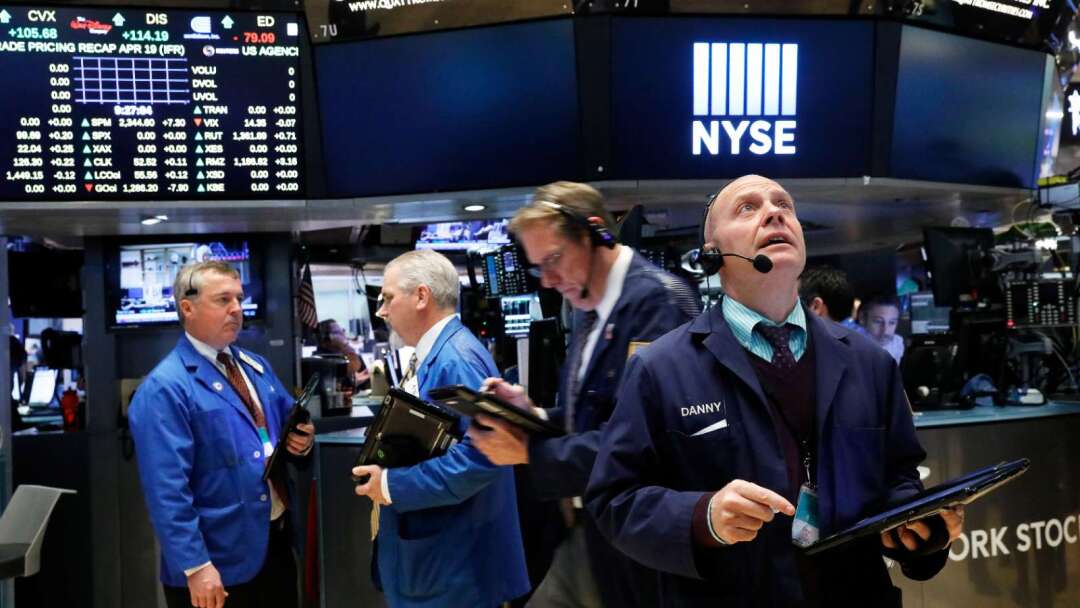
Major U.S. stock indices opened higher on Monday (3rd), as U.S. President Trump canceled planned military attacks on Iran, raising hopes of de-escalation in the Middle East. This triggered a sharp drop in international oil prices, with West Texas Intermediate crude falling below $80 per barrel, easing market concerns about energy-driven inflation.
Risk appetite improved, supported by solid corporate earnings, sending the Dow Jones Industrial Average up more than 600 points in early trading. U.S. Treasury bonds also rose as yields declined. Investors are also bracing for a wave of corporate earnings and key economic data this week.
At press time, the Dow Jones Industrial Average was up nearly 600 points, or 1.1%; the Nasdaq Composite rose nearly 220 points, or nearly 0.9%; the S&P 500 gained 0.7%; while the Philadelphia Semiconductor Index dropped 2.9%. TSMC ADR fell nearly 0.8%.
Signs of easing U.S.-Iran tensions caused international oil prices to plunge over 7% on Monday, alleviating concerns that rising energy costs could fuel inflation and keep interest rates elevated. This boosted U.S. stock index futures and Treasury bonds.
S&P 500 futures rose 0.5%, raising hopes for a positive start to the week. After President Trump canceled the planned military strike on Iran, Brent crude futures dropped 7.3% to $81.55 per barrel.
U.S. Treasury yields declined across the board. The benchmark 10-year yield fell 6 basis points to 4.68%, retreating from its highest level since January. The Bloomberg Dollar Index dropped 0.1%.
Alexandre Baradez, Chief Market Analyst at IG in Paris, said geopolitical developments have driven down oil prices and eased upward pressure on bond yields. However, he cautioned that uncertainties around U.S. yields, financial leverage, and Federal Reserve (Fed) policy remain, meaning markets cannot yet claim to be fully out of risk.
Progress Reported in Hormuz Strait Talks – Markets Await Peace Deal
Iran announced on Monday that negotiations to restore vessel passage through the Strait of Hormuz are making progress. President Trump had previously stated that the U.S. and Iran would resume talks after he canceled the military strike.
Supply disruptions caused by the U.S.-Iran conflict had driven up fuel costs, intensifying market fears of a new inflation wave. Nick Twidale, Chief Market Analyst at AT Global Markets, said that if the U.S. and Iran reach a concrete peace agreement—or more importantly, if the Strait of Hormuz reopens—global markets could see a strong relief rally.
However, Bloomberg strategists warned that oil markets cannot yet dismiss the U.S.-Iran conflict, as price risks remain skewed to the upside. Options markets still show greater concern about rising oil prices than falling ones, indicating traders believe supply shocks are more likely to push Brent crude higher than sustained price declines.
Aside from Middle East tensions, AI stock valuations and inflation risks continue to dominate market sentiment. Investors will closely watch Friday’s release of the U.S. July employment report to gauge the Fed’s next move. SpaceX will release its first post-listing earnings report on Tuesday, while European firms HSBC and Novo Nordisk will also report earnings.
On individual stocks, Bristol-Myers Squibb surged over 8% in pre-market trading after reports that UK pharmaceutical giant AstraZeneca had considered acquiring the company; AstraZeneca shares plunged over 7% in London. Marriott International dropped 3.7% due to weak profit outlook.
The European Stoxx 600 rose 0.4%, led by consumer goods and auto stocks. Asian markets were mostly lower, with South Korean chip stocks tumbling, indicating that AI-related stocks remain highly volatile.
Yen Volatility – U.S. and Japan May Intervene Again
The yen initially fell then sharply rose on Monday morning, gaining 1.4% against the dollar before giving back most gains, trading around 156.90 in London. Markets speculate that after last week’s coordinated intervention, authorities may step in again to buy yen, though some volatility may stem from nervous traders or algorithmic trading.
Japan’s Ministry of Finance confirmed that the U.S. and Japan conducted coordinated yen-buying operations on July 31 (U.S. time), and will not hesitate to intervene again if necessary. U.S. Treasury Secretary Bessent said the intervention aimed to curb “disorderly” yen movements and that the U.S. stands ready to assist Japan again, noting Japan can access a Fed liquidity mechanism.
Julia Wang, Head of North Asia Investments at Nomura International, expects the yen to remain volatile in the coming week with temporary strength, but intervention hasn’t changed the fundamental direction of USD/JPY. Once official operations end, the pair may resume its upward trend.
As of around 9 p.m. Taipei time on Monday (3rd):
Dow Jones Industrial Average: +659.95 points or 1.26%, at 53,144.98
Nasdaq Composite: +95.23 points or 0.38%, at 25,469.09
S&P 500: +41.14 points or 0.55%, at 7,530.86
Philadelphia Semiconductor Index: -375.12 points or 3.32%, at 10,935.95
TSMC ADR: -1.29% to $399.08 per share
10-year U.S. Treasury yield: down to 4.68%
NYMEX crude: -6.37% to $79.28 per barrel
Brent crude: -4.94% to $83.59 per barrel
Gold: -0.45% to $4,088.60 per ounce
DXY: down to 99.79
Key Stocks:
AstraZeneca (AZN-US): -7.62% to $156.72
The Financial Times reported AstraZeneca and Bristol-Myers Squibb (BMY-US) are in merger talks, causing divergent stock reactions. AstraZeneca fell over 4% pre-market, while BMS surged over 5%.
Alibaba (BABA-US): +4.60% to $127.87
Alibaba (09988-HK) unveiled its new AI model Qwen3.8-Max on Monday, one of the company’s most powerful models to date, set for official launch next week. The news boosted Alibaba’s U.S.-listed shares by 4% pre-market.
Micron (MU-US): -3.79% to $791.82
Memory stocks broadly declined Monday pre-market after last week’s volatility. SanDisk (SNDK-US) and Micron both fell over 3%, while Seagate (STX-US) dropped 2.5%.
Key Economic Data Today:
U.S. July ISM Manufacturing Index: expected 54.0, prior 53.3
U.S. July Manufacturing PMI Final: expected 53.8, prior 53.8
Wall Street Analysis:
Morgan Stanley upgraded South Korea’s market rating from “Neutral” to “Overweight,” arguing that recent deleveraging has created a better entry point for investors to reposition into AI and industrial supercycle themes. The firm noted the Korea Composite Stock Price Index (KOSPI) still has about 36% upside to its 9,000 target, with the recent decline driven largely by technical factors. Deleveraging among leveraged ETFs, hedge funds, and retail margin positions is already over halfway complete. KOSPI has fallen over 30% from its June peak.
As a key barometer of Asian AI demand, South Korean stocks have seen intensified declines due to rapid capital outflows, the prevalence of leveraged ETFs, and excessive index concentration. Morgan Stanley forecasts KOSPI could trade between 5,500 and 10,500 in the short term, with Samsung Electronics and SK Hynix providing valuation support. Industrial, defense, and financial sectors may also benefit from fundamental tailwinds.
FACT BOX
- Source: PR Times
- Category: News
- Organizations: SpaceX / HSBC